
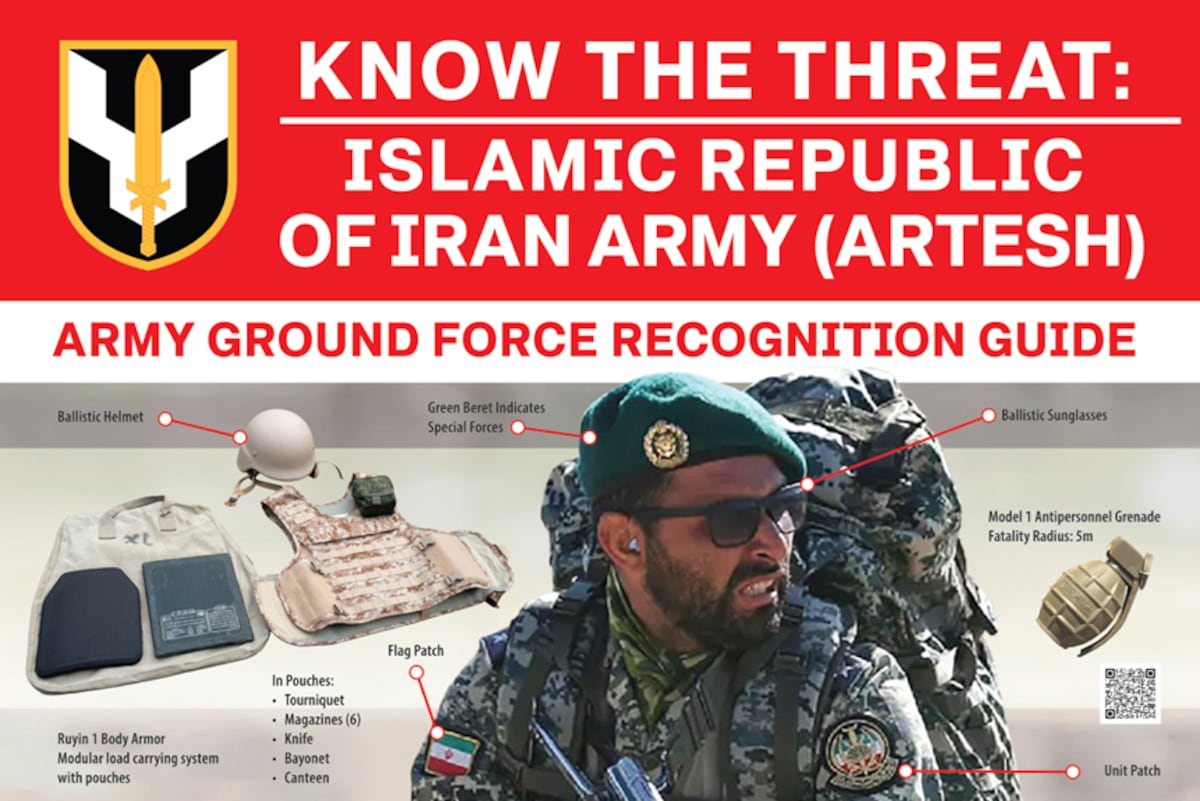
If America engages in a ground war with Iran, the U.S. Army wants to ensure that its soldiers can recognize the enemy.
A new U.S. Army poster depicts a soldier of the Iranian army. The graphics show a bearded soldier wearing sunglasses and a beret, with captions describing the various weapons he might carry and the uniforms he might wear.
That the U.S. Army has a quick-recognition guide for Iranian soldiers doesn’t mean America will invade Iran. The Army’s Training and Transformation Command has a library of graphical recognition posters for the armies of various nations, including China’s People’s Liberation Army.
The U.S.’s ongoing conflict with Iran has lasted nearly eight months. For now, both sides have waged war with aircraft, missiles and drones. But the possibility of American boots on the ground has always been present, such as seizing vital Iranian oil facilities on Kharg Island.
The new guide, published Sept. 24, isn’t focused on the Islamic Revolutionary Guard Corps, the praetorian guard of the Iranian regime that grabs most of the headlines. The IRGC controls many of the weapons that have been fired at American forces and Iran’s neighbors, including ballistic missiles, drones and fast-attack boats.
Instead, the U.S. Army guide displays a soldier of the Islamic Republic of Iran Army, also known as Artesh. It is a mainly conscript force of 350,000 personnel that is essentially the regular armed forces of the nation of Iran, including armored, infantry, special forces, air defense, aircraft and naval units, according to the research organization the Institute for the Study of War.
In contrast, the IRGC protects an Iranian regime that doesn’t fully trust the regular armed forces, which date back to the days of the Shah. As in many authoritarian nations, such as Saddam Hussein’s Iraq, there is a deliberate rivalry between the regular and politicized armed forces, with the regime’s pet army getting the best equipment.
There have been numerous reports of low morale and harsh conditions for Artesh soldiers, including lack of food and medical care. One draftee said in a 2022 essay for the Atlantic Council, a Washington, D.C.-based think tank, that most soldiers do menial work, rather than combat training.
The Artesh soldier in the U.S. Army poster — wearing the green beret of the Iranian special forces — doesn’t appear much different than the infantry in many other armies, with a mix of Soviet, Western and Iranian gear. He is shown carrying an AKM, Masaf-2 or Heckler & Koch G3A6 rifle. He can also be armed with an MG3 machine gun or an RPG-7, plus grenades, body armor, rucksack, canteen and gas mask, among other gear.
The image shows five different camouflage uniforms, including khaki and woodland, as well as three camouflage patterns for the special forces. Also shown are the insignia of officer and enlisted ranks.
About Michael Peck
Michael Peck is a correspondent for Defense News and a columnist for the Center for European Policy Analysis. He holds an M.A. in political science from Rutgers University. Find him at theuncommondefense.com. His email is mikedefense1@gmail.com.