
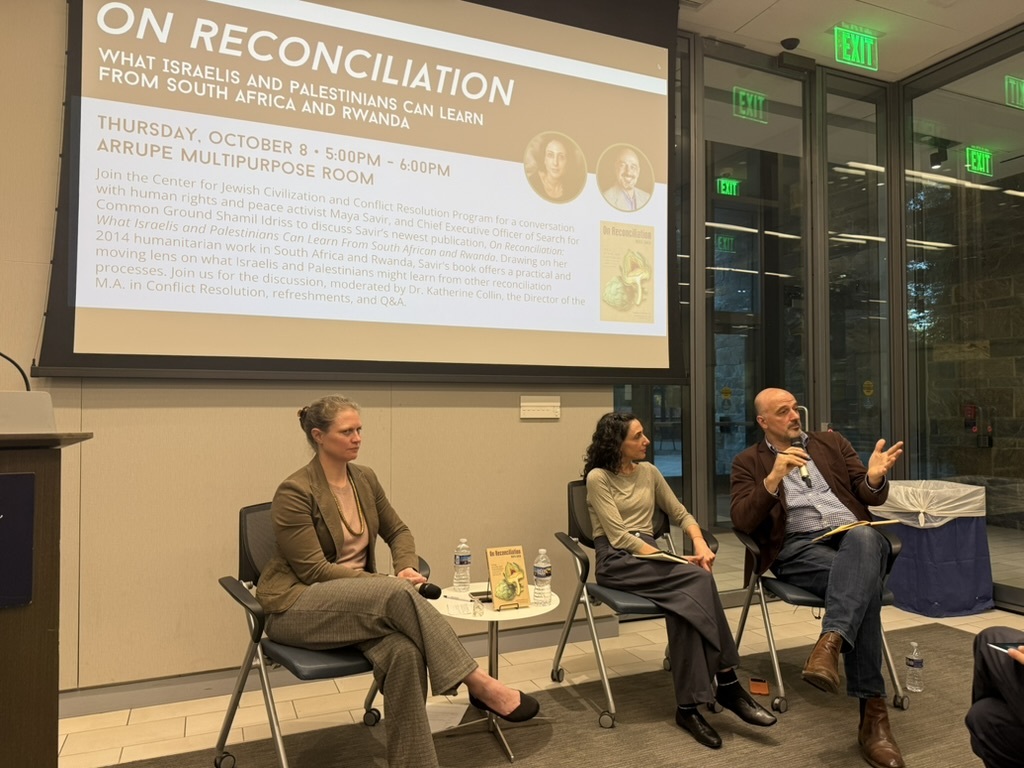
A panel of peace activists argued reconciliation between Israel and Palestine may be possible, but requires active reflection inspired by South Africa and Rwanda at a Georgetown University event Oct. 8.
Maya Savir, a human rights and peace activist, and Shamil Idriss — CEO of Search for Common Ground, the world’s largest international peacekeeping organization dedicated to mediation programs — positioned post-apartheid South Africa and post-genocide Rwanda as useful case studies for a possible peace between Israel and Palestine. Savir and Idriss based their argument on Savir’s recent book, which argues reconciliation requires more than pure political or economic change.
Savir said South Africa and Rwanda’s reconciliation efforts can help model potential peace plans in Israel and Palestine, three years after Hamas’ Oct. 7, 2023, attack on Israel ignited the latest phase of the ongoing war.
“In a conflict, there is a division between us and them, and it’s a very sharp division,” Savir said at the event. “In every conflict, there is something that us and them want, and this something can be land, in our case. It can be power. It can be narrative. But if there’s something that goes to covet, they must have it.”
After the South African apartheid ended in 1994, South Africa, under Nelson Mandela’s leadership, established the Truth and Reconciliation Commission (TRC) — a court-like restorative justice organization dedicated to restoration between the apartheid state and resistance movements through public hearings, amnesty to individuals who came forward with information and policy recommendations. The TRC successfully transitioned South Africa from an apartheid state to a constitutional democracy, although economic disparities between white and Black South Africans remain.
After the Rwandan Genocide — during which militias killed between 500,000 and 700,000 members of the Tutsi ethnic group in just 100 days in 1994 — the reformed Rwandan government took a similar approach that achieved some economic recovery and coexistence.
Savir said her book’s main focus was analyzing the moral requirements for Israeli-Palestinian reconciliation.
“Both sides of the conflict need to acknowledge that neither is going anywhere,” Savir said. “Both sides will forever share the space together. That the rights of both sides to this coveted thing are equal, and therefore the future of this coveted thing needs to be agreed upon together.”
Since October 2023, Israel’s counteroffensive has led to the deaths of 75,000 Palestinians and displaced at least 80% of the population in the Gaza Strip. The conflict has also led to the deaths of over 1,400 Israelis. Though Hamas and Israel have agreed to a tentative ceasefire, strikes continue from both sides.
Savir said reconciliation efforts must confront individuals’ unwillingness to confront opposing perspectives.
“Those who say that the conflict is intractable are not those who are invested in solving it,” Savir said. “So when we don’t want to solve something, we persuade ourselves and we persuade others that it’s too difficult.”
Idriss said actively facilitating such conversations, however, is crucial.
“If people feel genuinely heard and respected, even when disagreed with, it’s incredibly transformational for them,” Idriss said at the event. “We’ve seen this again and again. Being agreed with is actually less important than having the genuine experience of being heard and respected by someone who really disagrees with you.”
Idriss said reconciliation must recognize genuine human suffering.
“It’s kind of the only path through which reconciliation actually does happen — people have to be made to feel safe, to be personal and vulnerable,” Idriss said. “You cannot expect people to go down this journey until they’ve had the genuine experience of being heard and respected.”
Savir added that survivors’ trauma can hinder reconciliation.
“People who are traumatized have difficulty with reflection of themselves, of others, and I know that there is no comparison,” Savir said. “Reflection and introspection are part of the reconciliation process, and we’re not there yet.”
Talya Dalloul (MSB ’30), a student of Palestinian descent who attended the event, said she felt like she was so moved that she almost cried throughout the panel.
“They did such a beautiful job speaking about it and making sure that both sides are heard,” Dalloul told The Hoya. “This really opened my eyes to the idea that peace is really the only way. The only question is maybe: Is it easier to ask for peace when you’re on the winning side?”
Savir said reconciliation must start with each individual.
“Think about what you’re sharing, what conversations you’re having, what you’re amplifying, who you’re expressing sympathy for,” Savir said. “You can do that even in your own lives, and it can make a difference. But over time, it will make a very important difference.”