
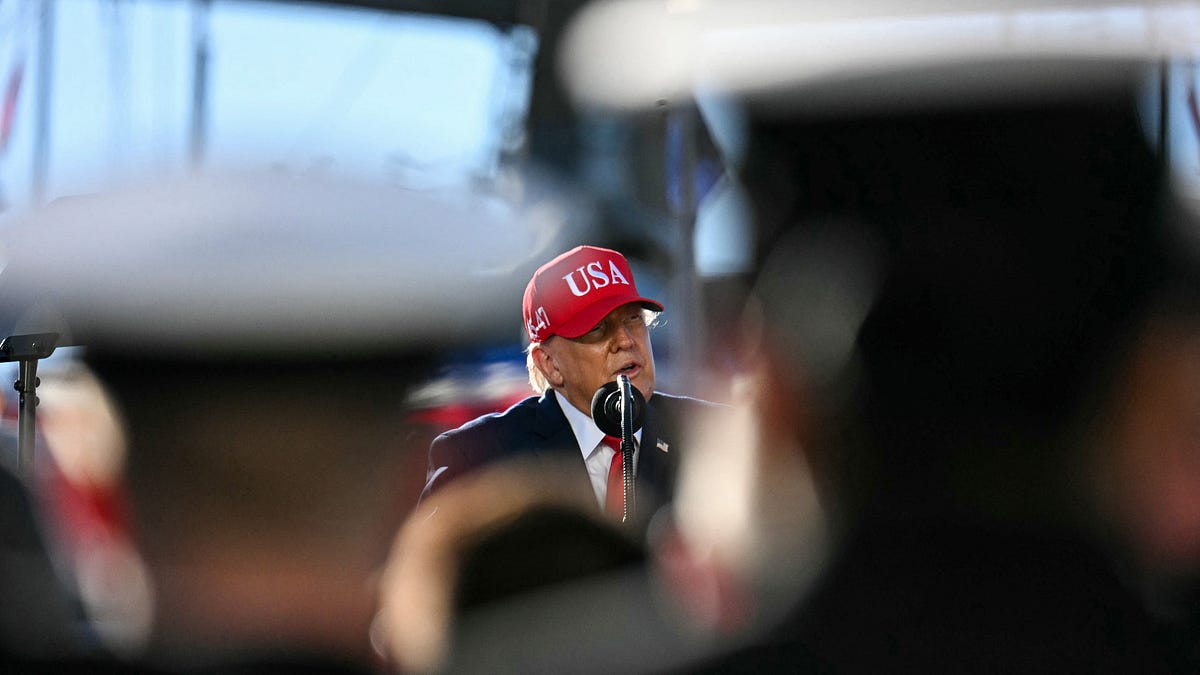
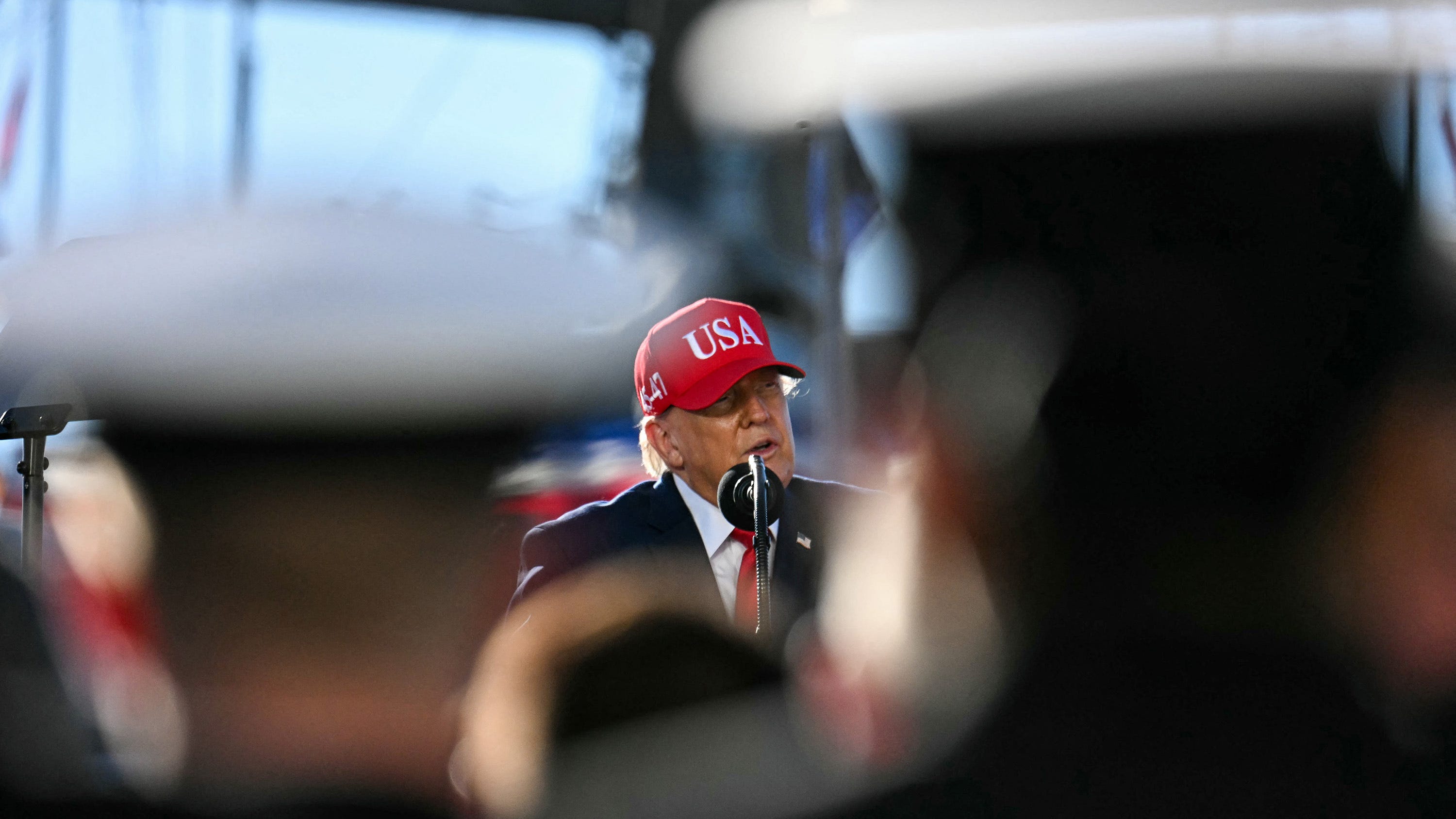
 Members of the U.S. Navy listen as President Donald Trump speaks at Anduril Industries in Sparrows Point, Maryland, on October 6, 2026. (Photo by Jim Watson / AFP via Getty Images)
PRESIDENT TRUMP DECLARED YET AGAIN this week that the war with Iran is almost over. “We have to finish up,” he said. “And it’s only a question of which way: Do we want to do it the nice way or the not-so-nice way?”
The unequivocalness of the president’s prediction—made months into a war he repeatedly said would last only days—set off alarm bells in my head. My experience in combat and in planning for operations and global contingencies taught me always to question when I or anyone else expressed certainty about the future—especially as it concerns war.
Iran has suffered enormous military and economic damage, and the United States has demonstrated overwhelming conventional military superiority. But that doesn’t mean we know how this will end. Following reporting that the White House and military were preparing a new round of attacks on Iran before the midterms, the president announced Thursday that “we will not be attacking Iran at any time prior to the Midterm Elections to be held in the United States on November 3rd.” This, too, suggests the president feels utter confidence about how events will unfold.
What if the enemy doesn’t do what we expect him to do? What if an operation takes longer than anticipated, an ally refuses to cooperate, another adversary sees an opportunity, or a seemingly unrelated crisis suddenly affects our operation? Most importantly, what if one of the assumptions on which the entire plan is based turns out to be wrong?
Military commanders and their planners are professionally paranoid because they must be. They look beyond the immediate area where forces are fighting to the larger area where events may occur that could eventually affect the mission. A commander who focuses exclusively on the enemy directly to their front is eventually going to be surprised. That’s why I would be uncomfortable today with any prediction that the Middle East war is about to end.
YEMEN IS THE FIRST PLACE I would look for reasons why the war might continue for months or years. After Houthi gains along Yemen’s Red Sea coast last month, Saudi-supported Yemeni government forces launched a counteroffensive and have retaken some territory along the Bab al-Mandab Strait. Saudi airpower, backed by American intelligence, has played a major role in that offensive. But the Houthis are hardly finished. They have responded with ballistic missiles and drones against Saudi targets, including King Khalid International Airport in Riyadh, as well as oil refineries and economic infrastructure.
Glance at any map of the region and the problem becomes obvious. The Strait of Hormuz sits on one side of the Arabian Peninsula and Bab al-Mandab sits on the other. Hormuz controls access between the Persian Gulf and the Arabian Sea, while Bab al-Mandab connects the Indian Ocean with the Red Sea, the Suez Canal, and Europe. Two of the world’s most important maritime chokepoints are in war zones at the same time.
That generates another round of what-if questions. What if the Houthis cannot defeat Saudi-backed forces on land but can still make passage through Bab al-Mandab prohibitively dangerous? What if missiles, drones, or mines convince commercial shipping companies and their insurers that the Red Sea is simply not worth the risk, and ships begin diverting around the Cape of Good Hope, increasing shipping times, fuel consumption, and costs? The military campaign might be going well in Iran, while the strategic and economic consequences of the war worsen.
ACROSS THE WATER FROM YEMEN, there are yet more what-ifs to be asked. Djibouti, Eritrea, Ethiopia, Sudan, and Egypt rarely play major roles in American foreign policy, but tensions among them are rising at the same time the war on the Arabian side of the Red Sea is expanding.
Ethiopia is again experiencing serious fighting in the northern province of Tigray, producing the worst violence in that country since the catastrophic 2020–2022 civil war in which between 100,000 and 800,000 people were killed. More ominously, the fighting is no longer merely an Ethiopian internal matter. Ethiopia and Eritrea have severed diplomatic relations, and Eritrean forces are reportedly more than 60 miles into Ethiopian territory. The Ethiopian government has accused Eritrea, Sudan, and Egypt of supporting its opponents—allegations all three governments deny. Egypt and Ethiopia have expelled diplomats, and the African Union has publicly warned Ethiopia, Eritrea, and Egypt to exercise restraint.
Ethiopia wants reliable access to the Red Sea, which it lost at the end of its sixteen-year civil war in 1991 when Eritrea became an independent state. Ethiopia, with more than 130 million people, understandably considers dependable maritime access an economic and strategic interest. Eritrea sees the issue differently, because Ethiopian access to the sea is likely to come at Eritrea’s expense.
What happens if the fighting inside Ethiopia spills across the Eritrean border? What if both sides of the Bab al-Mandab become the settings for combat at the same time, and passage through the Suez Canal is cut off? What knock-on effects will that have for America’s on-again-off-again conflict with the Houthis, for America’s security partners in Egypt and Saudi Arabia, and for the world’s patience in allowing these major waterways to be semi-strangled indefinitely?
EGYPT IS PARTICULARLY IMPORTANT in these calculations. Cairo has its own long-running dispute with Ethiopia over the Grand Ethiopian Renaissance Dam and the waters of the Nile. Egypt, Eritrea, Sudan, and Somalia have also been drawing closer in their positions on Red Sea security. None of that means Egypt—with a population of 120 million—is preparing for war with Ethiopia, but a military planner looking beyond the immediate area of operations would certainly put Egypt into an area of concern. The same is true of Sudan, where instability and war create another potential connection to an already complicated strategic picture.
Djibouti, a tiny country almost directly across Bab al-Mandab from Yemen, is one of the most strategically valuable pieces of real estate on earth. It hosts Camp Lemonnier, the United States’ only enduring military base in Africa and a critical hub for operations throughout the Horn of Africa and beyond. China also maintains a military base there—one of only three Chinese bases outside China.
Put all this together and the what-if drill becomes much more interesting. What if refugees start flowing out of Eritrea and Ethiopia into Djibouti? Or from Yemen into Saudi Arabia or Oman? What if outside powers begin supplying their preferred partners, and some combination of Egypt, Saudi Arabia, and the UAE feel compelled to protect interests on both sides of the Red Sea? And what if Iran, even in a badly weakened state, sees an opportunity to complicate American and Saudi operations by encouraging instability elsewhere?
Wars create death and destruction—but also opportunity. This is sometimes how they grow. What President Trump has seen as an American–Iranian war is becoming connected with the Yemeni civil war, the Horn of Africa, the Nile dispute, and the security of the Red Sea.
The United States could win militarily against Iran, but the strategic problem is likely to grow. In fact, one of the most dangerous moments in any military campaign comes when tactical success begins producing strategic overconfidence. Destroying an enemy’s aircraft is measurable. Ships sunk, headquarters destroyed, and commanders killed are measurable. Those things matter enormously, but they don’t tell you what happens next.
Every good military organization I ever served with had people whose job, formally or informally, was to challenge the plan. They tested assumptions, played out scenarios, and asked intelligence officers to describe what the enemy could do rather than simply what we thought they would do. Commanders asked what might happen if the operation succeeded as well as what might happen if it failed.
President Trump may be right that Iran is in terrible shape, and he may even be right that the war will soon end. I certainly hope he is. But I hope his military advisors bring him a map that extends well beyond Tehran and the Strait of Hormuz, and describe several scenarios that begin with the phrase “what if?”