
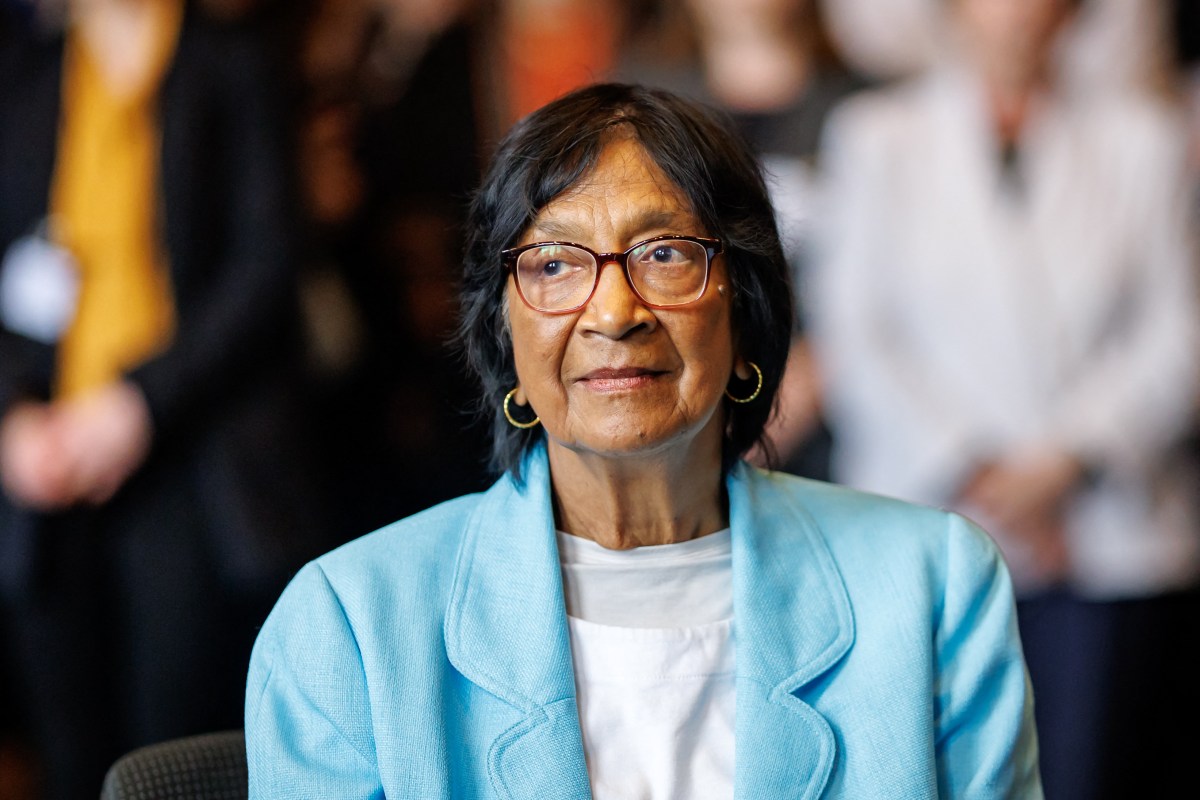
The decision to award the 2026 Nobel Peace Prize to former international judge Navi Pillay has sparked fierce criticism from Israel, pro-Israel advocacy groups and allies of President Donald Trump, turning what would normally be a celebration of international law into a flashpoint in the debate over Gaza, war crimes and allegations of genocide.
Pillay, an 85-year-old South African jurist and former U.N. human rights chief, has served as a judge on the International Criminal Court (ICC), the International Criminal Tribunal for Rwanda and the International Court of Justice.
The Norwegian Nobel Committee said it selected Pillay “for her efforts to promote peace and international law” and praised her decades-long career as a judge, prosecutor and human rights advocate. The committee cited her work on international courts and efforts to hold perpetrators of war crimes, crimes against humanity and genocide accountable, saying the award highlighted the importance of a rules-based global order at a time when the international legal system faces growing pressure.
Read More on World
U.N. Secretary-General Antonio Guterres welcomed the award, calling it “a tribute to all those working to uphold and defend international law, the rule of law and human rights, and secure peace, justice and human dignity.” U.N. Human Rights Chief Volker Türk similarly said the award was “well-deserved” and represented “a recognition, a reaffirmation that human rights, the rule of law and justice and accountability are fundamental to everything.”
But for Israel and its supporters, Pillay’s selection is significant because she chaired the United Nations commission of inquiry that concluded Israel’s actions in Gaza amounted to genocide, a finding Israel has repeatedly rejected.
Newsweek reached out to the White House, U.S. State Department, and Israeli Foreign Ministry for comment on Friday.
Israel Condemns Nobel Decision
Israeli officials reacted angrily shortly after the announcement.
Daniel Meron, Israel’s ambassador to the U.N. in Geneva, told Reuters that the Nobel committee’s decision was “disgraceful” and amounted to “an endorsement for proponents of antisemitism like Pillay herself.” He accused her of using her position at the U.N. to undermine Israel and pursue a political agenda.
The criticism was echoed by Israeli Prime Minister Benjamin Netanyahu, who wrote on X that the Nobel Committee had “lost its moral compass” and accused Pillay of building her career around “inventing and propagating blood libels against the one and only Jewish state.”
The dispute centers largely on Pillay’s role as chair of the U.N. Commission of Inquiry on the Occupied Palestinian Territory, whose findings on Gaza were sharply rejected by Israel.
Israel dismissed the report as “scandalous.”
Pillay also referenced Gaza while speaking to a crowd gathered to celebrate the award in Nuremberg, Germany.
“The last thing I did is the delivery of the report on Gaza, naming what’s happening there as genocide,” Pillay told the crowd.
Award Draws Sharp Criticism
In a statement shared with Newsweek on Friday, the Anti-Defamation League said the Nobel Committee had rewarded what it described as Pillay’s “record of legitimizing” the demonization of Jews and Israelis while “championing antizionism.”
The ADL accused Pillay of driving the “unsubstantiated ‘genocide’ charge against Israel” and argued that her work had helped elevate narratives that fueled antisemitism. The group also criticized comments and positions it said Pillay had taken regarding Israel and Jewish organizations.
“Learning of this award in Nuremberg and using the moment to double down on the genocide claim is a betrayal of ‘never again,'” the ADL statement said. “The Nobel Committee has handed its most prestigious honor to someone who has repeatedly given cover to antisemitic narratives.”
The criticism echoed a separate statement from UN Watch. The Geneva-based watchdog said it was “shocked” by the decision and argued that Pillay’s past statements about Israel should have disqualified her from receiving the prize. The organization accused her of bias and faulted her handling of the U.N. inquiry into Israel.
The Simon Wiesenthal Center also criticized the award. In a statement shared with Newsweek on Friday, Jim Berk, the organization’s CEO, said Pillay’s leadership of the U.N. commission of inquiry on Israel and Gaza had raised concerns about whether international institutions were applying standards fairly. Berk said the decision risked reinforcing concerns that international legal bodies apply different standards when Israel is involved and warned that “when that trust erodes, the institutions meant to protect the most vulnerable lose their credibility, and the pursuit of lasting peace suffers.”
For Israel and its supporters, the controversy is not simply about the Nobel Prize itself but the legitimacy the award could confer on Pillay’s findings. They argue that honoring Pillay elevates and legitimizes allegations of genocide that Israel rejects, giving greater international prominence to findings that have become a focal point of criticism of the country’s conduct in Gaza.
Trump Amplifies Criticism
Trump also weighed in on the controversy. On Friday morning, he shared on Truth Social a post from attorney David Schoen attacking Pillay and the Nobel Committee.
Schoen wrote that the committee had “shamed itself beyond repair” by honoring Pillay, whom he described as “an unabashed hater of America and Israel.” He accused her of conducting a “phony” investigation into Israel and argued that she had done “just the opposite” of fostering peace.
The post contrasted Pillay’s award with Trump’s foreign policy achievements, citing the Abraham Accords, hostage releases and efforts to end international conflicts. Trump has repeatedly argued that he deserves a Nobel Peace Prize.
The Nobel Committee did not mention Trump in its citation. However, the award comes at a time when the International Criminal Court and other international legal institutions have faced increasing pressure from the Trump administration, particularly after the court issued arrest warrants for Israeli leaders.
Explaining its decision, the Nobel Committee said, “The system of international law is under tremendous pressure, and its institutions are under attack.”
The committee viewed the prize as a defense of international law and accountability. For Israel and many of Pillay’s critics, however, the award represents something very different: international recognition for the jurist who helped lead one of the most consequential and controversial investigations ever conducted into Israel’s conduct in Gaza.
The dispute comes as the Trump administration has intensified its campaign against the ICC, which has become a focal point of international tensions over Israel and Gaza.
Rubio Sanctions ICC
On Friday, Secretary of State Marco Rubio announced sanctions against the International Criminal Court, accusing it of threatening U.S. sovereignty through investigations involving Americans.
“Either the ICC will end its threats or we will end the ICC,” Rubio said in video posted on X. “The U.S. will continue to dismantle the ICC piece by piece until Americans are threatened no longer.”
The move drew immediate praise from Netanyahu, who thanked Trump and Rubio on X for what he called a “critical decision” and described the court as a political body that threatens democratic nations and national sovereignty.
The sanctions announcement prompted criticism from several U.S. allies and from the court itself. Japan’s foreign ministry said it was “deeply concerned” by the measures and reiterated its support for international courts, including the ICC.
The ICC called the sanctions an “assault on the rule of law” and said it would continue carrying out its mandate independently. ICC President Tomoko Akane said the court “will continue to fully discharge its mandate, with independence and impartiality.”
In an email to Newsweek, international lawyer Philippe Sands described the Nobel Prize and sanctions announcement as “a day for international law and international justice.” Sands praised Pillay’s career, from her service as a judge in post-apartheid South Africa to her role in international tribunals and U.N. investigations, calling her “independent, fearless and a bearer of the torch of international law.”
Sands also drew a connection between Pillay’s Nobel award and the Trump administration’s actions against the ICC. “Then a few hours later, no coincidence perhaps, the Trump Administration announces draconian new sanctions on the ICC, to dismantle the very system of international rules the Nobel Committee and Navi Pillay stand for,” he wrote.
Separately, the foreign ministers of Canada, Denmark, France, Germany, Italy, Japan, the Netherlands and the United Kingdom issued a joint statement expressing support for the court and saying they “strongly disagree” with the U.S. sanctions.
The sanctions fight underscored the broader significance of Pillay’s Nobel Prize. Supporters saw the award as recognition of a career dedicated to international justice, while critics viewed it as an endorsement of findings they reject. The sharply divided reactions reflected the wider battle over the role of international courts and accountability mechanisms in conflicts such as Gaza.
Newsweek reporters and editors used Martyn, our AI assistant, to produce this story. Learn more about Martyn here.
Contact Newsweek editors on this story: Samantha Beech and Gray R. Thomas