
Facebook
Twitter/X
LinkedIn
Pinterest
Reddit
Email
Print
Four-minute read
On October 6, a U.S. federal judge allowed a civil torture case against Parviz Sabeti the former head of the Shah’s secret police, SAVAK’s Third Directorate (Internal Security) and one of the most powerful security officials under Iran’s last monarchy, to move forward.
Three former political prisoners allege that Sabeti directed or oversaw their detention and torture in the 1970s. Judge Gregory Presnell rejected his effort to end the case on statute-of-limitations grounds, allowing litigation over the underlying allegations to continue.
The importance of the case extends beyond what happened five decades ago. It revives a question directly relevant to Iran’s current opposition politics: how completely has the monarchist movement broken with the authoritarian system from which it derives its political identity?
SAVAK’s Record Is Not a Historical Invention
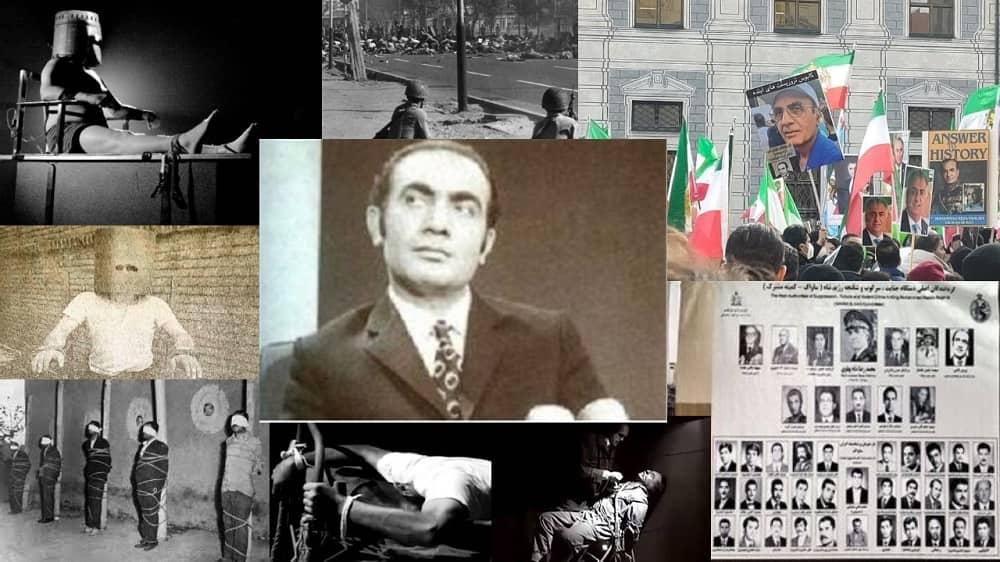
The brutality of the Shah’s secret police, SAVAK, was neither revolutionary propaganda nor a historical allegation invented after the monarchy’s collapse. It was documented while Mohammad Reza Pahlavi was still firmly in power. Throughout the 1970s, Amnesty International and other human rights observers exposed a machinery of repression in which political opponents were subjected to arbitrary arrest, prolonged detention without fair trial, systematic torture and, in some cases, extrajudicial killing. Behind the walls of Evin Prison and the notorious Joint Anti-Sabotage Committee detention centre in Tehran, prisoners endured savage beatings, electric shocks, whipping with cables, burns, and confinement in specially constructed torture devices, including the infamous heated metal cage known as the “hot box”. One particularly chilling example came in April 1975, when nine political prisoners were shot dead by security personnel. The authorities claimed they had been killed while attempting to escape, a version subsequently contradicted by testimony concerning their deliberate execution.
Ex-SAVAK Chief Parviz Sabeti Sued in U.S. for Brutal #Torture Under Shah’s Regimehttps://t.co/wLrPeVGIdd
— NCRI-FAC (@iran_policy) February 27, 2025
SAVAK’s operations extended far beyond prison walls: political organizations were dismantled, newspapers censored, intellectuals intimidated, and dissidents placed under surveillance. The Shah’s decision in 1975 to abolish the remaining legal political parties and impose the single-party Rastakhiz system further institutionalized this repression. These were not isolated excesses committed by a handful of rogue interrogators. They formed part of a state security apparatus operating under the authority of the monarchy, designed to silence political opposition and preserve the Shah’s absolute power. The historical record leaves little room for the romanticized portrayal of the Pahlavi era as an age of freedom and enlightened government.
Reza Pahlavi Proud of His Father’s Legacy
Reza Pahlavi cannot be held personally responsible for the torture chambers and political executions of his father’s dictatorship. But he can—and must—be held accountable for how he chooses to confront that legacy today. When questioned by Sweden’s SVT on April 12 about his family’s authoritarian record, he responded by expressing pride in his heritage and invoking crowds chanting the names of his father and grandfather. Yet pride in a political legacy carries an obligation to confront its darkest chapters. Where, then, is his unequivocal condemnation of SAVAK’s systematic torture, political imprisonment and extrajudicial killings? Where is his acknowledgement of the victims whose suffering made the Pahlavi monarchy synonymous with repression? The question becomes still more disturbing when monarchist demonstrators display portraits of Parviz Sabeti and celebrate him as a symbol of strength rather than demanding accountability for the abuses associated with SAVAK.
Nor is this attachment to his father’s legacy merely a matter of words. In an article published on 27 February 2007, The New Yorker reported that Pahlavi had long been surrounded by a small circle of his father’s loyalists. It identified Ahmad Oveyssi, whose brother had administered martial law under the Shah, as Pahlavi’s closest confidant, and discussed Parviz Sabeti, the former head of SAVAK’s division responsible for suppressing political opposition, describing him as one of the most despised surviving figures of the Shah’s regime. The report provides important historical context for examining the political circles surrounding Pahlavi and their connections to the former dictatorship. The question becomes still more disturbing when monarchist demonstrators display portraits of Sabeti and celebrate him as a symbol of strength rather than demanding accountability for the abuses associated with SAVAK.
Reports of intimidation, threats and attempts to silence rival opposition groups by militant monarchist supporters raise further concerns about the authoritarian political culture being revived in the name of democracy. Reza Pahlavi speaks to Western audiences about pluralism, tolerance and free elections. Yet democracy cannot be measured by promises made in comfortable television studios while Reza Pahlavi and his supporters glorify the instruments of yesterday’s dictatorship.
When SAVAK Becomes a Symbol Again
A dictatorship does not necessarily need to return to power for its political habits to make a comeback. Sometimes, all it takes is a portrait, a slogan and a group that equates political disagreement with treason. On June 3, The Guardian reported the appearance of SAVAK emblems on banners and clothing at pro-Pahlavi demonstrations, alongside concerns about threats and intimidation directed at journalists and opposition figures. The symbolism is difficult to ignore. SAVAK was not a patriotic association or a harmless relic of Iran’s past. Its rehabilitation at demonstrations ostensibly dedicated to freedom raises an obvious question: freedom for whom?
The answer becomes more troubling when one examines the language directed at those who reject the monarchy. At a demonstration in Munich on February 14, Die Zeit reported that Pahlavi supporters chanted, “Death to the three corrupt—the mullahs, the leftists and the Mujahedin.” This was not simply a denunciation of the Iranian regime. It placed two opposition currents alongside the ruling clerics as targets of a death slogan. The same gathering reportedly echoed with cries of Javid Shah—“Long live the Shah”—a slogan historically associated with the royalist mobs involved in the August 1953 coup against Prime Minister Mohammad Mossadegh. History has a peculiar sense of humour: through their embrace of the symbols and language of the former dictatorship, Reza Pahlavi and his monarchist supporters show their true colours.
Nor is this intolerance confined to the fringes of street demonstrations. According to a Reuters report dated July 28, Saeed Ghasseminejad, a prominent Pahlavi associate, declared: “You’re either with Prince Reza Pahlavi or with the Islamic Republic,” describing those who weakened Pahlavi as agents of the enemy. It is a remarkable political proposition. Under this logic, an Iranian can oppose the clerical dictatorship, risk imprisonment or execution in that struggle, and still be branded an enemy simply for refusing allegiance to the Shah’s son.
The implications extend far beyond the conduct of individual supporters. Iran’s opposition encompasses republicans, leftists, national and ethnic minorities, and organised resistance movements with profoundly different political visions. The right to disagree is not an inconvenience to be eliminated; it is the foundation of the democracy they claim to seek. When supporters of one political figure glorify a notorious security apparatus, threaten rival dissidents and equate criticism with collaboration with the regime, they reproduce precisely the authoritarian instincts that Iranians have spent generations resisting.
A Gift to the Clerical Regime
For years, reports have documented the Iranian regime’s covert efforts to amplify Reza Pahlavi and the monarchist narrative, not because it wishes to restore the Shah, but because a weak and divisive opposition serves its interests. Remarkably, this political calculation has even surfaced in the regime’s own media. On 1 February 2025, the state-controlled newspaper Vatan-e Emrooz described monarchism as a weak and rootless movement whose activities could help preserve the Islamic Republic. The logic is chillingly simple: convince Iranians that their only alternatives are the dictatorship they endure today or the dictatorship they overthrew in 1979.
Against this background, the spectacle of monarchist supporters wearing SAVAK-emblazoned T-shirts, displaying portraits of notorious secret police officials and threatening rival opposition groups becomes an extraordinary propaganda gift to Tehran. Every such display helps the regime revive memories of the Shah’s torture chambers and portray the struggle for democratic change as a campaign to restore the old monarchy. The bitter irony is that the clerical establishment need not manufacture all this material itself; some monarchist supporters are supplying it in public. Whether intentionally or otherwise, their conduct reinforces the very false choice the regime seeks to impose: the turban or the crown, as though Iran’s people must forever choose between two forms of dictatorship rather than determine their own democratic future.
#Iran News: State-Run Newspaper Says Reza Pahlavi and Monarchists Have Served Clerical Regimehttps://t.co/iey2VpMKXU
— NCRI-FAC (@iran_policy) April 8, 2025
Why it matters
This is what makes the Florida case politically relevant in 2026.
If SAVAK were regarded throughout contemporary monarchist politics as a disgraced institution belonging unequivocally to a discarded authoritarian past, Sabeti’s lawsuit would primarily concern delayed accountability for alleged crimes from the 1970s.
Instead, SAVAK symbols have reappeared. Dynastic slogans have returned. Iranian opposition groups have faced rhetoric of political elimination. And each such episode does something the clerical regime cannot accomplish by repression alone: It presents Iranians who despise the mullahs with a false choice between the current clerical dictatorship and the former monarchical dictatorship.
The crimes alleged in the Florida courtroom belong to the 1970s.
The political consequences of rehabilitating their symbols belong entirely to 2026.