
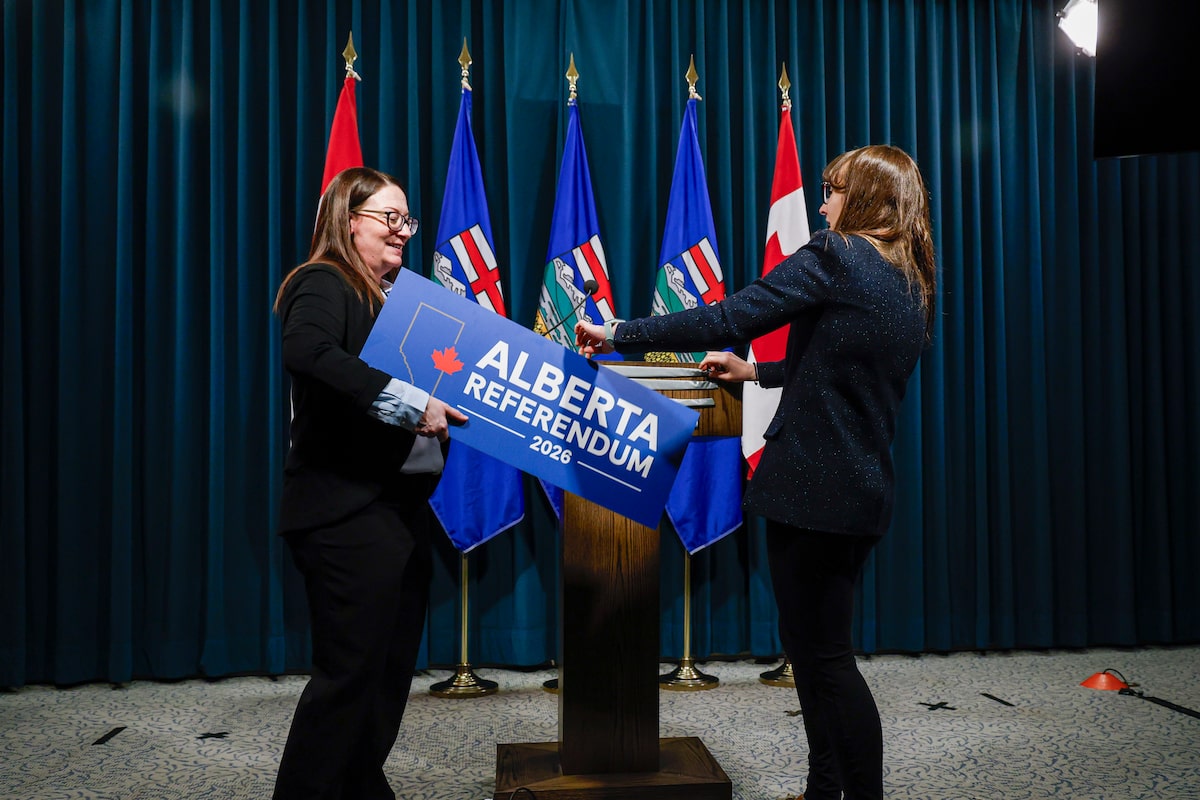
Alberta Premier Danielle Smith, shown in Edmonton on Wednesday, has characterized the nine ballot proposals as a tool for leverage over Ottawa.James Maclennan/The Canadian Press
With little more than a week until the Alberta referendum, campaigners on both sides of the separation question have turned an eye toward the nine other ballot proposals around immigration, voter ID and constitutional issues – but they are doing it for different reasons.
Some federalist leaders, claiming early victory on the question around independence, have shifted their energy to persuading Albertans to vote against the nine proposals and have pitched their campaign as a proxy war against Premier Danielle Smith. On the flipside, some separatist camps are suggesting voters boycott the nine questions, arguing their participation would be capitulating to federalism.
The nine questions propose new fees for non-permanent residents accessing health care and education, limiting non-permanent residents’ access to other social supports and working to reopen the Canadian Constitution with the aim of wresting more power from Ottawa.
“We are very likely to reject the premise that we should be a separate country, but the other nine questions remain very much in play,” said Stephen Carter, a political strategist who has organized a campaign around the slogan, “Stay in Canada, no to the nine.”
On Friday, the separatist Alberta Prosperity Project posted to social media: “IGNORE THE 9, VOTE OPTION 2,” referring to the choice on the 10th question for a binding independence referendum.
Alberta’s referendum campaign has been subsumed by the ballot question asking voters whether they wish to remain in Canada or begin working toward a second, binding secession referendum. Support for separation has held steady during the campaign, floating between 20 per cent and 25 per cent.
Alberta’s referendum is approaching. Ask us your questions
The nine other questions, meanwhile, have received less scrutiny and face greater odds of winning public support.
The provincial government has offered little detail how it would enact the proposals if approved by voters.
Ms. Smith says the nine questions will give her a mandate and is focused on successfully having them pass. The government has dedicated a $4-million advertising budget to the campaign – nearly seven times what third-party advertisers are legally allowed to receive or spend during the referendum period.
Despite bubbling interest in the nine questions, they appear likely to continue to take a back seat to the question of national unity.Jeff McIntosh/The Canadian Press
Ms. Smith has characterized the proposals as a tool for leverage over Ottawa, the same argument some separatist camps have made in their pitch for voters to endorse a binding secession referendum.
Mr. Carter, the political strategist, said he’s pivoting away from the separation question to campaign exclusively on the nine others for the final week. Unlike the separation question, there are still swaths of undecided voters on the remaining questions, he said.
His campaign is attempting to frame a rejection of the questions as a rebuke of Ms. Smith’s leadership.
“It’s up to us to make sure that people understand that they can oppose these questions and oppose Danielle Smith at the same time,” he said.
Elections Alberta notifies thousands of referendum voters about invalid mail-in ballot packs
Ms. Smith has said she will vote for Alberta to remain in Canada and her government has vigorously campaigned on the nine other questions, with brochures and advertising deployed across the province. Asked on Thursday how she and her United Conservative Party will be working to get out the federalist vote, she said: “Well, I want people to vote for our nine questions.”
“We want to seek a mandate on that, and if people want to change the relationship with Ottawa, that’s the best way to do it.”
Ms. Smith has said the proposals would help boost Alberta’s autonomy within Canada.
Mitch Sylvestre, chief executive of the Alberta Prosperity Project, said in an interview that he’s “disgusted” by the nine questions, though he may vote for the proposals he believes are “pertinent.”
“I haven’t really taken a chance to inform myself on anything but the one directly related to us,” Mr. Sylvestre said.
Not all movement leaders agree, however. Keith Wilson, a lawyer and co-founder of separatist group Let Alberta Decide, called the nine proposals a “political gimmick” but said refusing to vote for them would be foolish.
“I still think they send a message,” Mr. Wilson told The Globe.
Andrew Coyne: The Alberta referendum: a pointless, futile stunt, just like the last one
Despite bubbling interest in the nine questions, they appear likely to continue to take a back seat to the question of national unity.
Thomas Lukaszuk, leader of Forever Canadian, said he has planned rallies with “very interesting speakers” next Thursday and Friday in Calgary and Edmonton, and he’s planning a get-out-the-vote drive that will encourage his list of 1.5 million electors.
“Our campaign has always been about remaining in Canada, so that’s our primary focus,” he said.
The Alberta NDP will be hosting rallies on Tuesday and Wednesday, and it has bought advertising slots that will air during Edmonton Oilers and Calgary Flames games.
Conservative Leader Pierre Poilievre said on Friday that he’ll be campaigning in Alberta next week “to keep our country united.”
Ms. Smith’s office said she will be in southern Alberta next week, and will be urging Albertans to vote with new campaign literature.
Let Alberta Decide’s Mr. Wilson, meanwhile, is organizing a pro-independence rally next Saturday at the Alberta legislature, and Mr. Sylvestre is planning to activate the roughly 250,000 people in the Prosperity Project’s database ahead of referendum day. He said he’s unsure if he’ll attend Mr. Wilson’s rally.