

Iran has retained the ability to manufacture ballistic missiles and drones despite eight months of US and Israeli airstrikes, allowing Tehran to replenish its weapons stockpiles as US President Donald Trump debates delaying further military action until after the November midterm elections, Bloomberg reported on Friday, citing Western officials familiar with intelligence assessments.
The officials, who spoke on condition of anonymity, said Iran had preserved parts of its weapons manufacturing infrastructure despite extensive strikes targeting its military-industrial capabilities.
One Western official assessed that Tehran still possesses significant stocks of ballistic missiles and certain anti-ship weapons, with the capacity to manufacture additional munitions relatively quickly.
The official also claimed that Russia has been supplying Iran with missiles, consistent with a separate intelligence assessment from June. Russia’s Defense Ministry did not respond to Bloomberg’s request for comment.
The findings contrast with repeated assertions by Trump administration officials that the US-Israeli military campaign has effectively dismantled Iran’s ability to threaten American military installations and regional allies.
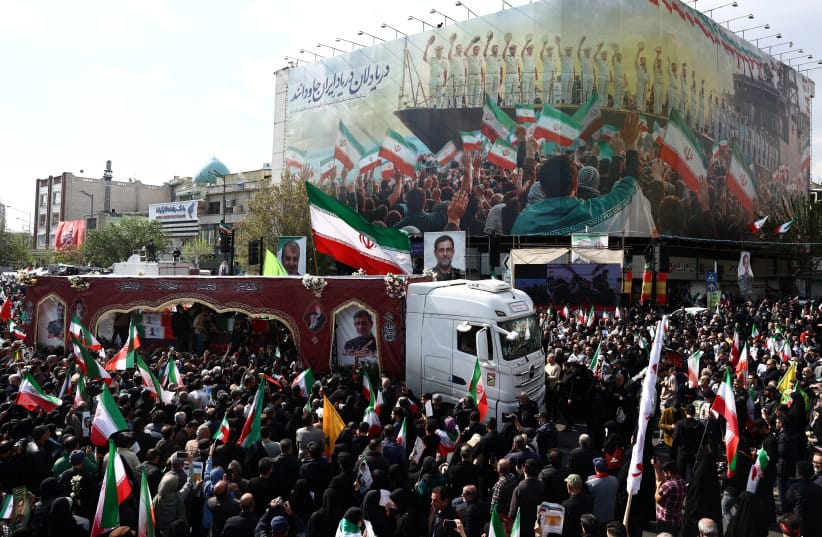 People attend a funeral ceremony for the Revolutionary Guards Navy Commander Alireza Tangsiri, who was killed in strikes, amid the U.S.-Israeli conflict with Iran, in Tehran, Iran, April 1, 2026. (credit: MAJID ASGARIPOUR/WANA (WEST ASIA NEWS AGENCY) VIA REUTERS)
Trump previously described Iran’s military as “totally destroyed,” while Defense Secretary Pete Hegseth said on September 30 that US operations had destroyed Iran’s “military industrial capacity” and “their entire defense base.”
White House disputes assessment of Iran’s military capabilities
White House spokesperson Anna Kelly rejected the Western officials’ assessment, defending the effectiveness of American operations against Iran’s nuclear and conventional military infrastructure.
“First, President Trump obliterated Iran’s nuclear facilities during Operation Midnight Hammer,” Kelly said in a statement.
“Then, Operation Epic Fury successfully destroyed the conventional shield that Iran sought to create over a nuclear program, including their ballistic missiles, production facilities, and navy.”
The extent of damage to Iran’s missile industry has remained disputed. A September report, citing US and Middle Eastern officials, indicated that Tehran had resumed limited ballistic missile production using existing components, including at underground facilities, although manufacturing remained below prewar levels.
Trump announced on Thursday that the US would refrain from attacking Iran before the November midterm elections, after previously considering renewed military strikes amid escalating attacks on commercial shipping.
The pause could provide Tehran with additional time to restore production and replenish its arsenals, according to the Western assessments.
Iran has intensified attacks on vessels operating near the Strait of Hormuz, with at least 10 ships struck over the preceding week, according to the UK Navy.
The attacks have increased concerns about maritime security and potential disruption to global energy supplies, particularly as the US continues its naval blockade of Iranian oil exports.
In September, Iran’s Islamic Revolutionary Guard Corps warned that it could deploy different weapons and strike new targets if Washington launched another offensive, signaling its intention to maintain military pressure despite the damage sustained during the war.
Iran’s remaining missile arsenal raises questions
The US-Israeli air campaign likely inflicted significant long-term damage on Iran’s prewar missile production infrastructure, according to an assessment by Jim Lamson, a former CIA analyst and visiting research fellow at King’s College London.
However, the precise size of Iran’s remaining arsenal remains uncertain.
Israeli estimates placed Tehran’s ballistic missile stockpile at approximately 2,500 before the war, while Western intelligence assessments in June suggested Iran still possessed roughly three-quarters of its prewar munitions.
Earlier Israeli military assessments indicated that extensive strikes on Iranian military-industrial facilities could require years of reconstruction, although the ability to restore launchers and other components remained a concern.
The discrepancy between assessments of Iran’s remaining stockpiles and its manufacturing capacity highlights the difficulty of determining how much military capability Tehran can regenerate without further external assistance.
A separate August assessment described how Iran had used periods of reduced fighting to repair launchers, restore access to underground facilities and accelerate efforts to rebuild missile and drone production. Analysts cautioned that such activity did not necessarily mean Tehran had recovered its full prewar capabilities.
For Washington and Israel, Iran’s continued access to ballistic missiles and anti-ship weapons raises concerns about its ability to retaliate against renewed military action.
With the Islamic Republic facing mounting economic pressure from the US naval blockade, Western officials assessed that Tehran could increasingly rely on asymmetric operations, including attacks on maritime traffic, to impose costs on its militarily superior adversaries.