

Listen to this article
Estimated 3 minutes
The audio version of this article is generated by AI-based technology. Mispronunciations can occur. We are working with our partners to continually review and improve the results.
It’s might be a tight race for mayor in Toronto as a new poll suggests the top two candidates are neck and neck with just three weeks to go until election day.
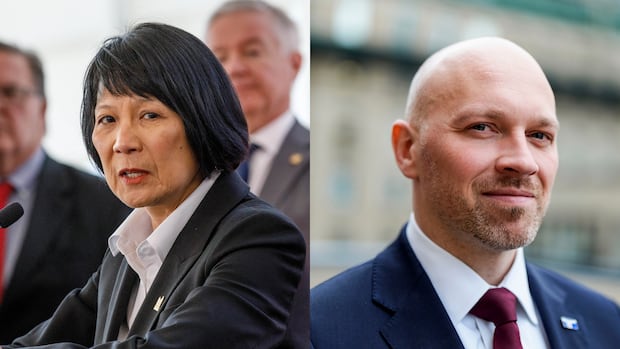
A Mainstreet Research poll released Friday put incumbent Olivia Chow at only 2.5 points ahead with 40.8 per cent support and Coun. Brad Bradford at 38.3 per cent support, following Chris Alexander’s withdrawal from the election. The survey found 10 per cent were still undecided.
The poll found the difference between Chow and Bradford had also narrowed among decided and leaning voters to 2.9 points.
The poll, conducted on Oct. 6 and 7, comes at a time when the competition is down to the wire, said Quito Maggi, president and CEO of Mainstreet Research.
“It appears the Bradford campaign may have some momentum,” he said in a news release. “With a short runway remaining, the chances of a Chow re-election are less and less certain.”
Maggi told CBC News the poll’s results were “statistically tied” between the two candidates, given the gap between them was about the same as the margin of error for the survey.
“It’s going to come down to relative turnout, in terms of how tight this election will be,” he said.
WATCH | Summary of CBC’s mayoral debate between Chow and Bradford on Thursday: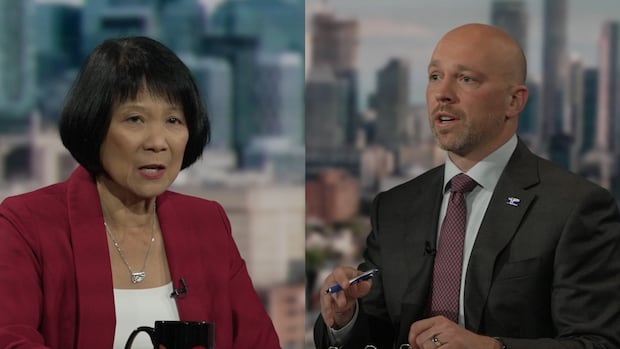
Chow vs. Bradford: CBC Toronto’s mayoral debate in 3 minutes
Bike lanes, property taxes and public safety: it was all on the table as Olivia Chow and Brad Bradford went head to head at CBC Toronto’s mayoral debate. Here’s everything you missed in less than three minutes.
Results have shifted since Mainstreet’s last poll at the end of September, which put Chow at a six-point lead ahead of Bradford.
Bradford’s campaign said in a news release that Chow would allegedly rely on “scare tactics” until election day given the shorter divide of support between them.
“The Mayor has a plan to scare you. That’s the whole campaign,” said spokesperson Laryssa Waler. “Change is within our grasp. To change the city, we need to change the mayor, and 17 days from now that’s exactly what we intend to do.”
CBC News has reached out to Chow for comment on the poll’s results.
Bradford support increased after Alexander’s withdrawal
Following Alexander’s departure from the race, poll respondents were asked who they would choose between Bradford and Chow. The current mayor took the lead with 44.7 per cent support, while Bradford had 41.5 per cent support.
“[Support] is tightening up overall and this tends to happen towards the end of an election,” Maggi said.
When asked whether people can count on the TTC to get to a destination on time, 40.2 per cent of people surveyed said it was somewhat reliable and 33.8 per cent said it was somewhat unreliable.
Nearly half of respondents said traffic congestion in Toronto was a very serious problem.
Mainstreet’s data found a gender and age divide between supporters of the candidates, showing Chow leading among female voters and the younger demographic, while more of Bradford’s support comes from older voters and men.
Mainstreet polled a random sample of 1,000 Toronto residents using interactive voice recording. People were reached on landlines and cellphones. The resulting data was weighted to match targets on the 2021 census. The poll has a margin of error of +/- 3.1 percentage points, 19 times out of 20.
With advance polls open and election day just weeks away, you can find the full list of Toronto’s 53 mayoral candidates on the city’s website.