
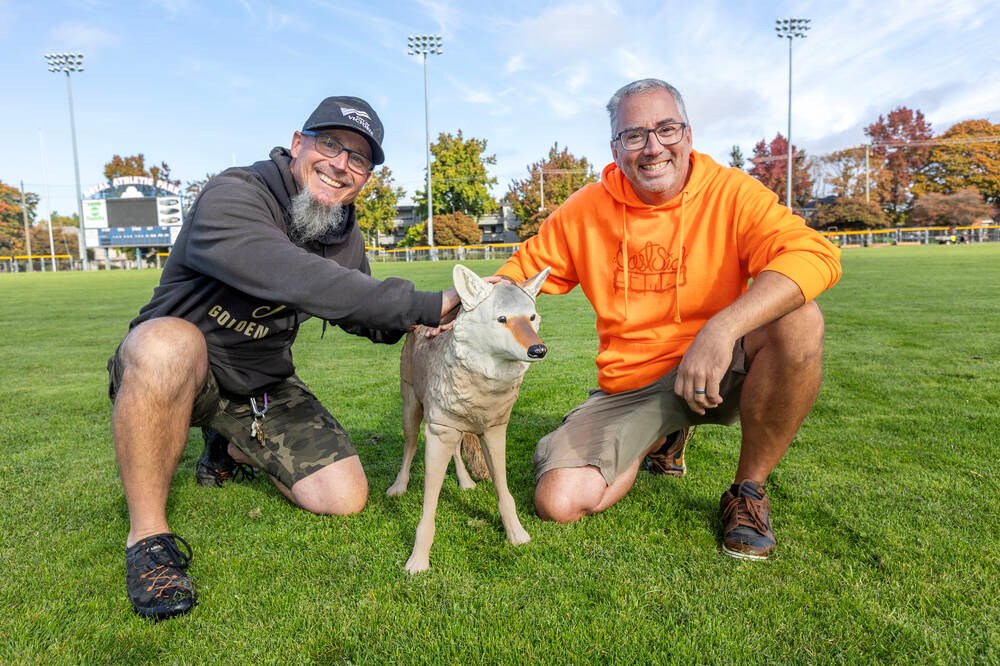
The city says geese have been a problem at the facility for years, but managing them in a humane way has been a challenge.
The City of Victoria’s ongoing battle with large flocks of Canada geese damaging the field at Royal Athletic Park has gone to the dogs.
In a bid to protect the playing surface, the city’s parks department has for the last few weeks been using a pair of coyote decoys to scare geese from the pitch.
So far, it appears to be working.
“Initially I’d say it’s been very effective, but time will tell,” said Brooke Stark, Victoria’s assistant director of parks and open spaces.
“This is a tool that we thought we should give a try. Royal Athletic Park is a premier sporting facility and we want to make sure the facility is maintained.”
Stark said the geese have been a problem at the facility for years, but managing them in a humane way has been a challenge.
The Capital Regional District in 2023 approved a Canada geese management strategy to reduce the impact of the birds’ rapidly growing population in the region. It included an egg-addling program — a technique that renders the embryo in an egg non-viable — and culling some birds.
It also looked at modifying habitat to deter geese, including planting trees and hedges to prevent easy access to water from land, and using new grass seed mixes that are less palatable to the birds.
The problem with large goose populations, according to the CRD, is that they can lead to high amounts of fecal matter in the water and on land, raising levels of fecal coliform and other pathogens, such as avian influenza and salmonella.
In a report, the CRD said some playing fields have at times been rendered unusable because of the volume of goose droppings.
Stark said the experiment at Royal Athletic Park started with two stationary coyotes, which staff would move periodically based on the behaviour of the birds on the field.
They have since ramped up their game, however, affixing one of the two stationary coyotes onto an autonomous grass mower. “It’s not actually mowing, but the coyote decoy is on top and moves around the field overnight.”
Stark said the hope is that the geese will not be able to get used to having the decoys moving.
“It’s like owl decoys on the roofs of buildings — sometimes birds get used to those, so here in the field we want to make sure the birds don’t get too used to it, and the mower changes direction, often in an unpredictable way.”
Stark said the city is monitoring the decoy program and will be reporting back to the CRD on how effective it is, and how long it takes the geese to learn what the coyote mannequins are up to.
“Hopefully by changing up the location and how it moves, it will help extend the time that this is effective,” she said, adding the program could be expanded.
“So far, two seems to be working, but again, geese are smart and they’ll figure it out.
“It’s just one of a suite of tools and different things that we can do to help minimize their damage to the field.”
She said there are no immediate plans to expand to other playing fields in the city, adding Royal Athletic Park is of particular concern, as it is enclosed and the geese feel quite safe there.
“So, we’re trialing at Royal Athletic Park, and being a secure facility, we can put things out like this overnight.”
When the CRD adopted its goose management strategy, the region was experiencing ongoing problems with geese damaging farmers’ fields and sensitive ecosystems, as well as accumulations of feces on fields and playgrounds.
At the time, the regional district said local goose numbers were doubling every four years.
Many of the Canada geese on Vancouver Island today are descendants of those brought to B.C. starting in the 1950s and into the 1980s in part to offer more hunting opportunities.
Prior to that, the Island’s goose population had been relatively modest.
Stark said she doesn’t know if the city has been getting calls from residents concerned about prowling coyotes in the North Park neighbourhood, but they have been fielding calls asking if dogs are now allowed in Royal Athletic Park.
The answer to that remains no.