

B’Yachad, formed through an alliance between former prime ministers Naftali Bennett and Yair Lapid in April 2026, is one of the parties vying for citizens’ votes in the elections for the 26th Knesset, which will be held on October 27.
Led by Bennett, with Lapid in second place, the party combines Bennett’s right-wing political background with Lapid’s centrist Yesh Atid party.
It is one of the major parties in the opposition bloc seeking to replace Prime Minister Benjamin Netanyahu. The party offers a combination of a right-wing security stance while holding more liberal positions on issues of religion and state, and reforms aimed at lowering the cost of living and the country’s education system.
 RAMAT HASHARON, ISRAEL – AUGUST 20: Former prime ministers Naftali Bennett and Yair Lapid attend an election campaign event for their joint B’Yachad party on August 20, 2026 in Ramat Hasharon. (credit: GILI YAARI/FLASH90)Bennett and Netanyahu: From aide and coalition partner to rival
Bennett’s political career began close to the leader he is now seeking to replace. He served as Netanyahu’s chief of staff from 2006 to 2008, when Netanyahu was opposition leader, before building an independent political career on the religious-Zionist Right.
After winning the Bayit Yehudi leadership in 2012, Bennett and Netanyahu held a coalition agreement that neither would join without the other.
Following the 2015 election, Bennett joined another Netanyahu-led coalition and served as education minister alongside the haredi (ulta-Orthodox) parties. Netanyahu also appointed him defense minister in 2019.
 Chairman of the B’Yachad party and former prime minister Naftali Bennett speaks during a press conference in the southern Israeli city of Ofakim, June 23, 2026. (credit: Tsafrir Abayov/Flash90)
In 2020, Bennett was outside Netanyahu’s government, and subsequently became the leader of the coalition that removed him from office, forming a rotation government with Lapid.
Lapid founded Yesh Atid in 2012 after a career in journalism and television. The party positioned itself as a secular, centrist, liberal-Zionist force, emphasizing the concerns of working Israelis, the economic burden on the middle class, and greater equality in military service.
It won 19 seats in its first election in 2013, becoming the Knesset’s second-largest party, and Lapid became finance minister in Netanyahu’s government.
In the current Knesset, Yesh Atid is also the second-largest party and holds 24 seats. Over time, Lapid became a leading opponent of the prime minister, and currently serves as opposition leader.
Lapid served as foreign minister and alternate prime minister in the government formed with Bennett.
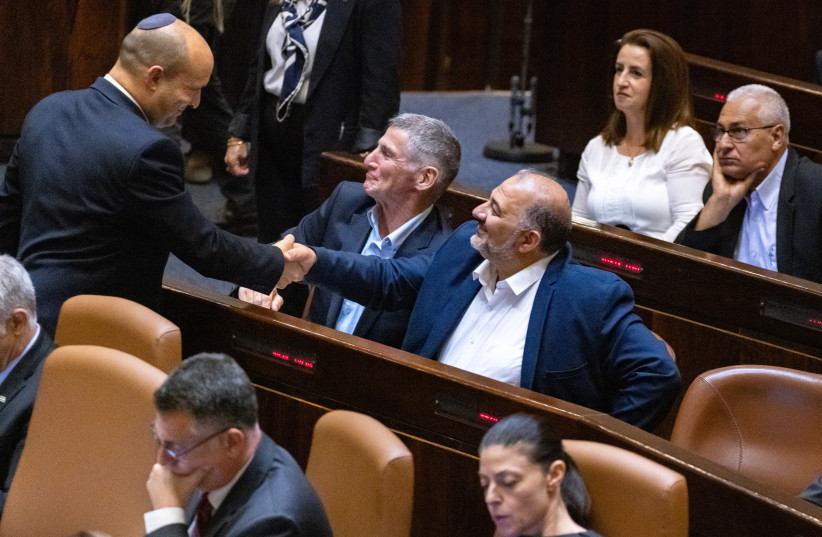 Then-prime minister Naftali Bennet with with head of the Ra’am party Mansour Abbas in the assembly hall of the Israeli parliament on June 21, 2021. (credit: OLIVIER FITOUSSI/FLASH90)The Ra’am coalition and Bennett’s changing red lines
A highly contentious move in the Bennett-Lapid government came in June 2021, when he formed a government with parties from the Right, Center, and Left, alongside Mansour Abbas’s Islamist Ra’am.
Ra’am became the first Arab party to join an Israeli governing coalition, and the partnership drew fierce criticism from Bennett’s former political camp, particularly because he had promised not to partner with an Arab party.
Bennett acknowledged the reversal in a recent interview with The Jerusalem Post, stating, “I did break a promise. That’s just a fact.” He defended forming the government as preferable to further elections.
Asked whether he could again join a coalition with Ra’am, he refused, saying, “October 7 changes a lot of things.”
Bennett has also campaigned against a coalition with the established haredi parties in the Knesset whose positions on military service conflict with his party’s policies and plans to offer no exemptions to haredim who evade IDF service.
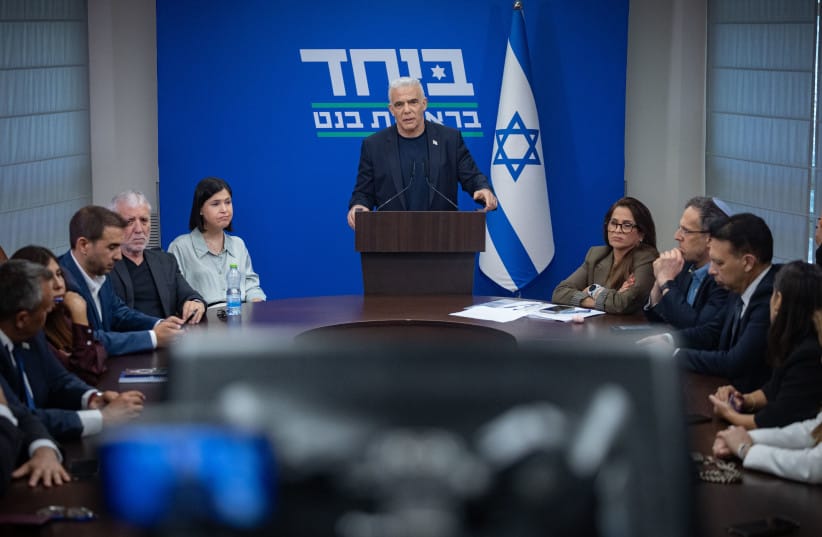 Opposition leader and former prime minister Yair Lapid leads a faction meeting at the Knesset, the Israeli parliament in Jerusalem, on July 6, 2026. (credit: YONATAN SINDEL/FLASH90)Where B’Yachad stands on the major issues
Bennett’s campaign has centered on rebuilding state institutions, drafting haredim, increasing economic competition, and improving Israel’s international standing.
In June, he presented his New Covenant plan, proposing changes to education, government administration, security, and the economy. The proposals included recruiting 20,000 additional soldiers, closing seven government ministries, and transferring more authority to local government.
Bennett also proposed restructuring the Education Ministry to direct more resources toward teachers and classrooms, alongside greater accountability for ministers and public officials.
The party’s approach to military service is among its clearest distinctions from Netanyahu’s current coalition.
In a March interview with the Post, Bennett said his next government would be based on a “covenant of those who serve.” He said haredi parties could not join unless they accepted his principles on education, universal service, and employment.
Bennett has called for mandatory haredi enlistment and an end to state funding for draft evasion and education without core subjects. He has argued that the shortage of soldiers places an unsustainable burden on those already serving and on reservists repeatedly called away from their families and jobs.
When presenting his plan in June, he described the state’s relationship with the haredi community as “a slow-motion suicide.” His proposals would instead offer military-service and employment pathways alongside state haredi schools.
Bennett’s economic platform focuses on reducing market concentration and increasing competition, particularly in the food sector.
 Campaign posters for the upcominge genral elections in Tel Aviv. July 26, 2026. (credit: YOSSI ALONI/FLASH90)
His July plan called for breaking up monopolies, preventing exclusive importers from distributing additional major brands, and requiring Shufersal to sell stores in areas where its presence limits competition.
The plan set a target of bringing Israeli food prices into line with the OECD average, which the party said could save a family approximately NIS 8,000 annually. That figure is a campaign projection whose realization would depend on the reforms being implemented and producing lower prices.
These proposals sit alongside Bennett’s broader promise to streamline government ministries, appoint ministers with suitable backgrounds to each role, and oversee them to ensure they operate efficiently.
The Bennett-Lapid alliance has also committed to pushing for civil marriage to be preformed in the country, rather than through the Chief Rabbinate.
Lapid previously told the Post that B’Yachad would pursue civil marriage and equal rights for LGBTQ+ couples if it joined the next government. He said the party would seek legislation guaranteeing equal rights for every couple within the government’s first 100 days.
The party’s economic proposals also extend into religious services, with Bennett calling for greater competition in kosher certification.
Bennett has pledged to establish a state commission of inquiry into the October 7 massacre on his government’s first day. He has called Netanyahu responsible for government failures that took place on that day, demanding that he take accountability.
Another law Bennett has stated that he seeks to pass is limiting a prime minister’s term to eight years.
Bennett has maintained his right-wing stance regarding security issues, arguing in favor of dismantling and disarming Hamas, and has expressed support for maintaining security zones in Gaza, Lebanon, and Syria.
However, he has also stated that military operations must be accompanied by diplomatic arrangements that prevent the organization from rebuilding, and with regard to Gaza, has favored a central role for Egypt, stating that rebuilding cooperation with Cairo could help contain and disarm Hamas.
 Chairman of the B’Yachad party and former prime minister Naftali Bennett speaks during a press conference in Tel Aviv, June 15, 2026. (credit: AVSHALOM SASSONI/FLASH90)What a vote for this party is likely to produce
Given the party’s alliance with the leaders of additional opposition parties – Yashar’s Gadi Eisenkot, Yair Golan’s Democrats, and Avigdor Liberman’s Yisrael Beytenu – a vote for B’Yachad would strengthen the opposition’s bid to replace Netanyahu while bolstering Bennett’s effort to be the next prime minister.
The four parties have agreed to work to form a coalition. Eisenkot has called for the leader of the party with the most votes to receive backing for the premiership – though none of the opposition party leaders have outright committed to this – leaving the possibility for Bennett to once again become prime minister still on the table.
The party is currently polling at around 13 to 15 seats, making it currently the second largest party in the opposition bloc.
A vote for B’Yachad would support an alliance campaigning for broader military service, changes to funding for haredi institutions, civil marriage, and economic reforms aimed at lowering prices, alongside Bennett’s security policies.
However, the party’s recent lower standing in the polls behind Eisenkot does call into question its ability to implement those commitments.
Rejecting Arab parties in a coalition and opposing the current arrangements with the haredi parties also narrows the available routes to a majority.