
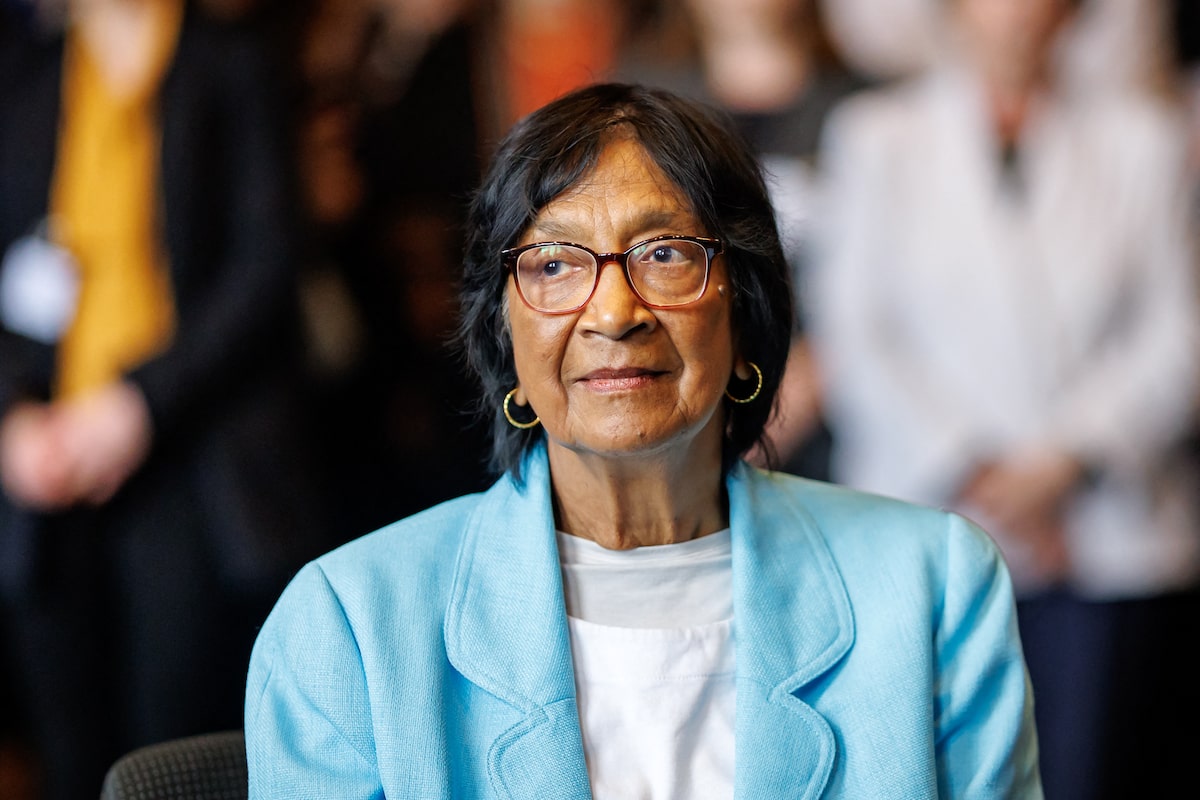
Navi Pillay, sits at the Nuremberg Forum in Nuremberg, Germany, on Friday, following the announcement that she had been awarded the 2026 Nobel Peace Prize.Daniel Karmann/The Associated Press
Navi Pillay, who fought apartheid in South Africa and became one of the world’s most respected international judges, has been awarded the Nobel Peace Prize in a decision that signals fresh resistance to the U.S. campaign to dismantle the International Criminal Court.
While the announcement by the Norwegian Nobel Committee on Friday did not mention U.S. President Donald Trump by name, it was a clear retort to his administration’s repeated attacks on international courts and judges.
Ms. Pillay, a pioneering South African human rights lawyer who has spent more than three decades in international justice, served on the ICC in The Hague from 2003 to 2008. She is also an ad hoc judge on the International Court of Justice, the top United Nations court, which has infuriated the Trump administration by issuing emergency orders against Israel in a genocide case launched by South Africa.
The system of international law is under “tremendous pressure” by a shift to “power politics,” including the use of sanctions to target judges, the Nobel committee said. It was a reference to the escalating campaign of U.S. sanctions against ICC judges, which began earlier this year when Secretary of State Marco Rubio vowed to “bring that court to heel” and to dismantle it “brick by brick.”
Just hours after the Nobel prize announcement, Mr. Rubio announced new sanctions against the international court. “We will ban transactions with this rogue court, cutting off their resources and crippling its ability to operate,” he said.
Canada signed a joint statement with Germany, France, the United Kingdom and other countries in response saying they strongly disagree with the sanctions and support the ICC.
Ms. Pillay, 85, was at a conference in Nuremberg, Germany, when she learned of the Nobel Prize. Applauded by a room full of human rights advocates, she joked about Mr. Trump’s repeated demands to be awarded the Nobel Prize. “If you clap a little bit more, I may share this prize with Trump,” she said as the crowd laughed.
“Clearly the fact that he never got the Nobel Prize, and never will, is an indictment against him,” Ms. Pillay told South African state broadcaster SABC later in the day.
“There’s a message there that all Americans should take on board: do you want to be on the side of justice and fairness and impartiality, which the whole world cherishes? He doesn’t like someone or their ideas, then he goes out to sanction, punish, forcibly deport, wrongfully invade and arrest leaders of other countries. These are threats to international law.”
An illustration of Peace Prize laureate Navi Pillay at the Norwegian Nobel Institute, in Oslo, Norway.Javad Parsa/Reuters
When she was informed of the Nobel Prize, Ms. Pillay was in the same Nuremberg courtroom where Nazi leaders were placed on trial for war crimes after the Second World War. Those trials helped create the foundation of today’s system of international criminal law, including the UN Genocide Convention, adopted in 1948, and the ICC, formed in 2002 with strong support from Canada and others. The ICC prosecutes war crimes and crimes against humanity, but the United States and Israel have never joined.
The latest assaults on international courts “endanger the progress painstakingly made since Nuremberg” and “risk returning us to a world in which power, rather than law, determines whose suffering matters,” Ms. Pillay told journalists.
The Nobel committee agreed. “At a time when the number of wars and conflicts is rising, and when judges and institutions of international law are under political attack, the Nobel Committee wishes to issue a reminder that the ability to resolve conflicts without force or violence is dependent on the international rule of law,” it said.
Ms. Pillay was born in the South African coastal city of Durban, where her grandparents had arrived from India in the 1890s to work as indentured servants on sugar plantations. She earned her law degree during the repressive era of white-minority rule, when schools were segregated and non-white students had to share textbooks.
After becoming the first woman of colour to open a law practice in her home province then known as Natal in 1967, Ms. Pillay began defending anti-apartheid activists in police custody, exposing the use of torture by apartheid police. In 1973, she won a precedent-setting case to protect the legal rights of political prisoners on Robben Island, where Nelson Mandela was among those jailed. In retaliation, the apartheid government denied her a passport.
She was elevated to the South African High Court in 1995, a year after the end of apartheid, and then moved into international justice as a judge at the International Criminal Tribunal for Rwanda. In a landmark decision that she cited on Friday as one of the proudest moments of her career, she co-authored a ruling that mass rape and sexual violence can be considered crimes of genocide.
After her five-year stint on the ICC, she became the UN High Commissioner for Human Rights in 2008, succeeding the Canadian judge Louise Arbour.
From 2021 to 2025, Ms. Pillay chaired the UN’s international commission of inquiry on the occupied Palestinian territory. The commission concluded last year that Israel had committed genocide in Gaza, an allegation that Israel has denied.
The Israeli Foreign Ministry reacted with outrage to the Nobel announcement. “It’s the grotesque weaponization of an award to legitimize anti-Israel hatred and prejudice,” the ministry said in a statement.
Mr. Trump reposted a Truth Social post by a supporter who accused Ms. Pillay of being an “unabashed hater of America and Israel.”
Many human rights groups, however, praised the Nobel committee’s decision. “At a time when human rights are under attack on so many fronts, including from those who wield enormous power, this award is particularly poignant,” said UN human rights chief Volker Türk.
Ms. Pillay is the fifth South African – including Mr. Mandela in 1993 – to be awarded the Nobel Peace Prize.
The Nobel committee hailed Ms. Pillay for her “exceptional courage.” But in her first reaction in Nuremberg, she said she was surprised at the compliment. “Why would you need courage to speak the truth?” she asked.