
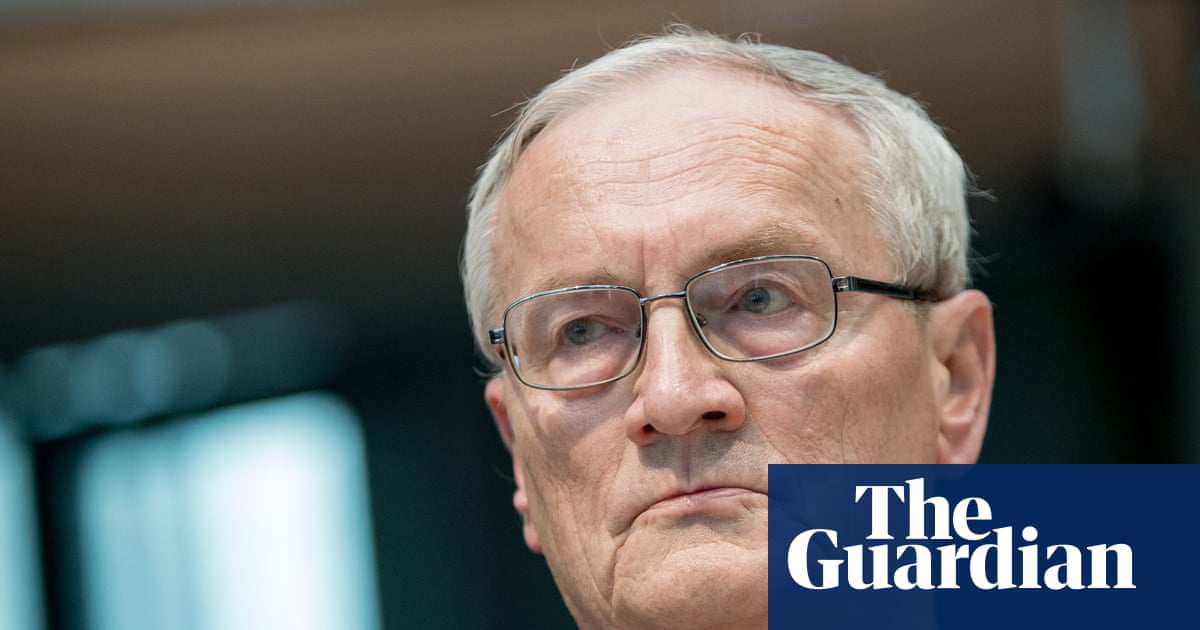
The ex-spymaster August Hanning once criticised Germany’s own intelligence services as “vegetarians” among prowling carnivores, demanding broader powers to keep the country safe in a treacherous world.
Often described as a “godfather” of Germany’s 21st-century security architecture, Hanning is now charged with treasonous espionage and handing state secrets to a foreign power in one of the most spectacular alleged intelligence breaches of the postwar period.
If true, Hanning may have irreparably damaged Germany’s global security cooperation while exposing grievous internal vulnerabilities, in a tale ripped from a far-fetched political thriller.
“This is an incident that has the potential to escalate into a genuine national scandal,” said Konstantin von Notz, a Bundestag member who sits on the parliamentary intelligence supervisory committee.
Von Notz warned of a “devastating” loss of trust among partner countries “whose support we cannot do without in the current extremely tense security situation”.
Tuesday’s scenes from a small town in Germany staggered even seasoned spy watchers: masked commandos led Hanning from his estate in his birthplace, Nordwalde, to a black police van, his familiar bespectacled face framed by neatly combed white hair. His expression was calm and focused, his wrists without handcuffs.
Masked commandos led Hanning from his estate in Nordwalde to a police van. Photograph: Christoph Reichwein/DPA/AP
The detention of the 80-year-old, who ran the federal foreign intelligence service (BND) from 1998 to 2005, marked a first in a western democracy given his previous rank, according to experts.
Federal prosecutors believe Hanning ran his former chief of staff, identified only as Manfred D, as a mole at the BND, paying him to spirit out nearly 2,000 documents, at least some of them classified, over 12 years.
He then allegedly exploited the intelligence for clients of the private consulting firm he launched after retiring – a legal business model that drew fierce criticism over the course of a tumultuous week.
Hanning is in pretrial detention and has, through his lawyers, denied passing on confidential documents to foreign powers. If convicted, he could face 10 years in prison.
Many of the compromised files are believed to have been briefing papers prepared for top officials including the chancellor.
The former BND vice-president Arndt Freytag von Loringhoven described the material as the “crown jewels of the BND”, telling Der Spiegel magazine they were “the most important assessments that a BND president provides”.
The explosive case sent allied secret services scrambling to assess the possible damage. A western official told Reuters that US foreign intelligence was included in documents stolen from the BND. The CIA has not commented on the case.
Luca Manns, managing director of the Intelligence Services Research Unit at the University of Cologne, called the case a “stab to the heart” of the BND, causing incalculable damage to allied cooperation.
“It won’t be an abrupt break,” Manns said, predicting a “creeping erosion of partnerships”.
Hanning is in pretrial detention and, if convicted, could face 10 years in prison. Photograph: Anna Szilágyi/EPA
The suspected betrayal could be corrosive within the agencies as well as in public perception, said Dieter Bacher, a historian at the University of Graz in Austria specialising in secret services.
“When the former head of a service does something like this, the implications are, of course, enormous,” he said. “A loss of trust is certainly inevitable. As information from partner services was apparently also involved, the impact on agency ‘business’ is all the greater.”
The news broke in a week in which Germany’s intelligence service directors had testified to parliament about the heightened threat posed by powers including Russia and China.
The BND chief, Martin Jäger, a former ambassador to Ukraine, warned of a possible violent conflict with Moscow, accusing the Kremlin of mounting a “shadow war” of hybrid and drone attacks.
“We sincerely want to be Germany’s first line of defence,” he said.
Jäger was reportedly already aware of Henning’s impending arrest at the time of his testimony, which came weeks after a foiled drone bomb attack that Berlin has blamed on Moscow.
skip past newsletter promotion
Sign up to This is Europe
The most pressing stories and debates for Europeans – from identity to economics to the environment

after newsletter promotion
Russia does not appear to be the recipient of Hanning’s alleged activities, according to reports, at least not directly.
Der Spiegel named Azerbaijan and China among the possible clients, claims not confirmed by authorities. Baku has denied involvement, although Hanning served on the board of the German-Azerbaijani Forum “fostering ties” with the authoritarian-run key energy transit country.
Azerbaijan has been named by Der Spiegel as a possible recipient of Hanning’s alleged activities, though it has been denied by Baku. Photograph: Kym Illman/Getty Images
Hanning’s primary motive may have been financial.
He sat on the board of failed Latvian bank PNB Banka, which was declared insolvent in 2019. Bild newspaper said Hanning and another member of the supervisory board – reported to be the former Nato secretary general Anders Fogh Rasmussen – were held liable for up to €4m.
Bild reported that Hanning’s pension had been confiscated to service the debt.
The secret services are facing a reform drive long held back by sensitivities over abuses under the Nazi and communist dictatorships. A law due to pass parliament this year would lift many of the restraints imposed during the postwar period.
Manns warned against any call to stop the measures in light of the Hanning case, saying it would “play into the hands of our opponents, who want a weak German foreign service”.
Hanning was the face of German intelligence during a turbulent period of the post-cold war period, overseeing anti-terror strategy after the 9/11 attacks which were planned in part by a cell in Hamburg.
Investigators only learned of his alleged criminal activities while gathering evidence in a separate child kidnapping case involving a steakhouse restaurant dynasty, which he is accused of abetting using his Israeli intelligence contacts.
The treason charges have sparked a range of troubling questions. Were there other moles? How could his espionage have gone undetected so long? Was the classified information passed to third parties? And who will still trust Germany’s intelligence agencies?
The charges against Hanning are hardly the first scandal to rock the country’s secret services in recent years, with high-profile cases involving spying for Russian intelligence and the CIA.
More broadly, the former head of the domestic intelligence service, Hans-Georg Maaßen, has allied himself with hard-right groups and causes, raising doubts about the neutrality of the agency on his watch.
And the former chancellor Gerhard Schröder, once a Social Democratic stalwart and respected economic reformer, has shocked Germans by taking on a string of lucrative Russian corporate jobs since leaving office in 2005 while becoming a close friend of Vladimir Putin, even attending the Kremlin strongman’s 74th birthday celebrations in Moscow this week.
And with the far-right, pro-Russian party Alternative für Deutschland on the brink of power in a German state for the first time since the second world war, authorities are racing to restrict its access to sensitive intelligence.
With criticism mounting of the legions of former senior German officials who cash in on work relating to their previous activities, Von Notz and Manns joined a chorus calling for a lifelong lobbying ban for high-ranking intelligence officers.