
Baroness Thatcher poured the tea, pushed a brass tray of peppermints across the table, and asked Israeli diplomat and author Yehuda Avner to tell her about “Mr. Begin.”
It was a bright April morning in 1992, in a borrowed mansion on Eaton Square, barely a month after Menachem Begin’s funeral. Thatcher had made no bones about opposing his settlement policies, she said, but she had greatly admired his convictions.
Avner told her he thought Begin had been worthy of a second Nobel Prize.
“For what, pray?”
For securing Israel’s parliamentary democracy, he said.
Thatcher’s voice sharpened. Surely he exaggerated. Israel was universally famous for its democracy, one of the most robust in the world.
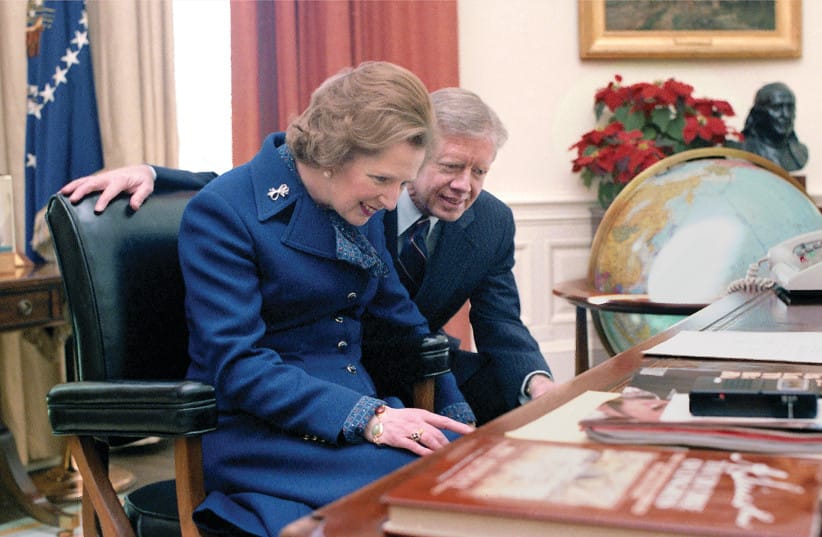 THEN-UK PRIME MINISTER Margaret Thatcher with US president Jimmy Carter in the Oval Office, 1979. (credit: WIKIMEDIA)
Not at the outset, Avner said.
Twice, just before independence and just after, Begin had saved the country from civil war.
In 1944, the Hagana seized Irgun men and handed them over to the British; Begin ordered his fighters not to retaliate. Not one of them did. He explained himself afterward in a ramshackle Galilee cinema, speaking over the sound of rain hammering a corrugated roof.
The Second Temple fell because Jews hated each other into civil war. There are fateful times, he told them, when the choice is between blood and tears. Against the British, blood had taken the place of tears. Jew-against-Jew, tears had to take the place of blood. God forbid that a decision of a democratically elected government should ever be defied by force.
He was talking about the Altalena – found intact on the seafloor recently.
Avner says plainly that he was not there and is familiar with the scene through eyewitness accounts years later.
Begin on the burning deck, black with smoke, flinging up his arms and shouting at his own men not to fire.
On the beach, one of the officers ordered to shell her was Yitzhak Rabin, who believed Ben-Gurion’s warning that Begin was mounting a coup and told Avner decades later that his gun crew fired the shell that set her alight. Two of this book’s four prime ministers were at opposite ends of that gun.
Thatcher had no idea, and she said so.
Avner once asked Begin what the most important thing he had done in his life was. “Twice I prevented civil war,” came his answer. That is recorded near the end of The Prime Ministers, and it is the boldest claim in 700 pages. Published in 2010, Avner’s tome is more relevant than ever.
ISRAELIS VOTE on October 27, at the end of only the second Knesset since 1988 to serve a full term – the other 13 having dissolved early.
Avner’s claim is that there is anything to vote in at all because a man twice refused to fight for power he believed was his, and then brought in the voters nobody else wanted, most of them from Arab and Asian countries with no parliamentary tradition and hardly a voice in the new state. They put him in office after eight consecutive electoral defeats.
Thatcher’s own Foreign Office had briefed her that Israel had elected a warmonger and a demagogue.
‘A Jew should never hate another Jew’
Avner never argues any of this on the page. He puts down what he saw and lets you do the rest.
In May 1967, with Egyptian divisions in Sinai, the leader of the opposition walked into Levi Eshkol’s study and asked the prime minister to stand down in favor of David Ben-Gurion.
How could Begin, of all people, ask him to make way for the man who had abused him at every turn and compared him to Hitler? “The enmity is his, not mine,” Begin said. “I live by the maxim that a Jew should never hate another Jew.”
Eshkol went to the window, looked out at picketers holding signs telling him to go, then yawned and refused in Yiddish. “These two horses cannot pull the same wagon together,” he said famously, referring to himself and Ben-Gurion.
Born Haffner in Manchester
Avner was born Haffner in Manchester in 1928, reached Palestine at 18 in November 1947, and dug trenches during the siege.
From 1963, he wrote the English-language speeches of Eshkol, Golda Meir, and Rabin, holding no party card in a country where public jobs ran through Mapai. He was in the room for much of it and scrupulous about when he was not, sourcing Golda’s confrontation with the Socialist International to her own memoir and a colleague she told of it on her return.
In June 1977, the country changed hands for the first time, and the incoming prime minister told his predecessor’s speechwriter he was keeping him.
There had to be continuity, Begin said, and the world had to see it. “This government has come to serve, not to reap.”
Avner stayed six more years. The peaceful transfer of power is not an abstraction in this book. It is the author’s employment record.
The book is also funny, and the joke is rarely where you expect.
Eshkol gets into his car one morning and asks Yankele the doorman, in Yiddish, how he is doing as prime minister. Yankele closes one eye and says the taxes are far too high. Eshkol, one leg in the car, cups a hand to his ear and spends several minutes explaining the defense budget and immigrant housing to his doorman, while his speechwriter wonders how many prime ministers ask a doorman his opinion, listen, and then try to explain themselves.
The word Carter had to ask about
Underneath it is one thing, and Thatcher walks into it. Avner tells her you cannot understand Begin without the Holocaust, that almost his whole family was murdered. In 1979, she admits that she had not really known what Auschwitz was. In the White House Cabinet Room in 1977, under a portrait of Truman, Begin told then-US president Jimmy Carter that, in the past, Jewish men had to deliver their women and children to their executioners. “We were tertiated, Mr. President.”
Carter lifted his head and asked what the word had been. Tertiated, not decimated, Begin said. Decimation is one-in-10. For the Jews it was one-in-three. He rose to his full height, banged his fist on the table, and swore an oath before the president, in the name of the Jewish people, that it would never, ever happen again.
Then Begin broke, knuckles white against the tabletop, blinking back tears, while the clock on the mantelpiece became audible and all the president’s men looked at the floor.
None of it is neutral, and Avner says so, explaining in an author’s note that he reconstructed conversations, edited speech, and thought Begin the most exceptional of the four. It shows in the Sabra and Shatila chapter, which spends more energy on the unfairness of the coverage than on the decision that put Phalangist militiamen inside those camps.
He ends where the man did.
The funeral Begin had specified: no lying in state, no guard of honor, no delegations, not even eulogies. A shroud, a prayer shawl, Irgun veterans carrying him, four kilometers of mourners on the road to the Mount of Olives.
Then, in that London drawing room a month later, Thatcher asked whether Begin had left a memoir.
No, Avner told her, and he could not explain the silence to himself, let alone to her.
What he had was the end of an old Time magazine interview, where, when the reporter rose to leave, he had turned back and asked how Begin wanted to be remembered in history. Avner repeats the answer and adds nothing: “As a decent human being, and a proud Jew.” ■
THE PRIME MINISTERS: AN INTIMATE NARRATIVE OF ISRAELI LEADERSHIP
By Yehuda Avner
The Toby Press
715 pages; $38