

Shalev Ben Simon wakes up every morning at the same time. He opens his eyes, looks at his mobile phone and sees – 6:29 A.M. “It doesn’t matter what time I go to sleep. Even if I fall asleep at six, after half an hour I wake up and can’t go back to sleep. It’s this urge, I feel haunted.”
Three years have passed since that hour was seared into the collective memory of Israelis. But unlike most other Israelis, Ben Simon was actually there, at 6:29 A.M., in uniform, not far from the border fence near Gaza. “I was actually trying to get out of Shabbat duty that weekend,” he admits. “I told all sorts of stories hoping they’d let me go home, but my request wasn’t approved. The truth is I wanted to go to Nova,” he says, referring to the music festival near Kibbutz Re’im, where hundreds of Israelis were murdered on October 7. “So I would have been screwed either way.”
He returned alive after that Saturday, but it is hard to say he returned to life. “I see blood on my hands, hear gunshots, feel my heart pounding. It doesn’t go away, I can’t shake the sights.”

Ben Simon, who is 22, enlisted in Battalion 51 of the Golani Brigade in March 2022. He was trained for combat, served in Hebron in the West Bank, completed a squad commanders course and then returned to his company. Two weeks before October 7, he was promoted to sergeant first class, with his company responsible for the Kissufim sector in southern Israel.
 Close
Close
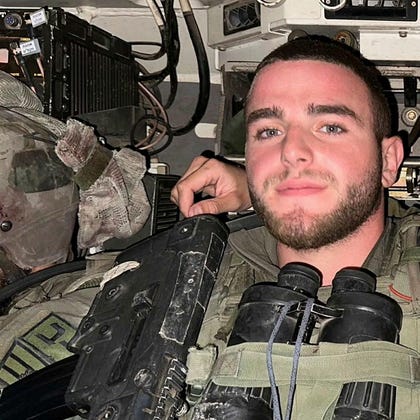
Ben Simon in his APC on the evening of October 7, 2023. He and his soldiers had never moved it before that day, not even in training exercises.
Ben Simon in his APC on the evening of October 7, 2023. He and his soldiers had never moved it before that day, not even in training exercises.
“After a few minutes, I asked him, ‘Why are you driving?’ and he looked at me with a stunned expression. ‘Don’t you remember what happened? Are you crazy? Do you know what you just did?’ he asked, and I replied, ‘Not really.'”
Ben Simon and his comrades were sent to a small outpost, made up of a combined combat team in a wooded area, near the Gaza border. Eight infantry soldiers in an armored personnel carrier and four armored soldiers in a tank – this was the force manning the border outpost that weekend.
“On Friday evening, we all made Kiddush together,” he says, referring the recital of the blessing over the wine on the eve of Shabbat. “We stayed up until 2 A.M., it was the time of our lives.” At 5:30 A.M., Ben Simon woke his soldiers for a routine round at sunrise. “Five of us entered the armored personnel carrier, sat and talked a bit, and then I decided to nap and asked one of the soldiers to listen to the radio.”
The 6:29 Wake-up
At 6:29 A.M., he woke up. “My soldier tells me there’s ‘purple rain’ [code for rocket and missile fire]. I didn’t understand what was happening, I asked if they said the word ‘chicken’ [code for drill] on the radio.” The soldier replied in the negative.
“I immediately yelled at the rest of the soldiers to get into the armored personnel carrier,” Ben Simon says. Five minutes later, a mortar shell landed near them, creating a crater in the ground. After a few more seconds, another mortar shell hit, this time striking the APC itself. “Everything shook,” he recounts. “I immediately called my officer to try and understand what was happening. He told me: ‘It looks like there’s going to be a hell of a war now. Get the guys ready, follow me.'”
Related Articles
Until then, they had never moved the APC from its spot. “Not even in drills,” he says. This was the first of many times that day that Ben Simon was to perform actions he had never practiced. But in real time, there was no time to think about it. They had to act, and fast.
A few minutes after they started driving, Ben Simon opened one of the APC’s hatches – and a drone appeared above it. “It was huge, enormous. It cast a shadow over the entire APC. I told the soldiers: ‘Listen, I don’t know why we got into this, but everyone has to be alert and focused. Load your weapons, and shut up.'”
 Close
Close
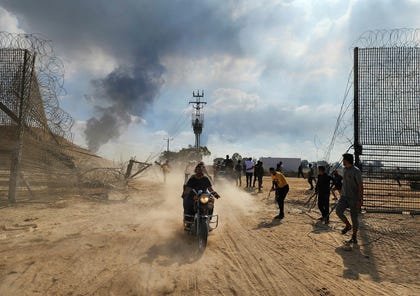
Hamas terrorist breaching the border fence on October 7. “We saw a huge number of motorcyclists just streaming in endlessly.” Credit: Hani Alshaer/Anadolu Agency via Reuters Conne
Hamas terrorist breaching the border fence on October 7. “We saw a huge number of motorcyclists just streaming in endlessly.” Credit: Hani Alshaer/Anadolu Agency via Reuters Conne
A few more minutes passed until they reached the breached border fence. “We saw a huge number of motorcyclists just streaming in endlessly,” Ben Simon recalls. “Bullets hit the APC again and again, there was also RPG [rocket-propelled grenade] fire. The tank with us went up to a position (a high earthen rampart), and we secured it and started taking down militants with the ‘lethal weapon’ [a firearm mounted on military vehicles].” At one point, Ben Simon noticed the tank’s engine cover was on fire. Get ready to dismount, he told his soldiers. But just before they exited into the chaos, he saw the tank move backward, and he stopped them from exiting.
“Follow me,” the armored officer in the tank ordered him. The destination was a path dense with vegetation, which the army anticipated would be used by militants to infiltrate in case of an attack. However, even the most extreme scenario they had trained for did not prepare the small force for what happened next. “We trained for an infiltration of six militants, maybe 10. Not hundreds,” he explains. On their way, they joined up with another small force from the battalion, and were immediately ambushed. Bullets were fired from all directions, one hitting the abdomen of a soldier. Ben Simon took out the stretcher and placed the wounded soldier inside the APC. Then they got a new order: “Drive to the kibbutz.”
When they reached the entrance gate of Kibbutz Kissufim, located a mere 1.5 kilometers (less than a mile) from the Gaza border, Ben Simon was stunned. Militants on motorcycles moved in one after another. One of them aimed an RPG at the APC and fired. Ben Simon ordered his driver to run him over. As they continued into the kibbutz, the chaos only intensified.
“The APC was just taking insane amounts of fire, I felt it was a miracle it kept moving,” Ben Simon recalls. “We drove around the kibbutz and tried to understand what was happening, but it was impossible — there was fire from all directions. I didn’t understand where to dismount, where I could drop off the wounded. Even distinguishing between our forces and the enemy was difficult. Some of them were in uniform.” Only their Kalashnikov assault rifles gave away their identity, he says.
 Close
Close
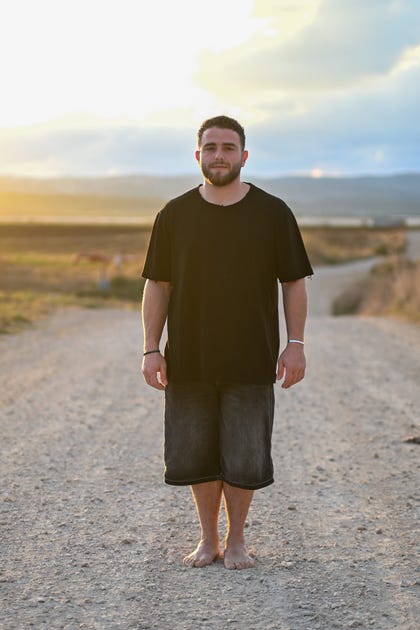
Ben Simon: “I started to isolate myself. I suffered from violent outbursts.” Credit: Rami Shllush
Ben Simon: “I started to isolate myself. I suffered from violent outbursts.” Credit: Rami ShllushAmbushed again and again
Then, for the first time that morning, they exited the APC, near the kibbutz dining hall. At that very moment, another force dismounted near them – and one of its soldiers immediately took a bullet to the neck. “The medic came and stopped the bleeding with his finger, and I put him in the APC.” Afterward, they began to move through the kibbutz on foot. There was one incident after another. Again and again they were ambushed, again and again they returned fire. “They pushed us to the limit, we had no grenades, and ammunition was running out. I replenished magazines from [the ammunition of] the wounded,” he says.
Near the kibbutz kindergarten, there was a particularly fierce battle. At the height of the commotion, a sergeant first class from another platoon in the battalion stood next to him. “Suddenly I hear on his radio that one of the soldiers is wounded and needs to be extracted. I look and don’t understand where he is, and then I suddenly identify him about a hundred meters from me. Insane fire was directed there,” he recounts, “I thought they were doing it because they wanted to kidnap him, so I ran to him. I felt the bullets whistling past me, flying over me. One of them hit the sole of my shoe, but didn’t penetrate.”
When he reached the wounded soldier, Ben Simon called his name, but there was no response. “I pulled him along with another soldier to a nearby fortified shelter. I removed the front part of his vest and checked his pulse. I felt something faint. I started to massage him, and after 10 minutes I understood that was it, he was no longer with us. His hands grew cold, his eyes closed.
“I removed the back part of his vest and saw an exit wound from a bullet and large amounts of blood. I covered his face, took his personal belongings from him and apologized. Afterward, I carried him about 250 meters, to the evacuation point.” His vest did not have a protective ceramic plate, Ben Simon learned later on. “He took a bullet straight to the heart, he didn’t have much of a chance.” Sgt. Guy Bazak was only 19. Four days later, he was buried in the military section at the Kochav Yair cemetery. “Every time I drive to the center of the country I visit him.”
 Close
Close
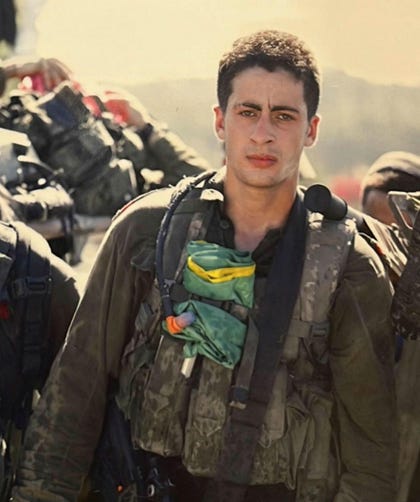
Sgt. Guy Bazak Credit: Courtesy of the family
Sgt. Guy Bazak Credit: Courtesy of the family
“It was a battle of few against many,” the military investigation into the Kissufim battle concluded many months later. “The chances of the soldiers of Battalion 51 and the [kibbutz] security squad members stopping the enemy’s attack were very low.”
According to the investigation, the first reinforcement force, from Battalion 450 of the non-commissioned officers school, arrived there only at 1:06 P.M. Ben Simon encountered them about an hour and a half later, around the time he met Sa’ar Margolis, who had been the kibbutz’s security coordinator for 11 years. About a year before the massacre, he left the position but remained a member of the security squad.
“I need a force,” Margolis told him. Ben Simon did not hesitate, even though he didn’t have much to offer. Two of his soldiers suffered combat shock, and another soldier evacuated them. The force under his command remained meager, and joined the force from Battalion 450 commanded by Staff Sgt. Adam Agmon. At 2:52 P.M., they departed.
 Close
Close
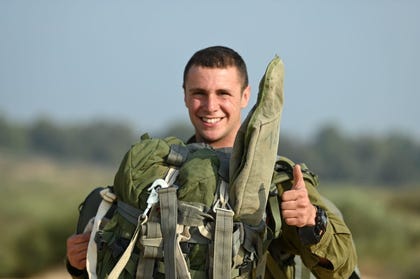
Staff Sgt. Adam Agmon
Staff Sgt. Adam Agmon
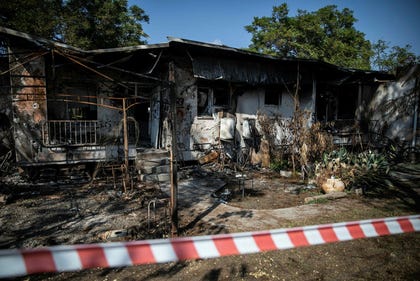
“We advanced through the kibbutz and saw several bodies of militants, and then the body of an Israeli civilian,” Ben Simon says. They continued to move and noticed a house consumed by fire. The military investigation revealed that it was the home of Ivan Illarramendi-Caesar and Dafna Garcovich. The fire left them no chance, and their remains were identified only about a month later.
The force continued on its way, trying to save whoever could still be saved. Next to the burned house stood the home of Kissufim’s current security coordinator. “Margolis told me, ‘I’ll go in from here, and you from the other entrance.’ Then he changed his mind: ‘No, actually, the other way around.'” Ben Simon complied, and Margolis and Agmon advanced toward the stairs. “I hear the door opening, and then a burst of gunfire.” Both were killed on the spot.
“I signaled to everyone to fall back because the guys from [Battalion] 450 were in shock, they still didn’t understand what they had gotten into,” Ben Simon says. “I started shooting at the house. I was terrified,” he admits. “One of the militants came out of the house and fired bursts at me. After I was discharged, I went back there and saw the bullet impacts; to this day, I don’t believe I survived it.”
Non-stop shooting
The shooting did not stop, and Ben Simon realized he had to change his approach. He decided to outflank the militants through the burned house, together with one of his soldiers. “I started firing in their direction. I knelt, and then I hear the sound of something rolling, and I spot a grenade. I immediately retreated.”
 Close
Close
Kibbutz Kissufim in the wake of the massacre on October 7. Credit: Hadas Parush
Kibbutz Kissufim in the wake of the massacre on October 7. Credit: Hadas Parush
Ben Simon returned to the kibbutz entrance and sought reinforcements to extract the bodies. A force from the Dekel Battalion of Bahad 1 [officers training school] joined the mission. They moved to the house, killed the militants inside and carried out the bodies of Margolis and Agmon on stretchers.
Ben Simon continued to encounter militants right up until the evening. He went from one encounter to the next without stopping. Only when the sun began to set did he return to his APC and meet his soldiers. “They made several rounds of evacuating the wounded and dead; everything was full of blood.” Afterward, they worked together to clear the nearby Kissufim outpost of militants.
In the days following October 7, they stayed in one of the kibbutz houses near the border. They ambushed militants who were still in the area. On October 12, the last militant was killed, and the kibbutz was cleared. The investigation revealed that about 150 militants from the Gaza Strip had infiltrated the kibbutz and outpost area. The army killed about 105 of them. The kibbutz became a memorial to the battle. “I looked around and felt my mind was messed up. The destruction remained, bodies everywhere, ash and dust.”
 Close
Close
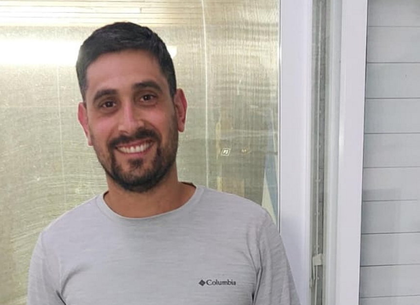
Sa’ar Margolis
Sa’ar MargolisNot the same person
In mid-October, Ben Simon and his comrades were transferred to a training base, and from there to a school in the town of Ofakim. There, for the first time, members of his family were given the opportunity to visit him. “I didn’t exactly process the situation, I had responsibility for my soldiers and was required to maintain composure. I didn’t express emotions, but inside I was broken.”
At the end of October, when the IDF ground maneuver began, Ben Simon entered the Gaza Strip. His platoon was positioned as the spearhead force of Division 36. They operated mainly in the Rimal neighborhood in western Gaza City. “We had encounters near the sea; it felt as if the militants were emerging from the water — it was surreal.” Afterward, they moved to the Zeitoun neighborhood, then to Shujaiyeh, and then to the Bureij and Maghazi refugee camps. Only at the end of December did Ben Simon go home, for the first time since October 1.
In those days, when he briefly returned to reality, he realized he was no longer the same person. The breaking point came in the evening, at nightfall. “I went for a drive with a friend in my parents’ car,” he recounts. “Suddenly I see a large van speeding toward me, trying to cut me off from the left. It honked at me, and everything came rushing back.” Ben Simon stopped and got out of the vehicle. In his hand, he held a crowbar he had brought with him from the Gaza Strip. He approached the driver and cursed him. “I almost broke his window.” A girl sat next to the driver and burst into tears. Ben Simon’s friend brought him back to the car, to the passenger seat.
“After a few minutes, I asked him, ‘Why are you driving?’ and he looked at me with a stunned expression. ‘Don’t you remember what happened? Are you crazy? Do you know what you just did?’ he asked, and I replied, ‘Not really.'”
Afterward, his friend recounted what had happened. “I didn’t believe it, at first I didn’t remember anything. It was as if a demon had entered me, I wasn’t myself.” His friend suggested he seek psychological treatment. He initially refused, but at some point, he relented. “The therapist told me: ‘You’re not in a good state, you must ask to see a mental health officer.'”
Kibbutz Kissufim. Hadas Parush
Meanwhile, Ben Simon returned to the army. His brigade, Golani, left Gaza and was transferred to the northern border. “I asked to see a mental health officer, but they strung me along. My condition worsened, I had violent outbursts, I was full of rage.” After his company commander refused to allow him to go for treatment, Ben Simon took his things and left, and has not returned since. “I was a deserter for a month, they called and threatened me with arrest.”
Eventually, with a bit of help from officers with connections, Ben Simon met with the division’s female mental health officer. “I told her everything I had been through, and she just started to cry. At the end of the meeting, she said I had PTSD.” She sent him to another mental health officer, who referred him to the Taatzumot center, which provides intensive treatment for combat soldiers dealing with PTSD symptoms. “I was there for four months, and they diagnosed me with severe PTSD. My condition didn’t improve, and they decided to discharge me from the army.”
Ben Simon is not the only one in his platoon to be discharged early due to his mental state. “Four of us, from the team that was in the APC that morning, were discharged. That’s fifty percent.”
In the days following his discharge, all the traumas began to surface. “I started to isolate myself, to cut myself off from friends. I suffered from violent outbursts, from dissociative episodes. My parents couldn’t provide me with a solution, but I understand them. It’s hard to see your child falling apart.” Ben Simon tried a wide range of treatments, but didn’t stick with most of them. “I hopped back and forth between psychiatrists and psychologists, but I felt judged. I couldn’t open up. The only treatment I have managed to stick with is Chinese acupuncture, it helps me.”
‘Feel betrayed’
At the same time he began seeking recognition for his condition with the Defense Ministry’s Rehabilitation Department. About four months ago, he appeared before the medical committee. “I told them everything, but I didn’t try to exaggerate,” he says. A week and a half later, he was informed that he would be recognized with a 40 percent disability for 10 years. The Rehabilitation Department’s new policy, revealed in Haaretz, is to minimize the granting of permanent disability status for PTSD sufferers as much as possible. Especially now.
“I felt betrayed,” he says, “I didn’t understand how it could be that after everything I went through, this is what they give me.” Since then, he says, his symptoms have only worsened. Flashbacks return and surge, and anger swells. “I am ashamed of my country, I feel like they spat in my face. Do you really think that after everything I went through, my mental disability will disappear? I can barely leave the house, certainly not work. I’m not asking for pity, just a safety net, and some peace of mind. That’s all. After everything I’ve given, don’t I deserve that?”