
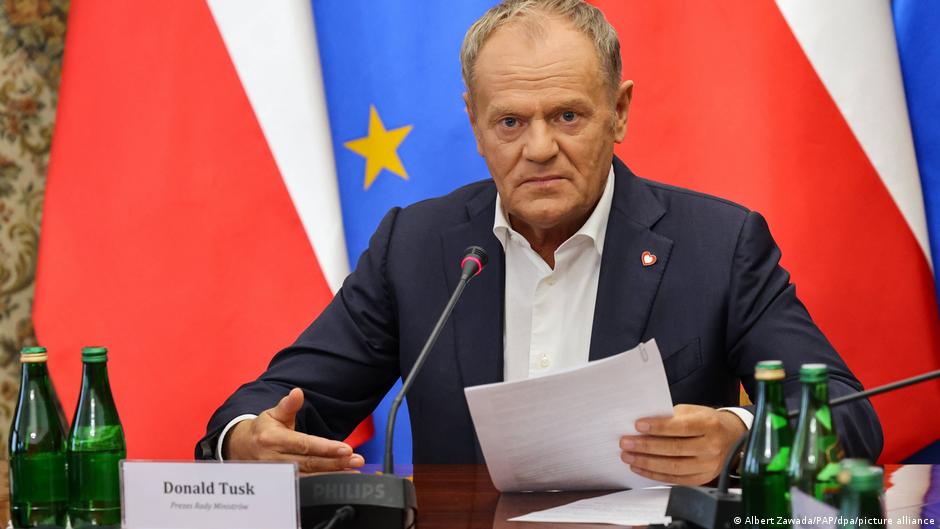
Authorities in Poland were meeting on Sunday to discuss a potential assassination attempt against Prime Minister Donald Tusk and Defence Minister Wladyslaw Kosiniak-Kamysz, Interior Ministry spokesperson Karolina Galecka said.
The emergency meeting at the Internal Security Agency’s (ABW) Counter-Terrorism Center was convened after police received information about a possible attack, Galecka said in a post on X.
While the nature of the apparent threat was not immediately clear, the meeting comes as Polish authorities are on high alert after a wave of violent attacks at schools in the country this week.
Poland, which borders Ukraine, has also been facing growing security threats from hybrid attacks by Russia in recent months.
What do we know about the school attacks in Poland?
Poland is reeling from three knife attacks at schools in just four days this week, which have left at least one person dead and injured many others, including children.
The first incident was on Wednesday, when a 19-year-old student at a vocational school in the central Mazovian province injured nine people when he attacked his fellow students and teachers with a sharp object.
A day later, a 15-year-old killed a school caretaker and injured two others at his former school in Leszczydol-Nowiny, also in the same province. Tusk said the suspect had worn a camera mounted to his helmet to film the attack.
On Saturday, a 21-year-old woman attacked an adult education school in Warsaw, wounding three other women.
Polish police have detained 117 people across the country for carrying knives or dangerous weapons, as well as for threatening to attack schools or students. Police checked 64,000 schools, most of them in central Mazovian province.
Police said Friday that cybercrime investigators have found no evidence that a social media challenge is fueling the wave of youth violence, or that the attacks were coordinated.
What did Tusk say about the attacks?
On Sunday morning, Donald Tusk said the attacks were “spontaneous actions” that were fueled by rising “glorification of violence” online.
“We are not dealing with any group organized on a big scale,” Tusk said during the government crisis meeting.
“In the past years and months, we have noted — globally and in Poland — a rise in the fascination with violence,” Tusk continued.
The prime minister blamed “nihilistic violence” for the wave of attacks, rather than a specific political ideology. However, he did acknowledge that “some of the people detained are active in the ultraright environment.”
Tusk added that authorities have observed an increase in online searches for Nazi or far-right content and for “mass killers who have become idols online.”
The prime minister pointed to a “civilizational phenomenon” of children becoming more exposed to violence online through video games or crime stories.
Tusk added that police checks would continue at schools across the country next week to make sure children who have been exposed to these stories of knife attacks do not “get stupid and unsafe thoughts” of perpetrating copycat attacks.
Edited by: Wesley Rahn
If you rely on our team for trusted reporting, please take a moment to select us as your Preferred Source on Google, so you’ll always see our verified news first.