
Kyiv’s drone operators are targeting critical components that are hard to repair because of international sanctions. The strikes are damaging Russia’s economy.
October 11, 2026 at 6:00 a.m. EDTJust now
On June 16, the Ukrainian military sent a wave of drones to attack one of the most well-defended oil refineries in Russia, on the southeastern edge of Moscow.
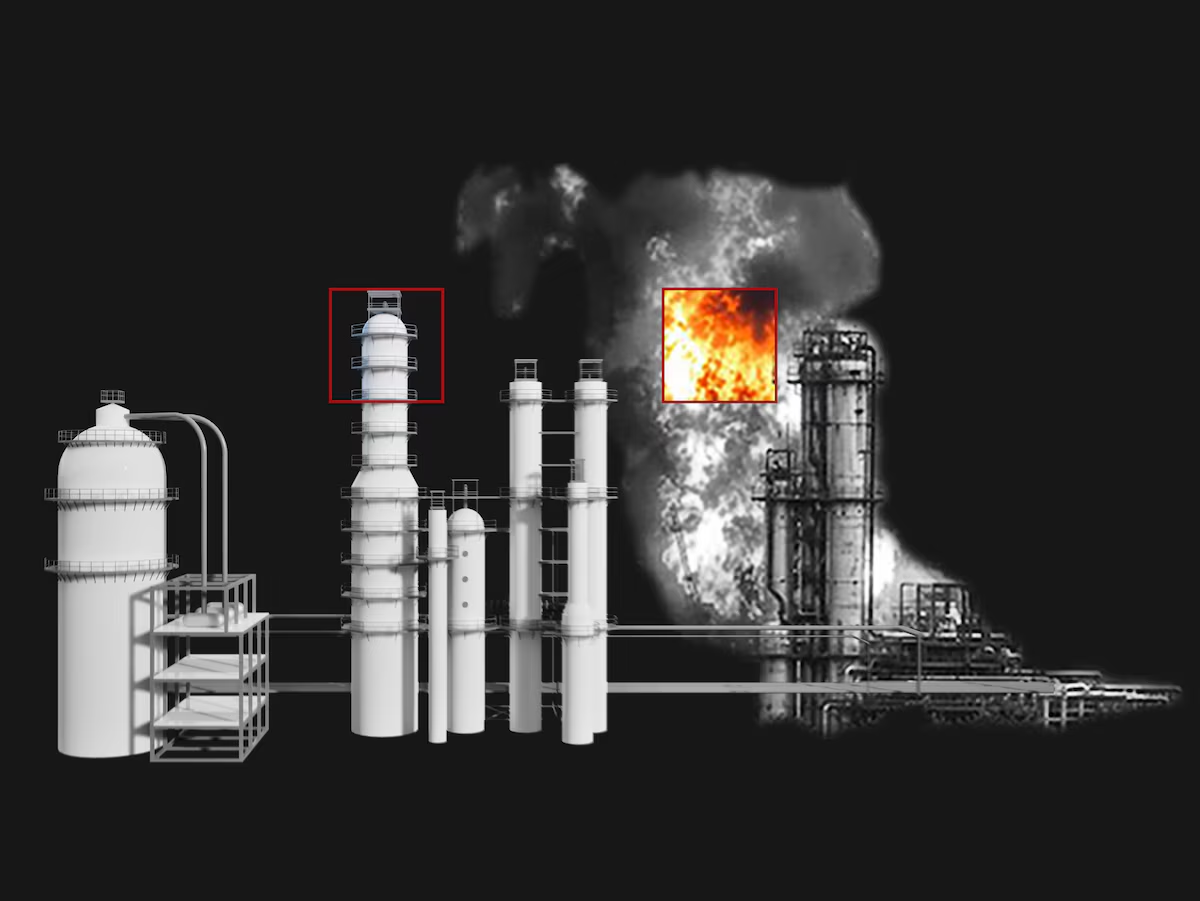
Videos of the aftermath show a cluster of tightly packed towers engulfed in flames. The target was no accident — it sits at the very heart of the refining process.
The flaming tower is part of a component most often known in Russian by the acronym ELOU-AVT, shorthand for an Electric Desalting and Atmospheric-Vacuum Distillation Unit.
Electric desalters remove water and salt from crude oil before it enters the distillation units, which separate the crude into discrete compounds — the first steps in the process of producing gasoline and other valuable fuels.
The strike, the first of two over several days, damaged one of the distillation units.
The strikes put the refinery out of service, and it remained offline as of September, according to Kpler, a global commodities data firm.
The Moscow refinery attacks were part of a concerted Ukrainian campaign to damage and destroy Russian refineries and other energy infrastructure, a strategy that Ukrainian President Volodymyr Zelensky has said is aimed at bringing the years-long war closer to an end.
The result is the worst fuel crisis in the country since the Soviet Union’s collapse. Major gas companies have limited the amount of fuel customers can buy, and the price of gasoline and diesel have both risen about 20 percent since the beginning of the year, contributing to nationwide inflation.
The military campaign has achieved such disruption in part by targeting critical refinery parts, notably the desalting and distillation units, that sanctions have made increasingly hard to repair, according to a Washington Post examination of satellite imagery and other visuals, as well as interviews with experts and Ukrainian military officials. The strikes on refineries have been aided by rapid advances in drone production and intelligence from allies that helps Ukraine plan and execute the attacks, the experts and officials said.
At least two-thirds of the 36 major Russian refineries tracked by market analysis firm S&P Global Energy were hit between April 1 and Aug. 31, some as many as five times, at a rate of one strike every three days, according to a Post analysis of a subset of Ukrainian strikes.
The Post reviewed scores of strikes and focused on those where satellite imagery of the aftermath was available and damage was evident. Three refinery experts reviewed the satellite imagery to identify which type of components were struck.
Of 54 strikes analyzed by The Post and reviewed by the experts, more than half appear to have damaged the desalting and distillation units, the examination found. More than one-third of the 54 appear to have hit nearby secondary processing units, which further refine the distilled materials into more valuable products like gasoline, jet fuel and liquefied petroleum gas.
“We aim at the most important parts of the oil refinery,” a Ukrainian drone battalion commander said in an interview with The Post. “We don’t need to hit the entire plant. We know where to hit so that it stops and does not recover.” He spoke on the condition that he be identified only by his call sign, Tango, in keeping with military rules.
The day after Russia invaded Ukraine on Feb. 24, 2022, the European Union banned the export of atmospheric-vacuum distillation and secondary processing equipment to Russia as part of a sweeping sanctions package. The United States followed days later and restricted export licenses for the same components, effectively banning their sale to Russia.
Those sanctions make it difficult for Moscow to obtain the parts necessary to repair units struck by Ukraine, said Alexander Kolyandr, the Europe director at the Eurasia Group and an expert on the Russian economy. “I don’t think that anything that’s been hit cannot be mended, the problem is the frequency of attacks is shorter than the time needed for repair,” he said.
Even if the units are repaired, repeated strikes stress the metal structures and render them more likely to fail catastrophically, said Sergey Vakulenko, a senior fellow at the Carnegie Russia Eurasia Center.
 Damage to ELOU-AVT units at various Russian refineries. (Vantor)
President Donald Trump has in recent weeks repeatedly expressed alarm about Ukraine’s attacks on Russian refineries, claiming that rising global diesel prices have been “mostly caused by the Russia/Ukraine War” rather than the war in Iran. On Friday, he announced that the U.S. would ease restrictions on the importation of Russian diesel fuel, effectively aligning Washington with Moscow and against Ukraine and its bombing of Russian energy infrastructure.
On Saturday, Trump lit into Zelensky for refusing to stop attacking Russian refineries. “He’d better damn well stop,” Trump told reporters. “It’s time for Ukraine to get a new president.”
Russian President Vladimir Putin acknowledged in an October public appearance that Ukraine had targeted Russian oil refineries in an attempt to damage the economy. “Did they achieve their goal? Partially, because, by our estimates, we lost about 1 percent of GDP,” Putin said.
He has pledged to improve the country’s air defenses, and his administration issued a decree allowing the state to take over privately owned critical infrastructure, including refineries, if owners can’t protect such properties or refuse to repair them. For the first time, the government has also begun to allow private companies to purchase and install their own air defenses.
The Financial Times previously reported on elements of Ukraine’s targeting of critical, hard-to-replace refinery components.
Mass Ukrainian drone strikes on Russian refineries began in earnest in August last year, according to data compiled by Tochnyi, an independent Ukrainian open source research group. The pace of strikes dropped over the winter months, as Ukraine and Russia met for multiple rounds of negotiations, then accelerated in April before reaching a new high this August, according to Tochnyi’s data.
Tango, the drone commander, said that while the Ukrainian military has targeted critical components at refineries since last year, it has found more success over time as “the intensity of the strikes has increased.” Tango serves in Ukraine’s 1st Separate Center of Unmanned Systems, which specializes in deep-strike operations — the long-range Ukrainian strikes targeting energy and military industry facilities deep inside Russia.
By the end of August this year, half of Russia’s total refining capacity had been knocked offline, more than twice the amount that was offline in late 2025, according to S&P Global Energy. As of early August, the volume of refined exports had fallen to half the volume at the same time in 2025, according to S&P.
Ukraine’s campaign has been aided by its growing ability to produce massive numbers of cheap drones and drone parts, which has enabled the military to deploy larger waves of drones in attacks, experts said.
One person involved in the deep-strike drone campaign, who spoke on the condition of anonymity because he did not have permission to discuss sensitive security matters, said that since last year Ukrainian forces have doubled the number of drones and decoys in each wave. Decoys, which carry no explosives, help confuse Russian air defenses and force them to waste ammunition.
“The ratio of success of drones is based on the decoys,” the person said. “If you don’t do this you will just lose quite expensive systems.” The person declined to comment on whether Ukraine is specifically targeting desalting and distillation units but said Ukrainian forces were generally targeting hard-to-repair parts of refineries.
András Rácz, a senior fellow at the German Council on Foreign Relations who has conducted research on drone operations in Ukraine, said that even if only 2 to 3 percent of the drones reach their target — a number he called “realistic” — they will inflict significant damage.
“The strike packages are just too large to defend,” he said.
The Ukrainian campaign has turned Russia’s size, historically one of its great strategic advantages, into a liability. Russian air defenses are spread thin, making it impossible for them to defend every refinery all the time, experts said.
Intelligence assistance from Western allies has helped Ukraine exploit gaps in Russia’s air defenses, according to experts and Tango, the drone commander. U.S. intelligence about the specific locations of Russian air defense systems and radars has been crucial in allowing planners to map routes that evade detection, according to a European security official, who spoke on the condition of anonymity because he was not allowed to discuss sensitive security issues. Such U.S. assistance has been previously reported.
The White House did not respond to a request for comment.
Ukraine is also able to mount attacks deep inside Russia by at times using high-altitude balloons to float drones before they deploy. This allows the drones to carry less fuel and more explosives, according to the European official and Deborah Fairlamb, founding partner of Green Flag Ventures, an American venture capital firm that invests in Ukrainian defense technology including drones. Artificial intelligence has helped improve Ukraine’s targeting, Fairlamb and Tango said.
In addition to targeting refineries, scores of other Ukrainian strikes this year have damaged fuel storage tanks and pumping and pipeline infrastructure across the country, making the transportation of fuel more difficult even as it becomes more limited, said Christina Harwood, a Russia researcher at the Institute for the Study of War.
Mary Ilyushina contributed to this report.
Methodology
For this investigation, The Post gathered information about strikes on refineries from three sources: Tochnyi, the independent Ukrainian open-source investigative group; the Institute for the Study of War, a U.S. think tank; and DeepStrike.live, an anonymous open-source collective.
Reporters independently used media reports and social media posts to collect additional information about the strikes, then cross-checked that information with the databases provided by the outside groups. They also searched for videos and photos of each strike and high-resolution satellite imagery to confirm damage.
An expert in geospatial analysis reviewed the imagery at our request and confirmed that damage was evident in 57 strikes between April 1 and Aug. 31. We asked three experts with experience in refineries and petroleum engineering to review the imagery to determine which parts of the refineries were struck. We eliminated three strikes from our analysis because of disagreement among the experts about which component was damaged. Shadows, condensation, complicated equipment and accumulated soot at refineries can make satellite imagery hard to read. In addition, refinery components are custom-configured according to the needs of each location, contributing to the difficulty of distinguishing one type of unit from another.
Of the remaining 54 strikes, 22 appeared to damage only desalting and distillation units, 14 appeared to damage only secondary processing units and six appeared to damage both types of units.
About this story
Design and development by Junne Joaquin Alcantara. Editing by Emma Brown and Nadine Ajaka. Copy editing by Briana R. Ellison.