

Want to bookmark your favourite articles and stories to read or reference later? Start your Independent Membership today.
Already a member?
Log in
Your support helps us to tell the story
From reproductive rights to climate change to Big Tech, The Independent is on the ground when the story is developing. Whether it’s investigating the financials of Elon Musk’s pro-Trump PAC or producing our latest documentary, ‘The A Word’, which shines a light on the American women fighting for reproductive rights, we know how important it is to parse out the facts from the messaging.
At such a critical moment in US history, we need reporters on the ground. Your donation allows us to keep sending journalists to speak to both sides of the story.
The Independent is trusted by Americans across the entire political spectrum. And unlike many other quality news outlets, we choose not to lock Americans out of our reporting and analysis with paywalls. We believe quality journalism should be available to everyone, paid for by those who can afford it.
Your support makes all the difference.Read more
Whatever marginal and transient impact on the price of a gallon of diesel that President Trump’s oil deal with President Putin may eventually yield, it will be dwarfed by the latest escalation of fighting in the Middle East.
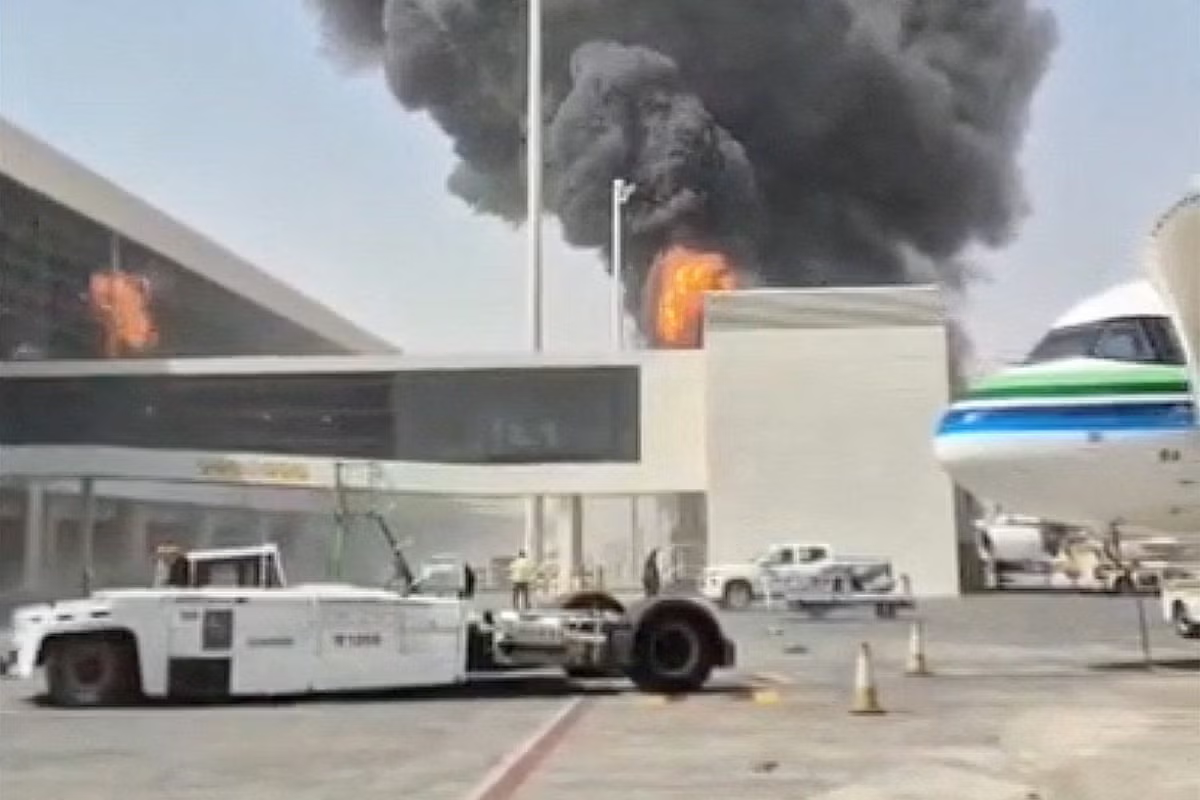
If, as seems likely, the attack by the Yemeni Houthi rebels on Riyadh airport leads to a widening of the various interlinked conflicts across the region, then the economic impact will be as wide and profound as the humanitarian tragedy that has already brought so much suffering, especially, once again, to the Palestinian people.
The Middle East is no stranger to terrorism and war; but now for the first time there is a clear danger of a conflagration drawing in players from Turkey to armed factions in Somalia as well as from Israel to Iran’s border with Pakistan. Ancient religious and racial divides are creating new alliances all armed with the new drone and missile technologies, and, in some cases, nuclear weaponry, either existing or within rapid development. What such an outbreak of a more generalised war would do to the price of a barrel of oil can only be imagined and feared. The economic consequences would be felt across the world. In brief, there would be an energy-driven upsurge in inflation, interest rates, sovereign debt crises (including the US), and recession.
This is why the Houthis’ successful strike on Riyadh airport is so significant at this point. It is because the long proxy war being fought by Iran and Saudi Arabia for decades on Yemeni territory was almost a private affair, mostly overlooked by the rest of the world. The Saudis and most other Gulf states backed the Yemeni government or some other group while the Iranians supported and armed the Houthi rebels, also known as Ansarullah (“helpers of Allah”). The Houthis are named after their late founder, and the fight for control of Yemen, and with it the entrance to the Red Sea and the Suez Canal, is but one contemporary emanation of the historic Shia-Sunni schism.
It bears repeating – because the White House cynically likes to pretend otherwise – that the current energy crisis and, in particular, the acute global shortage of diesel fuel is not primarily due to the targeting of Russian refineries by Ukrainian forces. It is, clearly, overwhelmingly caused by the Iran war, in which Mr Trump decided to join with Israel in February. That ill-considered decision then linked US-allies in the region such as Saudi Arabia to the continuing conflict between Israel and Iran, plus Iran-sponsored groups in the “axis of resistance” – Hamas, Hezbollah and the Houthis. Yet, as has been seen in a series of attacks on lightly defended bases, oil, shipping and infrastructure in and around Saudi Arabia, Qatar, the UAE, Qatar and Kuwait, the United States is in no position to defend its partners in the region, nor, at times, even its own military installations there.
The US remains the world’s single superpower with a vast nuclear arsenal and the most advanced weaponry anywhere; but it is demonstrably poorly equipped to deter a bunch of Yemeni gangsters with cheap drones and Toyota pick-up trucks taking over a strategic slice of the Arabian peninsular. Neither, on its own, is Saudi Arabia. Hence Riyadh’s decision to form a tripartite military pact with Turkey and Pakistan. As in Europe, so in the Gulf – America cannot be relied upon to look after its friends. If Ankara and Islamabad decided to deploy in the region, that would obviously broaden the tensions, and be an indirect challenge to Tehran – they share land borders. Meanwhile, the Houthis are deepening their links with the Al-Shabaab, militant Islamists in Somalia, and also prone to murderously asserting themselves in East Africa.
Such are the complex and unpredictable geopolitical consequences of America’s latest fatal entanglement in the region – precisely the kind of quagmire Mr Trump promised Americans was never going to happen again with him in charge. If things get worse it will make Vietnam, Afghanistan and Iraq look like tea parties. China, Europe, Russia and virtually every other power has an interest in the flow of oil and the economic damage caused by these inexorably widening wars. They have to be de-escalated. But how? And who, will do this? Asked about America’s response to the attack on Riyadh airport, and whether the US would join Saudi retaliatory air strikes, Mr Trump commented: “We may. We’re going to look at it. We just found out about the recent attack. So we’ll make a decision. We move very quickly.”
Perhaps. But it is difficult to see how America opening up yet another front, in Yemen, the Red Sea and Somalia would bring peace and stability. The Houthis never surrendered during their previous long and merciless experience of being carpet bombed by the Saudis, and there’s even less reason for them to do so against the US, because they realise that Mr Trump’s war is deeply unpopular in America, and they can see how US forces are experiencing overstretch and have failed to subdue Iran itself. Even if America just abandoned the region, the wars would continue, the fires now feeding themselves. Yet if Washington declines to act then the Saudi government will have little choice other than to ask Pakistan and Turkey for assistance (and even ask the same of Israel, albeit covertly). Yet again America is losing control of events, and finding itself trapped.
One thing is, unfortunately, very certain and that is that the world will probably enter 2027 with intensifying energy shortages and a widening war in the Middle East, which even a change in control of the US Congress on November 3rd will be unable to stop – simply because it’s now too late. So much, by the way, for the US and its “representative” Donald J Trump being awarded the next Nobel Peace Prize.