
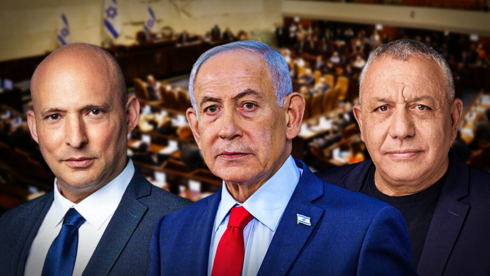
Former Prime Minister Naftali Bennett triggered a public clash within the camp seeking to replace Benjamin Netanyahu on Sunday after saying he would have no objection to the incumbent prime minister serving as a minister in a future Bennett-led government, provided he accepted a series of fundamental reforms. Within hours, three other opposition leaders rejected the prospect, insisting Netanyahu should have no place in the next cabinet.
Speaking at an election conference organized by the Hador newspaper, Bennett, chairman of the Beyachad party, said: “As long as we get our fundamental principles, I have no problem with Netanyahu serving as a minister in our government.” The statement came just over two weeks before Israel’s October 27 election, with the makeup of a possible alternative coalition a central point of contention.
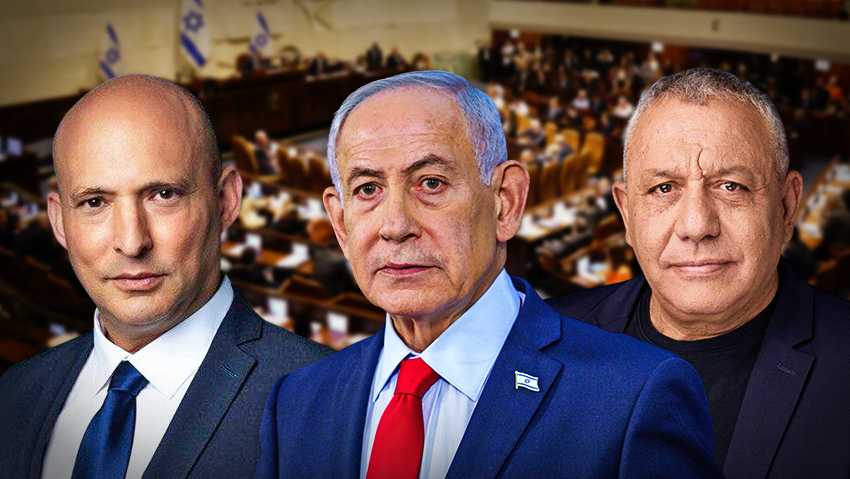
Bennett says he could appoint Netanyahu minister if he agrees to major reforms
(Photo: Beyachad party campaign, Shalev Shalom, Shutterstock)
“In 2003, Netanyahu, and I say this to his credit, was one of the best finance ministers Israel has had,” he said. “I don’t know whether a man approaching 80 still has the energy for that, but if he accepts all our central principles, including an immediate state commission of inquiry, conscription for everyone and a constitution for Israel, he should pick up the phone.”
Bennett gave no indication of contacts with Netanyahu or any offer of a portfolio. He made the possibility conditional on reforms that are central to the election campaign, particularly accountability for the October 7, 2023, Hamas attack and military conscription. But the suggestion alone brought a swift backlash from opposition leaders.
Eisenkot, Lieberman and Golan reject idea
Former IDF chief of staff Gadi Eisenkot, leader of the Yashar party, responded at the same conference. “I don’t accept that,” he said. “Anyone who was in office on October 7 is not fit to hold positions of command and leadership, including as finance minister.” His response rejected the idea that Netanyahu’s economic record justified a return to government.
Yisrael Beytenu chairman Avigdor Lieberman demanded that Bennett withdraw his statement. “I call on my colleagues in the Zionist bloc to make it absolutely clear: Even if the world turns upside down, we will not sit with Netanyahu,” he said. “In the next government, Netanyahu will not be able to serve even as regional cooperation minister.”
Yair Golan, a retired major general and chairman of The Democrats, issued an equally categorical rejection. “Netanyahu will not sit in any government as long as it depends on The Democrats. Not as finance minister, not as water minister and not as a minister without portfolio,” he said.
“The man responsible for the October 7 failure, who led a government that promoted mass draft evasion during wartime and the judicial overhaul, will not receive from us any approval to return to power,” Golan said. “We will not sit with Netanyahu and his partners. Period.”
Draft policy sharpens divide
Earlier Sunday, Bennett had taken a far more confrontational tone toward Netanyahu while unveiling what he calls a “service revolution,” a program intended to channel public money toward soldiers and reservists and away from Israelis who avoid military service. Bennett pledged to redirect 30 billion shekels from what he described as subsidies for draft dodgers to those who serve.
His proposal includes free daycare for reservists, 50% discounts on certain payments and a housing subsidy of 1 million shekels for eligible service members. He accused Netanyahu of funding draft evasion for political survival and warned that the IDF faces a shortage of 20,000 soldiers.
“A vote for Netanyahu and Deri, who promise another four years of state-funded draft evasion, is a vote that guarantees the next disaster,” Bennett said, referring to Netanyahu and Shas leader Aryeh Deri. “For 17 years, Netanyahu has funded draft evasion in exchange for staying in power. Netanyahu is dismantling the IDF, and he knows it.”
The contrast between that earlier attack and the later suggestion of a possible ministerial role for Netanyahu sharpened the dispute. The same issue Bennett made central to his campaign, military service for all, was one of the conditions he said Netanyahu would have to accept to join his government.
A fractured election landscape
Military service has also become a dividing line among smaller parties. Ofer Winter’s Amcha Yisrael party unveiled a proposal Sunday to increase pay for soldiers and double the salaries of combat troops toward the end of mandatory service, while allowing up to 25% of each Haredi draft-age cohort to be recognized as full-time Torah scholars, exempting them from army service.
Winter has repeatedly said he would recommend only Netanyahu to lead the next government. Yet Likud has launched a paid social media effort against Winter’s party, seeking to keep it below the electoral threshold. That campaign has prominently targeted Winter’s No. 2 candidate, Arab Israeli activist Yoseph Haddad, who, according to the earlier report, rejected efforts by Netanyahu’s aides to recruit him onto Likud’s Knesset list.
Taken together, the disputes leave the parties contesting the October 27 election arguing not only over the draft, accountability and political reform, but also over the composition of any government formed afterward. Bennett has now laid out conditions under which he would be willing to serve alongside Netanyahu; Eisenkot, Lieberman and Golan have made clear that, for them, a Netanyahu-free cabinet is itself a condition.