
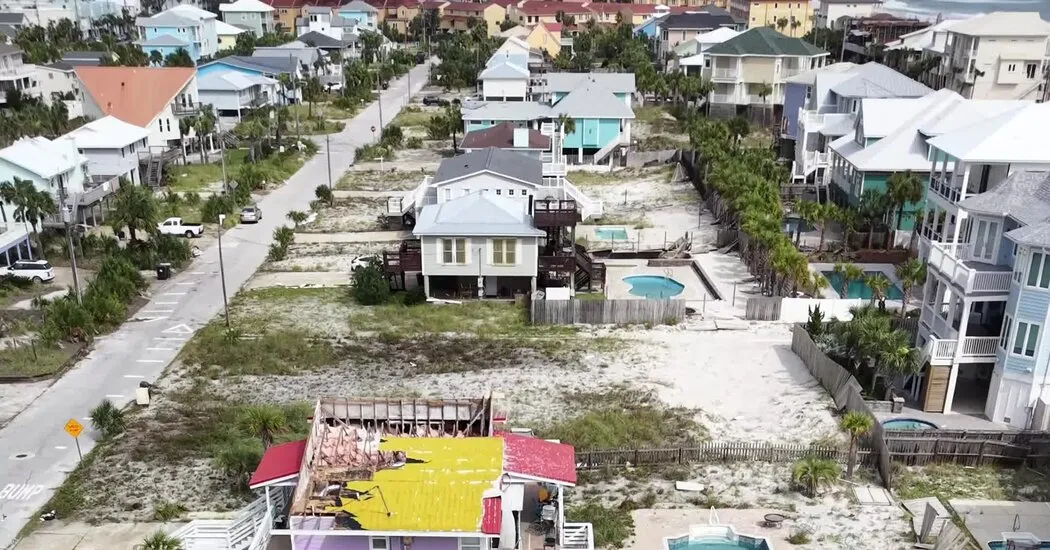
Hurricane Isaias lashed the Gulf Coast with downpours and heavy winds after it made landfall on the Florida Panhandle.
The storm left at least four people dead in Florida and Alabama, two of them after trees toppled onto their homes. Isaias had become powerful quickly, briefly reaching Category 3 strength, with winds up to 120 m.p.h., before it came ashore.
Its winds toppled trees and left shingles and siding shredded. Roads were flooded. Neighborhoods were littered with debris. Isaias was the first Atlantic hurricane of the season and the first to strike the mainland United States in two years.
As Isaias weakened, crews worked quickly to clear roads and bridges of debris. The damage was bad, but the flooding was not as catastrophic as residents of beachside towns had feared. In Destin, Fla., where the National Weather Service had warned of a storm surge between 6 and 9 feet of seawater, measurements on Saturday were closer to f4 feet.
Seasonal festivals and other weekend events were canceled along the coast, which had emptied of tourists. In Tuscaloosa, Ala., however, a highly anticipated football game between the University of Alabama and the University of Georgia on Saturday went ahead. (Georgia won, 20-17.)
At one point on Saturday, more than 900,000 people were without power in Florida, Alabama, and Georgia. By Sunday, that number had dropped to just over 350,000, according to the tracking site PowerOutage.com.
By Sunday, Isaias had weakened considerably and was moving inland as a post-tropical cyclone, sending damaging wind gusts, showers and thunderstorms to parts of the Mid-Atlantic and Northeast. Several tornado warnings had been issued in parts of the Carolinas.
Forecasters said Isaias was expected to dissipate over West Virginia by Sunday night.