
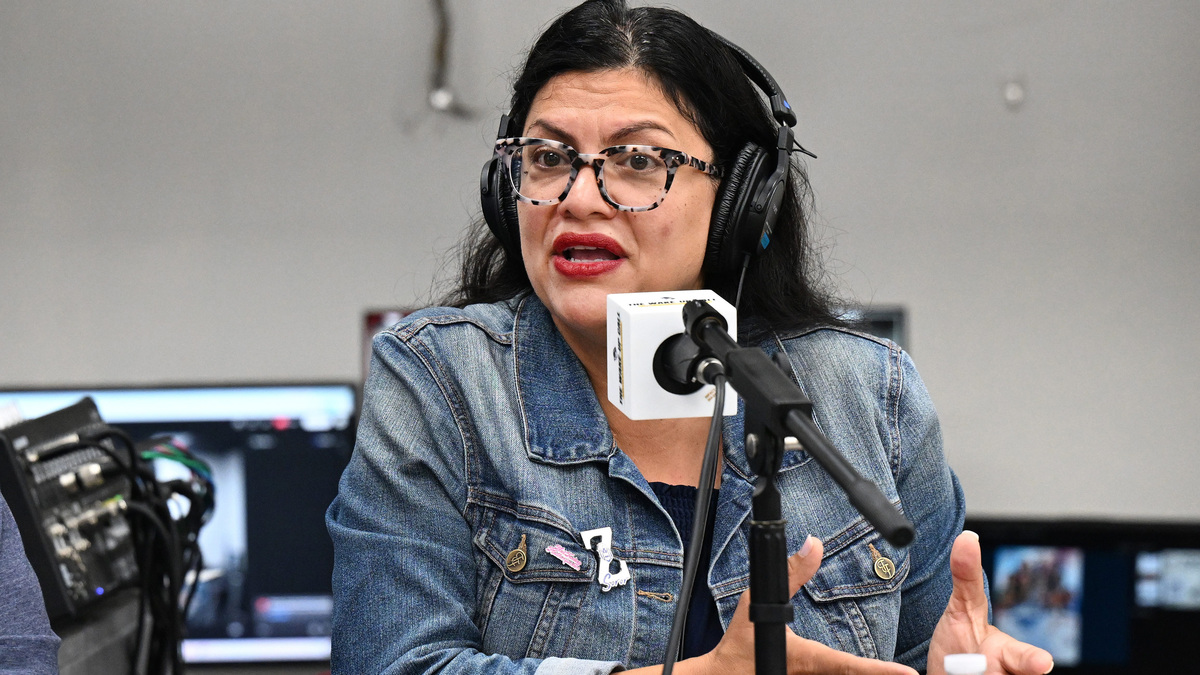
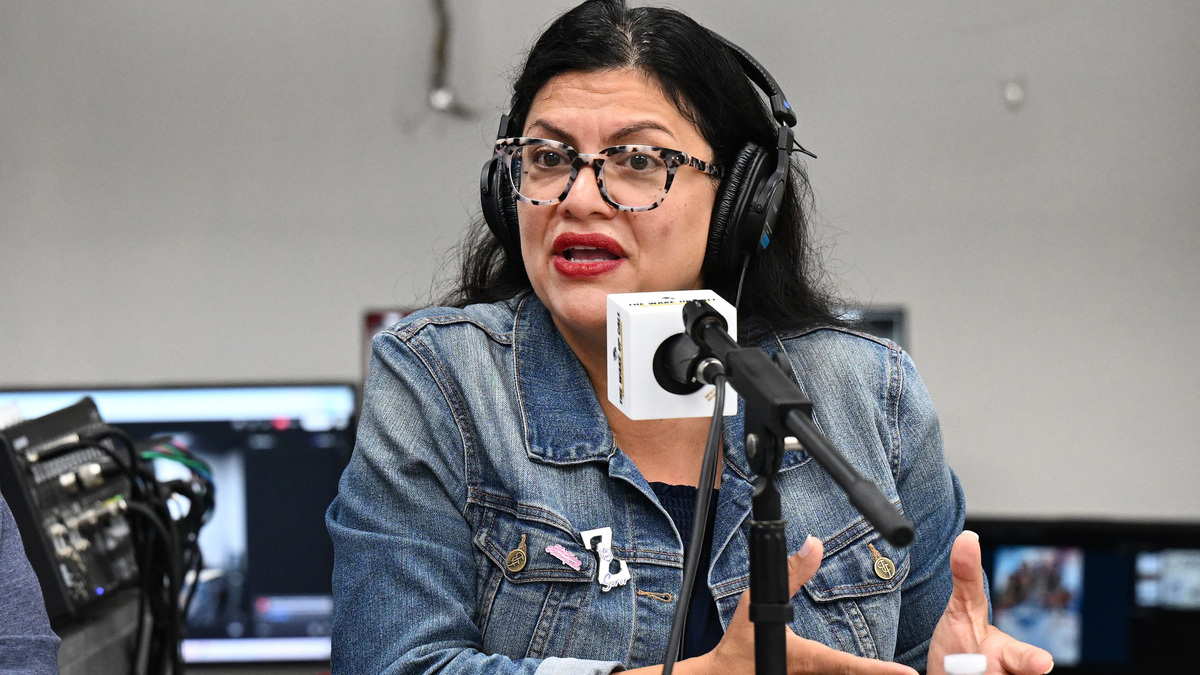
U.S. Rep. Rashida Tlaib, the only Palestinian-American in Congress and a fervent critic of the Israeli government, has sought to prevent state tax dollars from being used to invest in Israeli military technology and defense firms.
Jose Juarez, Special to Detroit
USA TODAY Network, Reuters
LANSING – Roughly $5.1 million has flowed through Michigan’s economic development agency since 2018 to a nonprofit organization that aims to facilitate economic collaboration between Michigan and Israel – an arrangement that has drawn public scrutiny in recent months.
The relationship between the state and the Michigan Israel Business Accelerator (MIBA), established at the end of Republican Gov. Rick Snyder’s time in office, has recently become a target of dozens of public comments, asking the state to end its partnership with the organization in light of the Israel-Gaza war.
Those complaints ratcheted up last month when the Michigan Strategic Fund announced it would award roughly $1 million to the U.S. entity of Capture Systems Ltd., an Israeli counter-drone company whose Michigan investments MIBA helped secure. Earlier this month, U.S. Rep. Rashida Tlaib, D-Detroit, said Capture “should not be receiving a dime of public funds.”
“When small businesses, many of them Black- and women-owned, are struggling in our state, there never seems to be money for them, but Governor Whitmer has funding for bombs that kill children,” Tlaib wrote on social media.
Both the Michigan Economic Development Corporation and MIBA said Capture Group Inc. is not manufacturing bombs. Whitmer’s office has not responded to requests for comment; the governor said in a press release announcing the grant that it would “help cement Michigan as the best place for cutting-edge research and development that moves our nation forward.”
Capture Group is one of several Israel-linked projects MIBA has helped secure over the years. According to its website, MIBA was instrumental in securing Michigan operations for manufacturing technology company SkillReal North America and wireless EV charging company Electreon, which has received $1.5 million from MDOT for a pilot program to create charging roadways.
The group also counts among its economic development wins a wood recycling operation in Muskegon, Daika Wood, and an autonomous driving tech company in Madison Heights, Mobileye, according to documentation submitted to the state.
MIBA’s work in Michigan has been aided by state leaders who have “understood the value of this economic partnership and the need to compete with other states that were working to establish their own partnerships with Israel,” said Mark Davidoff, chief executive officer for MIBA. The group has no formal relationship with the government of Israel and does not fund Israeli-based businesses, he said.
“MIBA has developed a proprietary approach to business development in Israel by forming long-lasting relationships and by selling Michigan in Israel on a consistent basis to opinion and thought leaders,” Davidoff said. “There are over 8,000 technological startups in Israel, and it takes a unique playbook to cover that landscape and zero in on the companies that have the right synergy with Michigan.”
Over the last several months, a group called MI Money Out of MIBA has organized groups of public commenters who have lined up at Michigan Economic Development Corporation meetings to urge the state to part ways with the Israel-linked organization.
The opposition coalition is made of several different groups, including Michigan Divest, which lobbied the State of Michigan Retirement System last year to divest from a $10 million Israel bond. Matthew Clark, a Detroit-based attorney who has helped lead the opposition, said the group is pushing back on MIBA largely because of the defense-based groups it has worked with.
Clark acknowledged that the state has also given grants to other defense-industry businesses not connected to MIBA or Israel. He said he’s generally not in favor of them.
“I’m certainly opposed to our economy being tied to the weapons industry, and many in our movement, we oppose many different wars that our country is waging and is involved in,” Clark said. “We’ve got to start somewhere. And I think Israel is unique in both its scope and its intervention in U.S. politics and our state politics. But also Israel, as a country, is tied so deeply to the oppression of Palestinians.”
How MIBA is funded
In its most recent contract with MIBA, the MEDC agreed to pay $650,000 toward the Michigan Israel Business Accelerator, bringing the tally in state support for the group between 2018 and July 2026 to $5.1 million, according to state treasury records. Those state funds, Davidoff said, are matched through private charitable contributions to the group.
The state funding over the years has come from a mix of Michigan Strategic Fund and Michigan Economic Development Corporation dollars, both of which are tasked with bringing jobs and businesses to the state. The MEDC said the payments toward MIBA have been a mix of taxpayer dollars and funds flowing through the agency’s corporate budget.
In 2024 alone, according to the group’s most recent tax return, the accelerator received roughly $900,000 in government grants.
The services provided to the state through the group, according to its 2026 contract, include the enhancement of “bilateral trade and investment relations between Michigan and Israel” and supporting the MEDC’s “strategic industries, small businesses and foreign direct investment in Michigan.”
That goal, this year, includes an effort to increase connections between Michigan and Israel businesses, an expansion of the Israel companies participating in MIBA’s “landing zone” and coworking community in Detroit and the completion of four trade missions between Michigan and Israel. MIBA must make a reasonable effort under the agreement to ensure technologies coming to Michigan from Israel are “additive” and don’t create direct competition with products already developed or sold by Michigan businesses.
According to its 2026 contract with the MEDC, MIBA must pay for all in-country travel, tours, hotel and meal expenses on an Israel trade mission for up to one MEDC staff member per delegation. The MEDC will pay for air travel for that staffer and all other expenses for other members of the MEDC attending the mission, according to the contract.
MIBA’s budget, as outlined in its 2026 contract with the state, sets aside about $75,000 for delegation support, another $100,000 for events, marketing, international travel and client hosting or entertainment, $105,000 for general administrative costs and $370,000 for personnel.
MIBA’s founding
While the accelerator predates 2018, it first began receiving regular state funding that year after Snyder attended a trade mission to Israel as governor. During that mission, Snyder said, he was convinced that Israel was the top place in the world for technology development outside of Silicon Valley.
“Israel has technology that’s incredible, and they have great entrepreneurs,” Snyder said in an interview with The Detroit News. “Their issue is markets.
“If you think about the natural marketplace for Israel, it’s not a large country, so they have to sell outside of Israel in terms of their technology,” Snyder added. “And I viewed Michigan to be a great gateway for them to establish a presence in Michigan to enter the U.S. market.”
Snyder said his initial vision for the state’s involvement was essentially to start a five-year, 50-50 partnership that could provide the seed money needed to make its efforts successful. After that five-year period, he said, leadership could reassess the ratio of state dollars.
“I think they’ve done some good things,” Snyder said of the MIBA.
MIBA has operated largely without controversy in the several years leading up to Hamas’ Oct. 7, 2023 attack on Israel and the country’s response in the years after. As the conflict progressed, spread and caused deep divisions over U.S. involvement, so did the calls for Michigan to separate itself from the Israel-linked group.
Last week, Snyder dismissed the protests against MIBA as being more tied to “political statements” than to economic development.
MIBA’s work
Last month, Whitmer announced Capture Group, a U.S. entity of Capture Systems Ltd., would receive roughly $936,000 in direct incentives for a $5 million business expansion in Sterling Heights. The company was described in a news release as creating “innovative, high-performance systems for the defense and homeland security sectors,” including advanced counter-drone systems and remote-controlled weapon stations.
The Michigan Business Development Program grant was awarded through the Michigan Strategic Fund and is separate from the $5.1 million MIBA has received since 2018.
The Sept. 2 announcement drew concern from an array of individuals, including Tlaib, who felt the investment could aid Israel’s efforts in the Middle East.
But Davidoff argued Capture specializes in advanced technology meant to protect people and does not manufacture bombs, weapons or explosives of any kind.
“The company specializes in defensive, counter-drone technology designed to protect critical infrastructure, first responders, and U.S. service members against hostile drone threats,” Davidoff said.
The Capture grant is not the only time the state has invested in or celebrated defense industry operations in Michigan.
Veptos, which assembles, repairs and modifies military armored vehicles, was awarded $5 million in 2025; Saab received at least $3.5 million in 2024 for a munitions assembly plant in Grayling; and CQT Weapon Systems was approved in June to receive $456,000 for an expansion that would “support precision machining, weapons assembly, UAV engineering and production, and technical training functions compliant with federal export regulations,” according to MEDC press releases.
American Rheinmetall, which creates tracked and wheeled military vehicles and subsystems, announced an investment in Auburn Hills while Whitmer toured a Rheinmetall proving ground in Germany last September.
MIBA also has highlighted its assistance to a variety of other businesses outside of the defense industry, including Daika Wood, Mobileye and Electreon, a company that installs inductive-charging coils in roadways so electric vehicles can charge while they drive.
Electreon won a $1.9 million contract with the Michigan Department of Transportation to pilot inductive charging in Michigan roadways, department spokeswoman Jocelyn Garza said. As of July, about $1.5 million of that contract has been paid out, according to treasury records.
MIBA also founded the Elevator in Detroit, an Israeli coworking community that offers office space and helps Israeli startups and companies establish connections in Michigan.
The pushback
At a Sept. 10 meeting in Lansing, dozens of individuals waited inside the MEDC executive committee meeting room to have a turn at the microphone during public comment.
Almost all of the few dozen people who spoke urged the executive committee to end its relationship with the Michigan Israel Business Accelerator, arguing, at times, that the funding for the group was akin to supporting the government of Israel. The message had become somewhat familiar for members of the executive committee, who had heard the comments again and again at recent meetings.
“MIBA is a highly inappropriate recipient of public funds,” said Jack Smith, a retired Michigan State University professor from Williamston, at the Sept. 10 meeting. “Because it aims to promote business development in the military and technology sectors with the country of Israel, whose current government engages in genocide.”
Attendees also criticized the fact that MEDC CEO Quentin Messer Jr. sits on the board of the accelerator, arguing his presence represents a conflict of interest. His appointment to the board is allowed under MIBA’s bylaws, which give the MEDC and governor the ability to appoint two members each to MIBA’s board. Messer is the only gubernatorial or MEDC appointee on the board, according to MIBA; the MEDC’s Director of International Trade Alyssa Tracey left MIBA’s board this year.
The statements made during public comment, Davidoff said, “are not based on facts and are fueled by other sentiments.”
“MIBA has no formal relationship with the Israeli government, nor does it provide funding to any Israel-based companies. We have one purpose,” Davidoff said, “drive economic growth in and for Michigan.”
Clark, who is Jewish, said the group’s actions are not “antisemitic” and called efforts to indicate as much “pretty tired” and “pretty thin.” The group is also supported by Jewish Voice for Peace – Detroit, he noted.
“I think the political leadership and the people who run things in our state have a lot of catching up to do in terms of the way that the public is changing in its viewing of this issue,” he said, referencing Israel’s influence in the U.S.
eleblanc@detroitnews.com
This article originally appeared on The Detroit News: Taxpayer support for Michigan-Israel biz accelerator draws scrutiny
Reporting by Beth LeBlanc, The Detroit News / The Detroit News
USA TODAY Network via Reuters Connect
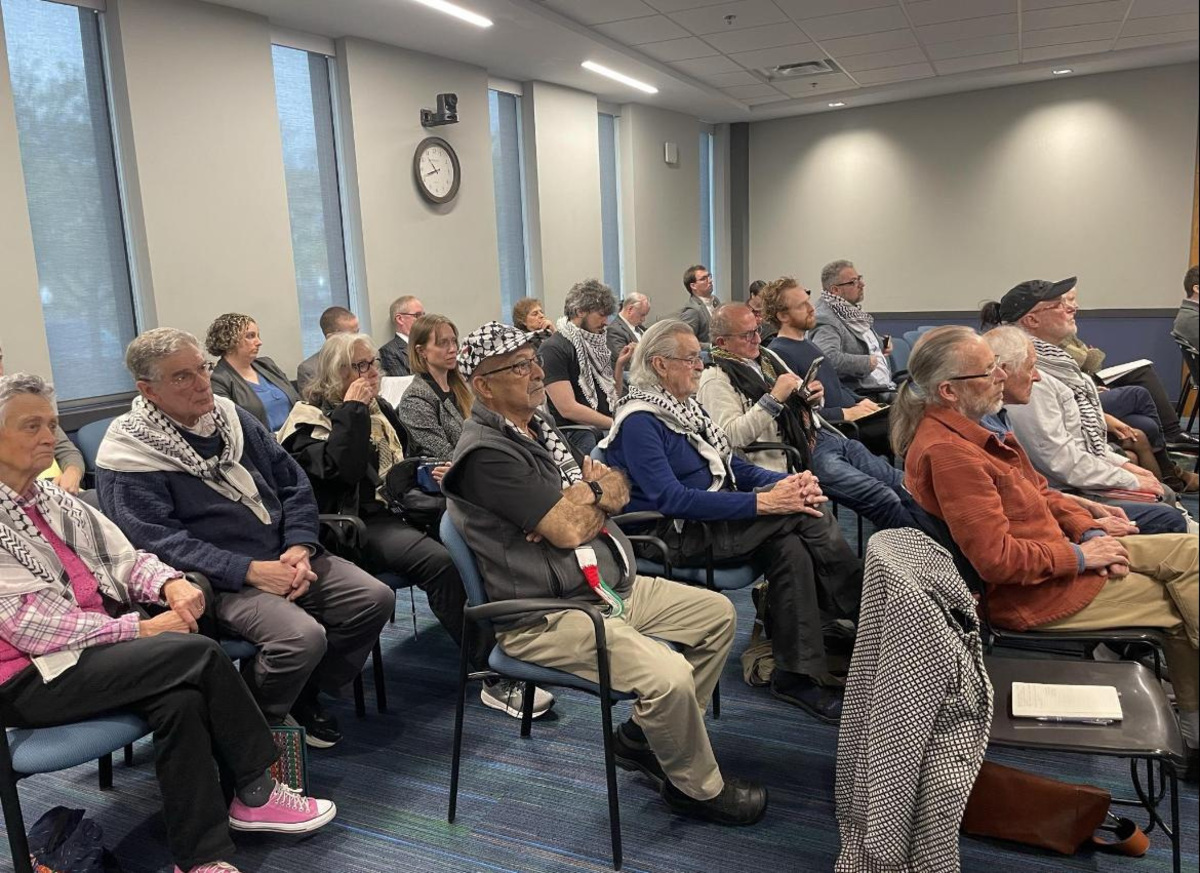 Individuals opposed to state funding for the Michigan Israel Business Accelerator (MIBA) wait to speak during public comment at the May 12, 2026 Michigan Economic Development Corporation executive committee meeting in Lansing. Submitted by MI Money Out of MIB USA TODAY Network, Reuters
Reuters_USATLocal_GANews
This story was originally published October 11, 2026 at 11:03 PM.