

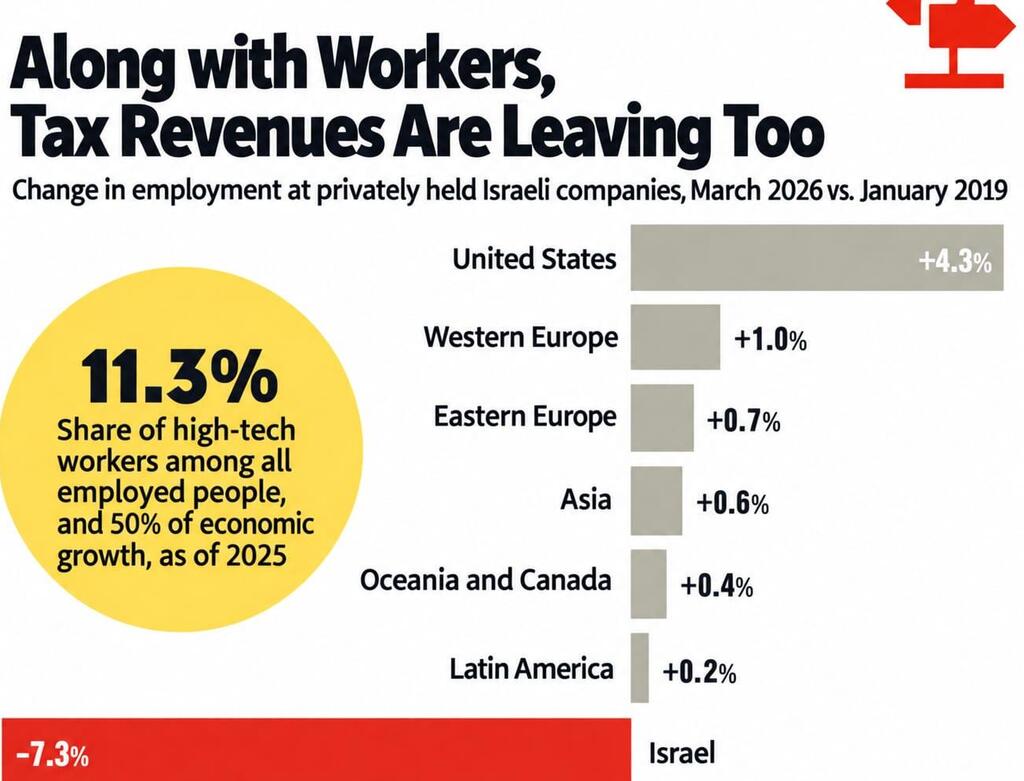
Israel’s high-tech sector employs approximately 12% of the workforce yet generates about 25% of tax revenues, even before accounting for one-off windfalls from deals such as the sales of Wiz, CyberArk and Armis, which inject billions more into state coffers.
The tax proposals now being considered in Jerusalem, put forward by the Tax Authority and the Ministry of Finance in recent weeks, reflect this complexity. One day, a proposal emerges to increase taxes on high-tech employees’ stock options by requiring them to exercise their options immediately upon vesting or face a higher tax rate. The next, Calcalist reveals a proposal that would move in the opposite direction: introducing an Israeli version of the U.S. Qualified Small Business Stock (QSBS) tax benefit, which exempts certain gains from the sale of startup shares. What explains this apparent indecision, and why has this flurry of initiatives emerged in Jerusalem now, just two weeks before the elections?
3 View gallery

The Wiz team at Nasdaq in New York
(Brandon Luckain: Lucky Shot Media – courtesy of Wiz)
The sector itself has been marked by a paradox in recent years. On one hand, startups and entrepreneurs are increasingly moving abroad, particularly to the U.S. and New York. In the previous decade, about 70% of new companies were incorporated in Israel. In 2024, that share fell to just half, with the rest incorporating in the U.S. Industry estimates suggest the trend continued into 2025 and will persist through 2026. More employees are relocating, while local R&D employment has stagnated, amid the growing use of AI tools, the rising cost of Israeli labor in dollar terms as the shekel strengthens, and continued war and political uncertainty.
Yet 2025, and by all indications 2026 as well, are shaping up to be excellent years for high-tech tax revenues. Stock markets are surging, employees are exercising options and selling shares, and companies are being acquired at a rapid pace. If Israeli high-tech continues to generate substantial tax revenues despite the challenging circumstances, why not squeeze a little more out of it, particularly when the state faces mounting defense costs?
In Jerusalem, the debate often swings between two competing impulses. On one hand, some voters, particularly among the current coalition’s base, favor extracting more taxes from the supposedly “hedonistic Tel Aviv crowd,” or at least denying it tax breaks. On the other, there is recognition that Israel should encourage its productive, entrepreneurial population to stay and grow, thereby expanding the tax base.
This tension was evident in 2024, when a provision offering tax incentives to high-tech companies was removed from the Arrangements Law at the last minute, only to be reinstated later. Now, the Tax Authority and the Ministry of Finance are once again floating proposals to test how far they can go.
3 View gallery
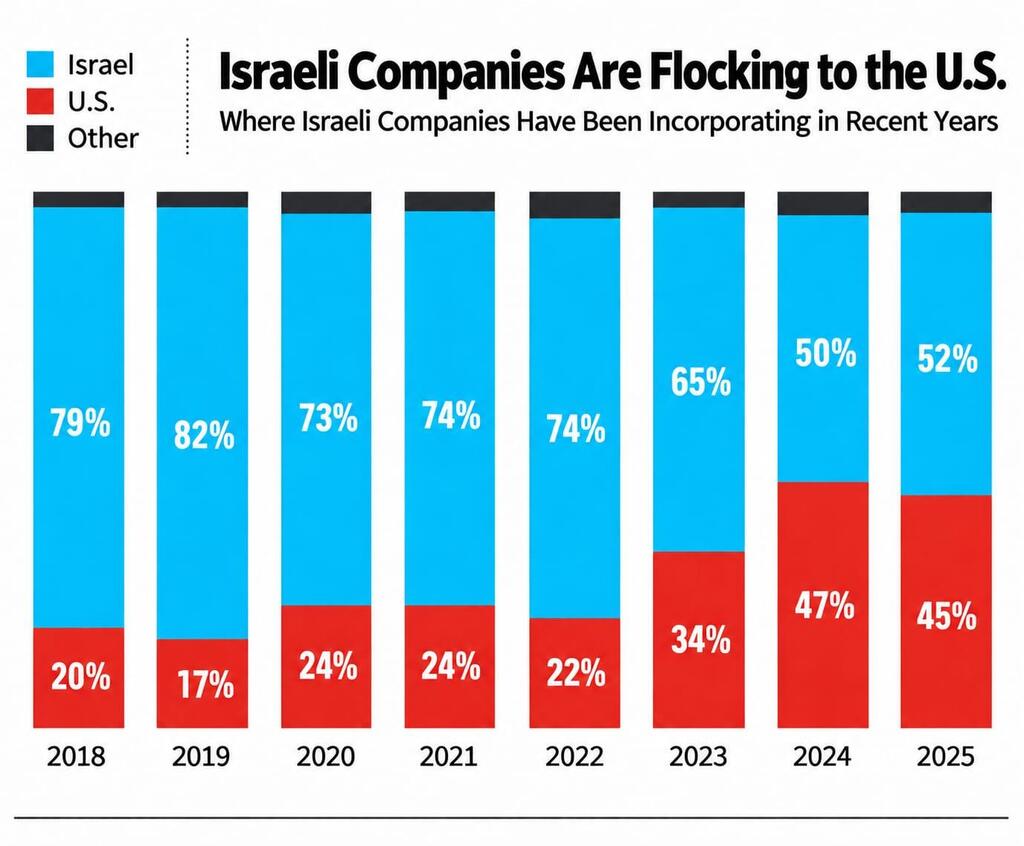
Israeli companies are flocking to the US.
(CTech)
“Somewhere between election economics and a joke”
“To the Tax Authority’s credit, it is the only government body acknowledging the problem of startups and entrepreneurs leaving the country and making a genuine effort to stem the trend. The QSBS track, a technical term for a tax exemption for entrepreneurs, emerged as the most significant factor in retaining entrepreneurs during discussions held since the beginning of the year between the industry, the Tax Authority and the Ministry of Finance. However, it remains unclear how they will manage to get it passed at all.
“That said, I wouldn’t call this ‘election economics,’ since very few high-tech entrepreneurs actually vote for Bibi,” says a senior figure in the local high-tech sector who participated in the discussions.
Others see it differently. “The recent initiatives by the Tax Authority and the Ministry of Finance feel like something between election economics and a joke,” Gidi Shalom Bendor tells Calcalist. He is the founder of S Cube, part of the IBI Capital group, a valuation firm and an expert in structuring employee stock option plans for the high-tech sector.
“It’s a case of taking with the right hand and giving back with the left. Taxes paid by high-tech workers account for a huge share of Israel’s total tax revenue, and the existing arrangement under Section 102, which allows employees to pay a 25% capital gains tax when they realize their gains rather than being taxed as wage earners at rates that can reach 50%, is a very significant benefit. It encourages Israelis to take the risks associated with working at a startup and to work harder,” he says.
“In contrast, the QSBS program, which offers a tax exemption on capital gains from share sales up to a certain cap, primarily affects entrepreneurs, since American investors are already exempt from paying taxes on investments in Israel. While such a tax benefit gives entrepreneurs another reason not to relocate to the U.S., a tax incentive alone won’t change their behavior. Its impact would be marginal, if any.
“Meanwhile, there is still no uniform policy on the pressing issue of taxation on secondary transactions, in which employees and early investors sell their shares on the private market. The authorities promised to issue a detailed circular on the matter by the end of 2026, but that hasn’t happened yet.”
Arik Kleinstein, founder of venture capital firm Glilot Capital, which specializes in cybersecurity investments and regularly meets entrepreneurs and employees at new startups, is also concerned that the Tax Authority and the Ministry of Finance are taking a scattershot approach to quickly boosting tax revenues from high-tech without considering the long-term consequences.
“The discussion needs to be purely professional, with zero populism. We must avoid the narrative of ‘let’s collect more taxes from wealthy high-tech workers.’ Instead, we need to think long-term about building a much larger base of taxable companies rather than focusing on short-term revenue maximization. You might collect an extra billion shekels in a single year, but more people and companies will leave Israel, something that is even easier and more tempting in the AI era than ever before.
“We need to recognize that we are competing globally and build a tax system that suits the ecosystem and bridges the current gap with the U.S. But we must do so seriously and thoroughly, avoiding knee-jerk reactions. We also need to reconsider institutions that may have become outdated or less relevant, such as the Israel Innovation Authority. What is its role today, given the vast amount of capital available for high-tech investment?” he asks.
“Israeli high-tech pays taxes that are disproportionate to its size, and employees pay significantly more in taxes than their counterparts in the U.S., where there is a strong emphasis on incentivizing startups.” In the U.S., he says, the tax burden includes a 15% federal rate plus the applicable state tax, while in Israel the burden is much higher, with tax brackets reaching 50% for many workers, capital gains tax of 25% to 30%, and a surtax. “One must be careful about how much this cow can be milked.”
3 View gallery
“Could create tension with investors”
Some have also warned that the QSBS program, welcomed by many in Israel’s high-tech sector as a positive development and a model for the country to adopt, could create conflicts within the ecosystem if introduced alongside the proposed tax measures targeting employee stock options.
Asaf Peled, CEO of Minute Media, points to a potential conflict of interest between founders and investors. An entrepreneur’s personal tax rate can be a critical factor in deciding where to incorporate a company. While the QSBS benefit could encourage founders to register a parent company in Israel to maximize their personal gains in an exit, foreign investors often prefer an international corporate structure, which they may view as offering greater stability and easier access to capital. This preference can become particularly pronounced during periods of political or security instability in Israel, when a foreign parent company may facilitate fundraising and an IPO.
Until recently, QSBS was a relatively obscure tax benefit. But in an era of increasingly frequent, relatively small exits, it is playing a growing role in efforts to encourage entrepreneurship. A little over a year ago, President Trump significantly expanded the benefit by shortening the required holding period from five years to three for a partial tax exemption, with a full exemption available after five years. The cap on eligible company assets was also raised from $50 million to $75 million, extending the benefit to more companies.
The incentive is particularly relevant to shareholders in smaller companies that are acquired relatively quickly. In such cases, founders and investors may qualify for substantial tax exemptions. The smaller the exit, the more significant the benefit can be in relative terms. For exits worth billions of dollars, the benefit is less consequential because the exemption is capped at “only” $15 million.
“There isn’t a single American venture capital fund operating in Israel today that doesn’t raise the issue of QSBS. It drives startups to incorporate in the U.S. and encourages entrepreneurs to relocate there, a move that is among the conditions for qualifying for the benefit,” Kleinstein says. “Ultimately, entrepreneurs who stay in Israel do so out of Zionism or family ties. From a purely economic standpoint, the U.S. holds a clear advantage today.”
Attorney Eyal Bar-Zvi, an international expert on transfer pricing at law firm HFN, also highlights the conflict created by the recent initiatives from the Tax Authority and the Ministry of Finance.
“While the state is trying to incentivize entrepreneurs by adopting the QSBS program, it is simultaneously seeking to increase the tax burden on employee stock options. The requirement to convert options into shares immediately, or pay a higher capital gains tax rate of 30%, up from 25%, severely harms employees who lack the means to cover the tax bill or pledge shares in private companies as collateral. It also creates unfair discrimination compared with employees of public companies.
“The result is a tax policy that offers generous financial incentives to individual entrepreneurs but risks creating friction with investors and undermining the high-tech sector’s primary engine of growth: its employees.”
The bottom line is that while tax changes may be necessary, taxation is not the only factor, or even the primary one, determining whether entrepreneurs and their startups remain in Israel. Industry figures say founders’ decisions are heavily influenced by the national mood and their confidence in the country’s stability.
Between 2015 and 2023, the atmosphere in Israel was highly positive. Most companies incorporated locally, and tax conditions were broadly comparable. Since then, Israel’s situation has deteriorated, while New York’s tech ecosystem has expanded significantly. Its smaller time difference from Israel, compared with Silicon Valley on the U.S. West Coast, also gives it an advantage for Israeli entrepreneurs. Meanwhile, tax disparities favoring the U.S. have become more pronounced.
Still, most industry figures agree that decisions are not driven by net tax considerations alone. “Entrepreneurs consult with accountants, lawyers and, quite often, peers who have already taken that step,” says Bendor, noting that roughly half of new startups are still incorporated outside Israel.
The decision, he says, is heavily influenced by the prevailing atmosphere and by a widespread belief within the high-tech sector that the election results, alongside a retreat from the judicial overhaul, could help bring startups and entrepreneurs back to Israel.