
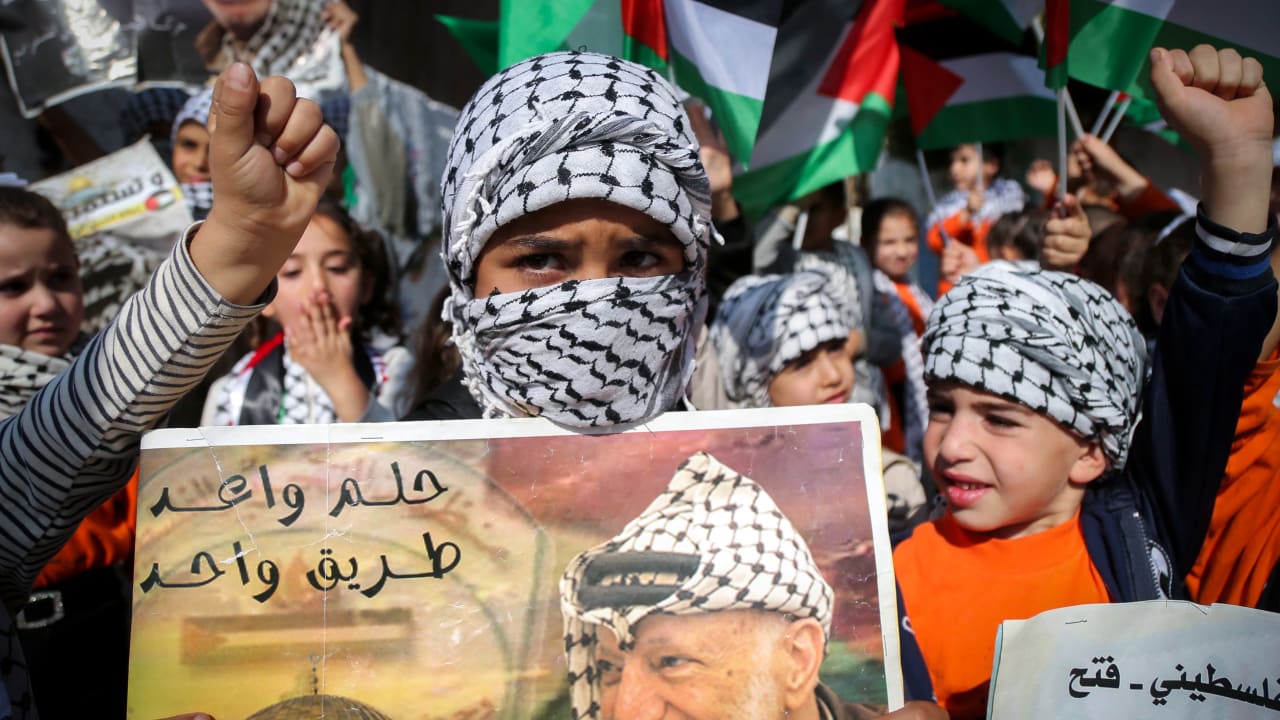
“We know the trap we have set for Israel by demanding a two-state solution,” Basel Abu Shahab, secretary of the Fatah movement in the Burj al-Shemali refugee camp in Lebanon, told Palestine TV over the weekend, adding that Israel “has reason to fear us.”
Abu Shahab, the son of Fatah Maj.-Gen. Jalal Abu Shehab, widely known as Abu Basel, said that within 20 years of a Palestinian state being established, it could develop an aircraft industry and an industrial sector capable of rivaling Israel’s, giving it the “components of a state capable of confronting Israel.”
“We know the trap we have set for Israel by demanding a two-state solution. But Israel understands why it does not want to give us a state: it knows what the future could hold,” he continued. “In my view, the establishment of a Palestinian state would mean the disappearance of the Israeli entity and the end of global Zionism or Freemasonry.”
Throughout the interview, Abu Shahab glorified the fida’i (Palestinian fighter) and portrayed past terrorist operations in a positive light, particularly Fatah’s abduction of Israeli watchman Shmuel Rosenwasser in 1969.
Fatah terrorists crossed into Israel from Lebanon and abducted Rosenwasser from his night-watch post in Metulla on December 31, 1969. He was held captive for over a year in Jordan before being released in March 1971 in exchange for Mahmoud Hijazi, a Fatah terrorist serving a life sentence in an Israeli prison.
Nostalgia for Fatah abductions, attacks
“The first Fatah operation involving the capture of Israeli soldiers took place in that area (Metula), led by the late Abu Ali Iyad, one of the Palestinian figures associated with the movement,” Abu Shahab said, speaking about how he was still able to look over the Israeli town from the Wazzani area. “You can see your village right in front of you, yet you cannot do anything to return to it.”
Although Abu Shahab expressed nostalgia for Fatah’s involvement in abductions and attacks, he acknowledged that handing over weapons to the Lebanese state had created a “historic opportunity” for Palestinians and Syrians in the Burj al-Shamali camp, allowing them to obtain permission to bring in construction materials to improve living conditions.
He argued that anti-Palestinian racism in Lebanon was evident in the conditions in the camp and the restrictions imposed on it, which he said had only grown more severe amid Lebanon’s security situation.
Without naming Hezbollah, however, Abu Shahab said there were “parties” who “embrace Palestinians, welcome them, and treat the Palestinian cause as one and the same as their own.”
Fatah invests in improving Palestinians’ image in Lebanon
Shahab said Fatah had invested in improving Palestinians’ image in Lebanon by funding Siraj al-Awda, a 133-member folk dance troupe that he said had “enabled us to enter areas that we could not otherwise have visited because of political sensitivities, including Kfar Shuba (a Sunni Muslim village) and other places.”
“Some Lebanese groups regard Palestinians as occupiers, but we were able to return to the embrace of the communities that had once welcomed the Palestinian revolution,” he claimed.
Shahab said that although Fatah can “operate” on Lebanese territory, the security situation has prevented it from holding a high-ranking meeting of the Palestinian National Council in Lebanon.
He also warned against individuals seeking to “exploit divisions” and “turn people against members of the Fatah movement.” To counter these efforts, he urged Fatah members to refrain from criticizing their leader, “even if you believe that he does not possess all the qualities a leader should have,” arguing that unity was essential to strengthening the movement.
“The road ahead of you is difficult. You must always understand that you are being targeted,” Shahab told Fatah members. “There is a saying in popular culture: when the arrows are directed at you, know that you are on the right path… God has protected [Fatah]. And why has God protected us? Because of the blood of the martyrs and the souls of those who sacrificed their lives. Their presence and their sacrifices continue to protect the Fatah movement.”