
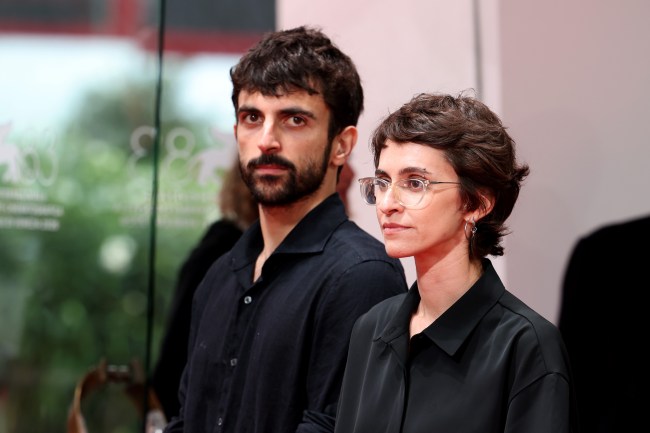
Yuval Abraham and Rachel Szor were among the four directors of No Other Land who won Best Documentary Feature at the 2025 Oscars. Their new documentary, Naza, won the Special Jury Prize at the Venice Film Festival last month, after a premiere that drew a record-breaking standing ovation.
But the two Israeli filmmakers say they can’t go home right now. In an interview on The New York Times podcast The Daily on Monday, Szor described the reaction in Israel, where the film hasn’t been released yet.
“It has been intense. The response to the film has been extremely aggressive,” Szor said. “Demonstrators outside my parents’ home were calling for us to be hanged. There has been a great deal of violence directed toward us. But I also feel that the film has sparked a conversation about what we have done — and what we are doing — in Gaza. For the last two years, there has not really been a conversation about this in Israeli society. We made this film in Hebrew, with testimony from Israeli soldiers, because we want to reach Israeli society.”


Abraham said those conversations are what he’s holding on to. “Part of the reason we made it was to try to make sense of the extremely large number of civilians killed by our country, Israel, in Gaza. But this is not an easy situation,” he said. “We want to go back home to Israel, but we cannot go back right now. Netanyahu recently said that our film was like ballistic missiles being targeted at Israel. There is a total atmosphere of incitement. There have been so many death threats that our parents and friends are telling us not to return. They say it is not safe for us.”
According to The Daily, Prime Minister Benjamin Netanyahu has also proposed legislation that could revoke the filmmakers’ citizenship.
Naza looks at the Israeli army’s methods in Gaza after the Hamas attacks of Oct. 7, 2023. The film features testimony from 24 anonymous military intelligence officers and soldiers, whom Abraham interviewed at night on rooftops in Tel Aviv. Its title comes from the language those officers use on the job.
“Naza is short for two Hebrew words that can be translated as ‘collateral damage’ or ‘incidental damage,’” Abraham explained. “Israeli intelligence officers use the term to describe the number of civilians they expect to be harmed in a particular airstrike. It is a euphemism — a substitute for saying ‘human beings.’ If an airstrike is expected to kill 15 civilians — women, men or children who are not the target, but whom the army knows may be killed or injured — the officers do not say ‘15 people.’ They say ‘15 Naza,’ or ‘20 Naza.’”
The Israeli military has rejected the film’s claims. In a statement cited on the podcast, it said the documentary presents “a distorted, misleading and disingenuous picture.” It also said commanders work to assess and reduce harm to civilians, legal advisers review proposed airstrikes, and alleged violations are investigated.
Despite the backlash, Naza is finding an audience. The documentary, which is being released independently with no distributor, expanded to 85 North American theaters in 30 cities over the weekend. The film has already passed $500,000 domestically, averaging $4,450 per screen. It has grossed nearly $4 million worldwide.
When asked what their lives will look like if they return to Israel, Abraham said he didn’t know.
“I think we will eventually go back, and I hope to continue working as a journalist and filmmaker. If I cannot walk as freely as I once did in certain parts of Israel, perhaps that is a price I will pay. I am not the only person paying a price for my work. Other people are paying much heavier prices,” he said. “I do not want to present myself as a victim. We did something we believe is important and true, and we believe people should see it. Sometimes that work comes with a price.”
Szor added, “I want the place where I was born to be somewhere people are not dying every day, surrounded by violence and fear. Israel and Palestine can be better places. I do not think there is a future for anyone without an honest reckoning with the present and the past.”