
WARSAW – Polish prosecutors said Monday that NSO Group, the Israeli manufacturer of Pegasus spyware, retained technical access to sensitive surveillance data collected by Poland’s anti-corruption bureau, raising new questions about Warsaw’s reliance on Israeli security technology as Turkish defense companies expand their presence in Poland and across Europe.
For more stories from The Media Line go to themedialine.org
Prime Minister Donald Tusk called the findings “a crime against the state,” accusing his predecessors of allowing an Israeli company and potentially Israeli intelligence to gain access to sensitive information about Polish citizens, opposition politicians, and independent prosecutors.
The findings emerged on the opening day of the Warsaw Security Forum, where Polish defense strategist Jacek Bartosiak identified Turkey, rather than Israel, as one of Poland’s principal security partners.
“Let’s not cry about it,” Bartosiak told The Media Line when asked about Israel’s reluctance to supply Ukraine with weapons. “Our key allies are Ukrainians, Swedes, Finns and Turks.”
The Pegasus revelations add another complication to Polish-Israeli relations, already strained by disagreements over Israel’s conduct in Gaza and its policies toward the Palestinians. Yet Poland continues to purchase Israeli defense systems, illustrating the competing political and military considerations that shape European arms procurement.
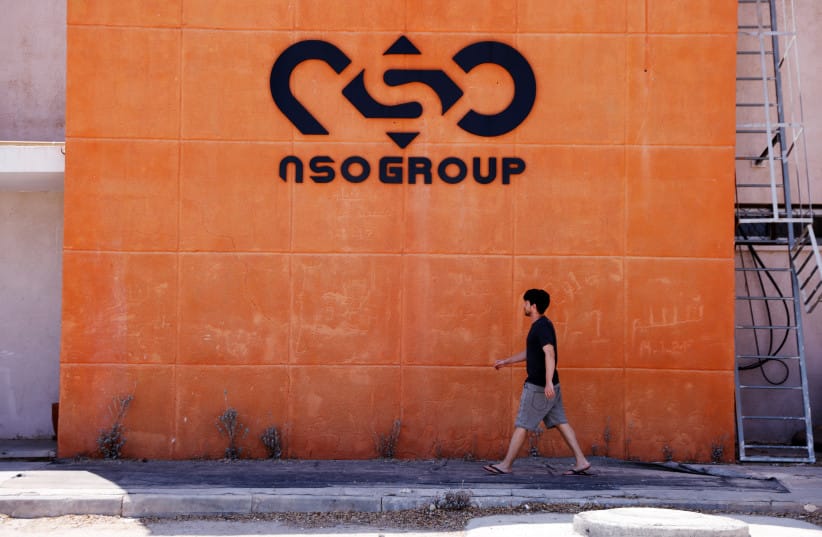 A man walks past the logo of Israeli cyber firm NSO Group at one of its branches in the Arava Desert, southern Israel July 22, 2021 (credit: REUTERS/AMIR COHEN)
According to Poland’s National Prosecutor’s Office, experts from the Internal Security Agency, known as ABW, determined that the Central Anti-Corruption Bureau, or CBA, “did not have full control over the Pegasus system.”
The bureau lacked passwords to some administrative accounts, while the server module responsible for infecting mobile phones remained under NSO’s “exclusive control.” Data collected through the system traveled through servers outside Poland that the bureau could not control.
Investigators found that NSO had the technical ability to access intercepted material, but they could not establish whether the company actually examined information collected during specific surveillance operations.
Tusk went further, saying it was “beyond any doubt” that NSO cooperated with Israeli intelligence. In a video posted on X, he accused the previous Polish government of surrendering control over sensitive surveillance information to an Israeli company and potentially the Israeli state.
His assertion that information reached the Israeli side goes beyond what investigators established about access to specific intercepted records.
A parliamentary commission investigating Pegasus presented its findings the same day and announced that it had prepared 11 criminal referrals. Its chairwoman, Magdalena Sroka, said the CBA had purchased and operated the spyware without the required security accreditation.
According to the commission, judges who authorized surveillance operations were not informed that Pegasus could extract virtually the entire contents of a mobile phone.
Poland acquired Pegasus in 2017 under the Law and Justice government, known by its Polish abbreviation PiS, using money from a Justice Ministry fund intended to assist crime victims and combat crime. The system was subsequently used to monitor hundreds of people, including political opponents. Tusk disclosed last year that his wife and daughter were among those affected.
In February, prosecutors charged former heads of Poland’s internal security and military counterintelligence agencies over their roles in approving the system. Both deny wrongdoing.
PiS maintains that Pegasus was necessary to fight crime and that its use was authorized by courts. Former CBA chief Ernest Bejda disputed Monday’s findings, denying that Israeli authorities had obtained Polish surveillance data.
NSO Group has previously maintained that its government customers operate Pegasus and control their surveillance activities. The company has not publicly responded to the latest Polish findings.
The controversy comes at a difficult time in relations between Warsaw and Israel.
In August, Poland summoned Israel’s ambassador after Israeli military authorities discontinued their investigation into the 2024 killing of Polish aid worker Damian Soból in Gaza. Warsaw also condemned Israel’s seizure of a United Nations facility in East Jerusalem.
Poland, alongside Britain, France declared restrictions on trade with Israeli settlements in West Bank.
In September, Poland joined 11 other countries, including Britain and France, in declaring their intention to introduce, support, or consider restrictions on trade with Israeli settlements in the West Bank.
The political disagreements have not ended defense cooperation. In July 2025, Poland signed a contract worth approximately $110 million for 18 coastal-surveillance radars from Elta, a subsidiary of Israel Aerospace Industries, to detect ships and low-flying threats over the Baltic Sea. Deliveries are scheduled for 2027 and 2028.
Polish forces also use Israeli-designed Spike anti-tank missiles manufactured under license by the Polish company Mesko.
Bartosiak, founder of the Warsaw-based Strategy & Future think tank, said the Pegasus affair was unlikely to significantly change Poland’s purchasing decisions.
“Right now, Poland is not buying too much of Israeli security, and I’m not sure if it’s going to change,” he said.
Future contracts, he added, “will depend on the capabilities on the battlefield” and on the “European stance towards Israeli policy. So there is a political problem here.”
The Warsaw Security Forum, held October 12 and 13, brought together political leaders, military officials, diplomats, and defense specialists to examine the war in Ukraine, Russia’s threat to European security, and questions about continued American involvement in the continent’s defense.
Ukrainian President Volodymyr Zelenskyy addressed the gathering by video, accusing Russia of attacking Ukrainian energy infrastructure despite President Donald Trump’s announcement of a ceasefire covering such targets.
Israel’s position on Ukraine remains a source of frustration for some European security experts.
Prime Minister Benjamin Netanyahu has resisted supplying Kyiv with weapons while maintaining relations with Moscow, which historically helped Israel conduct military operations in Syria. In July, The Washington Post reported that Netanyahu had blocked the transfer of American-owned Iron Dome missile-defense batteries to Ukraine because of concerns that the technology might eventually reach Iran.
The forum nevertheless included an Israeli-founded defense technology company. Heven AeroTech, established in Israel in 2019 by former Israeli army reconnaissance commander Bentzion Levinson, is now headquartered in the United States and manufactures hydrogen-powered drones, with operations in Israel as well.
Levinson joined former Ukrainian Prime Minister Oleksiy Honcharuk for a discussion of drone warfare and the lessons emerging from the Russia-Ukraine conflict.
“We’re looking at an era of drones,” Levinson told the panel. “Ukraine is amazing. Russia also became very close,” he said.
He argued that other countries had fallen behind and needed to accelerate development and production. Manufacturers willing to establish local operations in Europe could gain access to military customers, he added.
The importance of drones to European security is creating opportunities for Turkish manufacturers, whose products have gained international attention through their use in Ukraine and other conflicts.
Turkey has also developed a substantial defense relationship with Poland.
At the MSPO defense exhibition in September, Turkish electronics manufacturer ASELSAN signed an agreement with Polish armored-vehicle producer AMZ-Kutno to supply additional reconnaissance and surveillance systems. The deal followed a $410 million electronic-warfare contract ASELSAN won in December 2025.
During the same exhibition, Turkey’s state-owned arms manufacturer MKE and Poland’s PGZ defense group signed a memorandum concerning TOLGA, a Turkish counter-drone air-defense system.
Poland also purchased 24 Turkish Bayraktar TB2 armed drones in 2021, becoming the first European Union member and the first NATO member outside Turkey to acquire the system.
Bartosiak viewed these relationships through the longer history of Polish and Turkish efforts to counter Russian power.
“Turkey is deterring Russia from expanding into the Middle East, Mediterranean, Black Sea,” he said. “We have been having wars against Russia for many centuries. So it’s always about Poland and Turkey together.”
He also argued that Poland’s strategic interests were closely tied to the security of Ukraine and its northern European partners.
“Everything that strengthens them strengthens us. Everything that weakens them weakens us,” he said.
The growing Turkish presence in European defense markets, however, does not mean that Ankara faces no obstacles.
Security Action for Europe, or SAFE, the European Union’s €150 billion defense loan program, is designed to strengthen European manufacturing and joint military procurement. Poland is its largest recipient, with an allocation of approximately €43.7 billion.
The program imposes restrictions on components originating outside the EU, the European Economic Area’s European Free Trade Association countries, and Ukraine. Such components generally cannot exceed 35% of the estimated component cost of eligible defense products.
These rules create difficulties for Turkish and Israeli manufacturers seeking access to EU-financed contracts, although partnerships and manufacturing operations within Europe may provide ways to participate.
Greece and Cyprus have also opposed expanding Turkey’s access to European defense initiatives.
Suat Kınıklıoğlu, a former Turkish parliamentarian and senior foreign policy analyst in Ankara, said Turkey regarded Poland as a partner rather than a rival.
“Turkey doesn’t see Poland as a competitor. On the contrary, we value our relationship with Poland,” he told The Media Line.
“Historically, we always valued Polish independence and continue to see it as a key country in countering Russian influence in the region.”
Turkish manufacturers, he said, were finding ways to work with European partners despite regulatory restrictions, including “by setting up companies in Europe or bilateral cooperation agreements such as with the Italians.”
“We Turks are very much disappointed by this exclusionary approach at a time when Europe needs a stronger [Turkey] by its side,” he said.
Turkish defense manufacturers are already establishing a stronger industrial presence inside the EU.
Drone maker Baykar’s joint venture with Italy’s Leonardo became operational in July, while armored-vehicle manufacturer Otokar is working with Rheinmetall’s Romanian unit on local production of Cobra II vehicles ordered by Romania.
Spain offers another example of Turkey’s growing position in the European defense market.
Madrid has canceled plans to purchase new Israeli-designed Spike anti-tank missiles and moved away from Israeli technology in a rocket-artillery program. At the same time, Spain has committed approximately €2.6 billion to a pilot-training program involving 30 Turkish-designed Hürjet aircraft, which will be adapted and integrated by Airbus in Spain.
The Spanish decisions reflect political objections to Israel’s military campaign in Gaza as well as efforts to increase domestic and European control over defense technology.
Turkish participation in European defense manufacturing is not without contradictions. Olena Tregub, secretary general of the Independent Anti-Corruption Commission in Kyiv, told The Media Line that Western electronic components continued to reach Russian drone factories “through intermediaries in countries such as China, Turkey, and the UAE,” often through shell companies.
In one case, she said, “a company presenting itself as an adult-toy manufacturer was supplying Russia with Western microelectronics.”
Tregub also warned that Russian-Iranian cooperation in drone technology “is increasingly becoming a two-way relationship.”
For Ankara, broader access to European markets is only one of several strategic challenges. Relations with Washington, including Turkey’s ambitions to acquire F-35 fighter jets, remain important.
Kınıklıoğlu said President Recep Tayyip Erdoğan “has a very special relationship with Trump,” but added that “Ankara recognizes that there is a time limit attached to it.”
He warned that a “more domestically preoccupied US president” after the American midterm elections could complicate Turkey’s efforts to obtain the aircraft.
Israel’s defense manufacturers face similar European procurement restrictions, as well as growing political opposition in several countries.
The Cypriot newspaper Philenews has reported that Elbit Systems, Israel Aerospace Industries, and Rafael have considered establishing production facilities in Cyprus that could improve access to EU-funded defense projects. The companies have not confirmed those plans.
Spain and Slovenia have imposed arms embargoes on Israel, while France barred Israeli offensive weapons from the Eurosatory defense exhibition in Paris in June. Germany and Italy, by contrast, have opposed broader EU measures against Israel.
Norway, this year’s partner nation at the Warsaw Security Forum, restricts exports of Norwegian defense equipment to Israel. Oslo recognized Palestinian statehood in 2024, and its sovereign wealth fund has reduced its Israeli investments.
At the same time, Norway lifted restrictions on arms exports to Turkey in 2024, reversing measures introduced in 2019.
Despite these political pressures, Israel’s defense industry continues to record substantial international sales.
Figures released by Israel’s Defense Ministry in June showed that arms exports reached a record $19.2 billion in 2025, the fifth consecutive annual high. Europe accounted for 36% of those sales, or approximately $6.9 billion, compared with 54% in 2024, when Germany’s major Arrow 3 missile-defense purchase helped increase the European share.
Danny Citrinowicz, a senior researcher at the Institute for National Security Studies in Tel Aviv and former head of the Iran branch in Israeli military intelligence, said Israel was counting on Europe’s concerns about Russia to sustain demand for its military technology.
“Israel is building on the fact that Europe needs Israeli equipment because of the Russian threat,” he told The Media Line.
But Israel’s conduct in Gaza and its policies in the West Bank create political limits on that relationship, he said.
“At the end of the day, it’s a glass ceiling thing,” Citrinowicz said. “There is a glass ceiling for the Israeli capacity to use some arms for its own greater good,” even if European countries “definitely need that.”
He also warned that excluding Israel from European security discussions could work against Europe’s own interests.
Israel “is a formidable force within the Middle East,” Citrinowicz said, with influence “for good or for bad.” Excluding it from European security discussions means “you’re missing a lot.”
The competing demands of military capability, political alignment, and industrial independence are particularly acute for Poland, which faces Russia’s military threat while reassessing its relationships with suppliers and allies.
Bartosiak recalled a conversation with Turkish diplomats a decade ago that he said captured the strategic questions facing his country.
“You used to have a great empire. Where are you guys?” he remembered them asking.
“American power is ebbing away from Eurasia. Wake up!”