
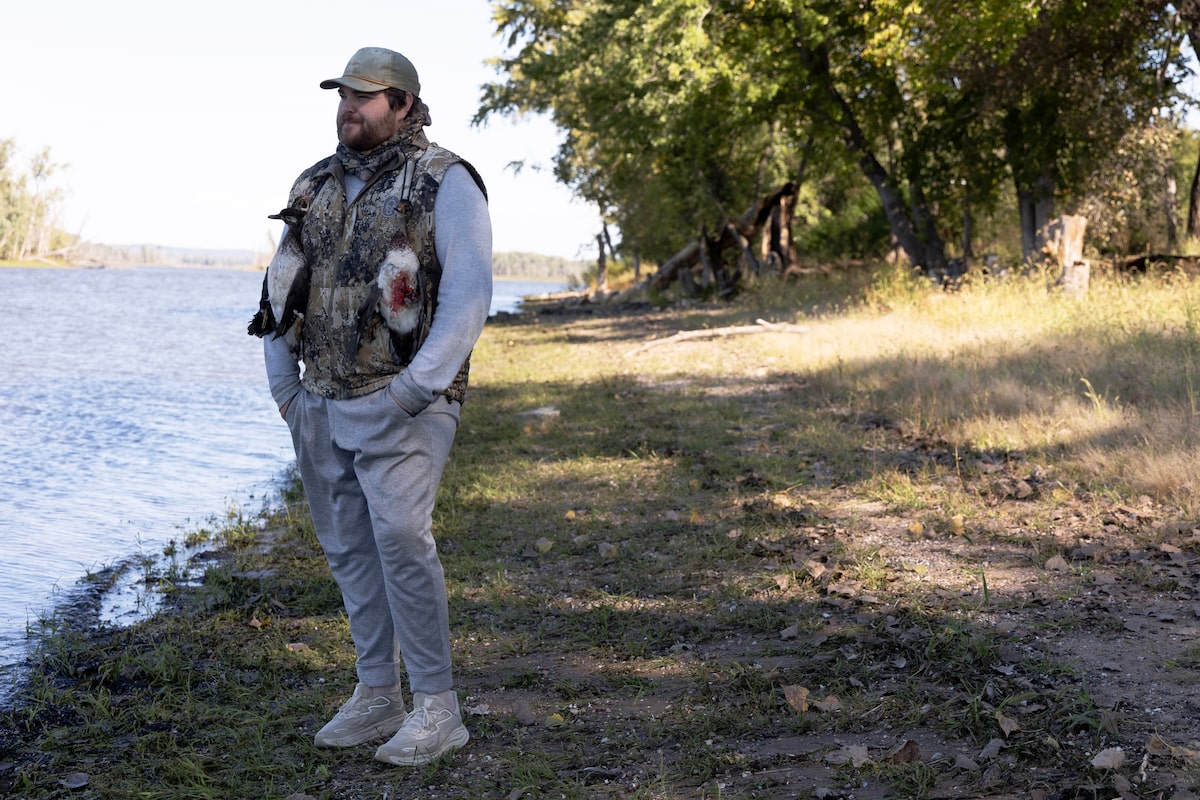
Kyle Hough could not muster much enthusiasm for Donald Trump. But two years ago, when it came time to mark a ballot for U.S. president, he chose the Republican candidate.
“I never went out and rattled the sabres for Trump or anything. But I voted for him because I thought his policies − at least at the time, what he said he was going to do − made more sense for me.”
Mr. Hough, 30, is a lawyer who works with veterans. Some weekends, he drives across Wisconsin to the Mississippi to hunt ducks, rising before dawn to target them from the placid waters that wend through the river’s braided channels.
He has been a registered Democrat since he was old enough to vote, though he has never felt wedded to any party. So it was no great stretch to support the man who promised to “Make America Great Again,” in part by making life more affordable for all Americans.
“A lot of Trump’s campaign this last time around was aimed at trying to get young people out to vote,” he said.
Then came the tariffs. Then the war in Iran. Then rising fuel prices. Then more tariffs and more high prices. Then higher mortgage rates, which will inflate the monthly payment for the home he will soon buy by US$700 a month.
A billboard opposing tariffs is displayed in the parking lot of the Pettit National Ice Center in Milwaukee, on Oct. 5.Kayla Wolf/The Globe and Mail
Then, too, the things that did not happen, like a promised increase to the child tax credit. Mr. Hough has a daughter who will soon turn two.
“I don’t think he’s done any of the things that he promised which made me want to vote for him the first time,” he said.
An unusual throng of voters propelled Mr. Trump to victory in 2024. People in lower-income brackets shifted his way, as did Muslim Americans and those of Latino descent. But in places such as Crawford County, which occupies a fertile quadrant between the Wisconsin and Mississippi rivers, poll watchers also noticed dozens of younger men coming in to vote, many for the first time.
In the state’s college towns, voting wards packed with young people counted a surge in ballots for Mr. Trump: a nine-point rise around Marquette University; a 9.5-per-cent increase around the University of Wisconsin-La Crosse; a seven-point gain around the University of Wisconsin-Platteville.
Students walk along Library Mall at the University of Wisconsin-Madison. Poll watchers noticed dozens of younger men coming in to vote in the 2024 federal election, many for the first time.Kayla Wolf/The Globe and Mail
Even in Madison, the state’s famously liberal enclave − alumni include Earth Day founder Gaylord Nelson and Tammy Baldwin, a pioneering gay politician who is now a U.S. senator − Mr. Trump saw a lift in support.
“That voting data doesn’t have gender in it,” said John Johnson, a research fellow at Marquette University who has studied the voting data. But he has little doubt “that this was young men moving in that direction.”
Now, traces of the affection and adulation − or even faint hope − the President once commanded are hard to find.
Mr. Trump is not on the ballot in the midterm elections next month. But whether Republicans can recapture the ranks of his 2024 supporters will determine how much, if at all, midterm voting this year reshapes American power. In Wisconsin, voters will determine who controls the governor’s office and a state legislature that has been dominated by Republicans since 2011.
Both parties are fighting for young voters in the Midwestern swing state, which had the highest turnout in the country in 2024. Next year, Republicans and Democrats will hold duelling youth conventions in Milwaukee.
Nick Jacobs, who chairs the state’s college Republicans, sees echoes of 2024 on campuses this year. Students are knocking on doors, volunteering at phone banks and taking intern positions with Republican candidates. Even at University of Wisconsin-Madison, young anti-abortion activists held signs saying, “Babies are Not Body Parts” on a recent weekday.
“People are incredibly, incredibly active on the ground,” Mr. Jacobs said. It reminds him of the energy Mr. Trump inspired two years ago.
Some supporters, meanwhile, find it hard to lay economic problems entirely at the feet of the man they voted for.
Anti-abortion activists demonstrate at the University of Wisconsin-Madison.Kayla Wolf/The Globe and Mail
The cost of fuel? “I think a lot of it is that there’s greed in the oil industry,” said Braden Horstman, a 25-year-old farmer and churchgoer who was raised in a conservative home.
“I never necessarily was a 100-per-cent fan, but I thought, in my opinion, he was the better alternative,” Mr. Horstman said.
Whatever has happened, “I’m not changing the way that I vote,” he added.
Yet there is reason to question whether the young men who came out just to vote for Mr. Trump will remain in the Republican fold.
A vote last year for a Wisconsin Supreme Court justice drew national attention, including heavy spending by tech trillionaire Elon Musk, who handed out several US$1-million cheques − one of them to Mr. Jacobs, the college Republican chair.
Yet the votes around Wisconsin campuses were no more conservative than before.
Mr. Trump’s success in Wisconsin is among the reasons he occupies the White House today. He won the state with the greatest percentage of the vote for a Republican since Ronald Reagan in 1984. He saw his greatest gains among younger voters and his worst among the oldest, an analysis by Mr. Johnson found.
Cows graze in a pasture near Hartford, Wis. The rising cost of fertilizer and diesel has struck particularly hard at agricultural communities in the state.Kayla Wolf/The Globe and Mail
But in subsequent votes, “there was no durable shift,” Mr. Johnson said.
Instead, the shortfall between what Mr. Trump pledged and what he delivered has spoiled the appetite of many young men for the politics this President has brought to the country.
Dawson Nickels liked the opening acts of Mr. Trump’s second term: a hardened southern border, pledges to slash government spending. Plus, “the Venezuela thing was cool,” said Mr. Nickels, 27, who raises competition jersey cows near Watertown, Wisc., and works in real estate development.
The abduction of Nicolás Maduro was a lightning-speed demonstration of U.S. power, removing a dictator and giving American companies new access to the world’s largest crude reserves.
“But the Iran thing …” Had that conflict also ended quickly, “we’d be perfectly fine,” Mr. Nickels said. Instead, war continues with no sign of resolution. “There’s always a price to pay, and we’re paying it.”
The Wisconsin Capitol building in Madison. In the most recent federal election, President Trump won the state with the greatest percentage of the vote for a Republican since Ronald Reagan in 1984.Kayla Wolf/The Globe and Mail
Not only has the cost of fertilizer and diesel struck particularly hard at agricultural communities, but U.S. debt has climbed over US$40-trillion. No politician who oversees that kind of borrowing should be allowed back into office, Mr. Nickels said.
Two years ago, he voted for the first time to mark a ballot for Mr. Trump.
In November, he expects to sit out the midterms at home.
Younger Democrats, meanwhile, have found new arguments to support their cause. In the state’s contest for governor, the Republican candidate, Tom Tiffany, has raised nearly three times more money than his Democratic opponent, David Crowley. (Both men have been funded by ultra-wealthy donors, including from neighbouring Illinois.) But 93 per cent of the Republican’s cash has come from just three billionaires, Wisconsin Public Radio reported.
”They do not care about the working class in the slightest,” argued William Walter, a Wisconsinite who sits on the steering committee for Young Progressive Democrats of America. His party, he said, is ”focused on the issues that actually resonate with young voters.”
The party hasn’t always found that easy. In Crawford County, the local Democratic Party is chaired by Jon Sutton, who is 65. “And I’m, like, practically the youngest person involved,” he said.
William Walter at his home in Germantown, Wis.Kayla Wolf/The Globe and Mail
They have tried new ways to reach younger audiences, relying on one woman − she is nearly 50 − to post pictures and videos to TikTok, accompanied by a soundtrack. But they don’t do much door-knocking, in part because “our old people can’t walk very well any more. And they don’t see or hear very well,” Mr. Sutton said.
But at a moment when the high-volume politics of the White House have drowned out many other political conversations, it may not matter.
Dylan Finger, a 21-year-old pre-med student at UW-Madison, was among those who voted two years ago for Mr. Trump, whom he saw as a rupture from politics as usual.
“I was like, ‘Hey, I want something new,’” he said.
The idea of reviving old industries resonated in a Great Lakes state that had, until recently, remained one of the few places in the country where manufacturing was the most important industry. Today, more Wisconsonites work in health care and social assistance than in factories.
Dylan Finger says he is considering voting for Democrats in the upcoming midterms.Kayla Wolf/The Globe and Mail
“I would love to see some of those companies, some of those factories, come back to life,” Mr. Finger said. The Trump administration has pointed to statistics showing Wisconsin has added 30,000 jobs this year alone. But it shed 9,500 manufacturing jobs in 2025. Mr. Finger can’t understand the White House argument that tariffs will help.
Not only have foreign-made goods increased in price, so have domestic alternatives.
“Consumers are inherently forced to buy a more expensive product,” Mr. Finger said. It means “you’re not really boosting the local economy.”
Mr. Walter holds up the shirt he typically wears when talking with voters.Kayla Wolf/The Globe and Mail
It all means that, come November, he is leaning toward marking a ballot for Democrats.
”At this point, I would consider changing. I’m definitely more up in the air than I was two years ago.”
Jacob Boggs, 21, is making a change of another kind. In 2024, he didn’t bother casting a ballot.
”I didn’t think my vote would mean anything,” he said. “And I was sorely mistaken.”
Two years later, politics was on his mind, even as he arrived at American Family Field to watch a Milwaukee Brewers playoff game. He is unhappy about tariffs, fuel prices and the state of an economy he called “terrible.”
He will not sit out another election.
This year, “I’m going to vote. I’m definitely voting Democrat,” he said.
He is done with Republican leadership.
“Things need to change.”
The Globe is sending reporters along the Mississippi, the heart of America, to gauge the body politic, ahead of the midterm elections.