
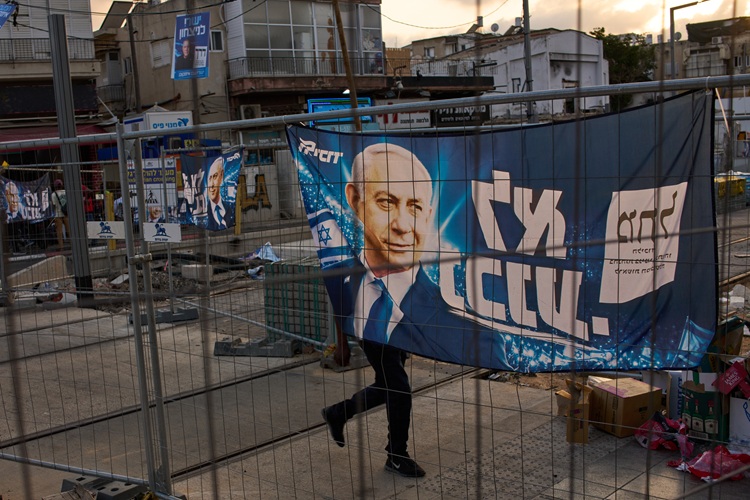
I just returned from an AEI trip to Israel. While there, my colleagues Dany Pletka and Brett D. Schaefer and I kept a busy schedule. We visited the United Nations Truce Supervision Organization in Jerusalem and the United Nations Disengagement Observer Force on the Syrian border; saw kibbutz Kfar Aza and the Nova festival site, where Israelis were slaughtered on October 7, 2023; and met with Israeli and US government officials.
Top of mind were the Israeli elections on October 27. Israelis are a plainspoken bunch, and most were happy to tell us which party would be getting their vote. My takeaway: No one can confidently predict the results. Uncertainty hangs over a country that has been at war for the last three years.
Right now, there are something like 13 parties vying for 120 Knesset seats. You do the math. The country’s proportional representation and low electoral threshold (3.25 percent) beget an extreme degree of horse trading and coalition building seldom seen in fellow parliamentary democracies. Parties that would have little shot of making into parliament in other countries win seats in the Knesset.
Polling indicates that no one party will win anything approaching a majority in this fractured field. Assuming pollsters have it right, bigger parties will be forced to woo smaller ones through ministerial appointments and other blandishments. The upshot will be a coalition government in which smaller parties are disproportionately powerful.
There may yet be a path to victory for Prime Minister Benjamin Netanyahu. Israel’s longest-serving head of government turns 77 later this month, but he’s a preternaturally able politician who knows how to win. He should not be discounted.
That said, it won’t be easy this time. Many Israelis blame Netanyahu and the government for the calamity of October 7. Many also dislike his Likud party, which they say has drifted from its right-wing roots. Netanyahu could hemorrhage significant support if erstwhile Likud voters decide to back someone else.
Gadi Eisenkot may be that man. A former Israeli Defense Forces chief who lost a son in the war in Gaza, Eisenkot is a newcomer who wasn’t in politics on October 7. His party, Yashar, is polling well and could win more seats than Netanyahu’s Likud.
Whether Eisenkot will be able to form a government is another matter. A national unity government including Likud may be a bridge too far. A coalition excluding Likud may be too small to govern. Eisenkot has said he wouldn’t enter into government with Ra’am, an Arab party that was in government from 2021 to 2022, but he wouldn’t be the first politician to break his word. If no one can form a government, then Israelis would go back to the polls for another election. Eisenkot and the rest of the country are trying to avoid this nightmare scenario.
It is unlikely that Eisenkot would court the Haredi, also known as ultra-Orthodox, parties. Why? Eisenkot is campaigning on reversing military conscription exemptions for the ultra-Orthodox, most of whom do not serve. Haredi parties would almost certainly be unwilling to compromise on the exemptions for tens of thousands of ultra-Orthodox young people. The ultra-Orthodox now comprise 14 percent of the Israeli population and have a massive birth rate. The draft exemptions have become the most politically fraught issue in Israel. The rest of the country, which proudly sends its own sons and daughters to serve, resents the Haredi refusal to do so. To outside observers, including me, the status quo seems precarious.
The draft exemptions aside, there is near consensus on security. Israelis are under no illusions about their neighborhood. They won’t brook a Palestinian state anytime soon and, despite some encouraging signs, want to proceed cautiously with overtures to the Lebanese and Syrian governments. Decades of terrorist attacks and existential threats have inured Israelis to their lot. Even the sole left-of-center Zionist party talks a tough game on security and is led by Yair Golan, a decorated former general.
There is no more left-right divide in Israel. It’s a fantasy-reality divide. The country’s politics reflect as much.