
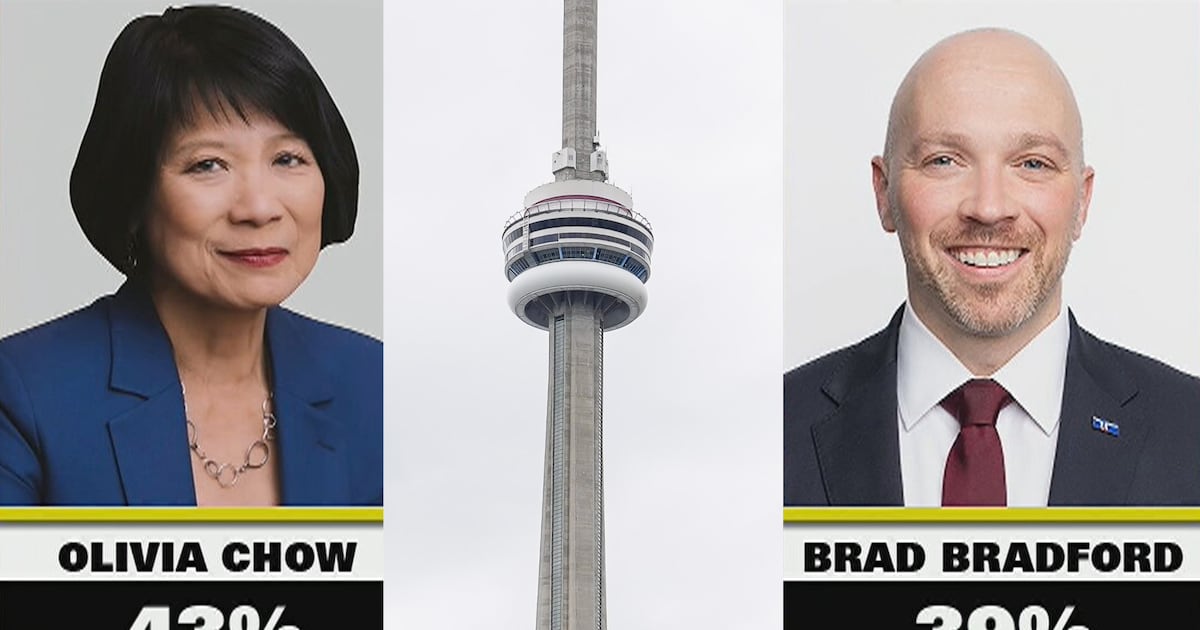
A tighter contest appears to be emerging in Toronto’s mayoral race as Brad Bradford reduces Olivia Chow’s lead to about 3.5 points among decided voters, according to a new poll conducted exclusively for CP24 and CTV News Toronto.
Nanos Polling, which surveyed 757 Toronto residents between Oct. 8 and Oct. 10, found that 51 per cent of decided voters said they would cast a ballot for Chow if an election were held today, compared to 47 per cent, who said they would vote for Bradford.
Among decided and undecided voters, 43 per cent said they would support Chow, 39 per cent backed Bradford, one per cent said they would vote for another candidate, and 17 per cent said they remain undecided.
In a Nanos poll published last week, Chow was up nearly 10 points over Bradford among decided voters.
The shift comes after mayoral candidate Chris Alexander announced his plans to drop out of the race last week. The last Nanos poll put support for Alexander at around four per cent.
“Chow still leads, but Bradford has cut her cushion to 3.5 points among decided voters. Chow draws strength from Toronto and East York, women and voters under 55,” Nik Nanos, chief data scientist and founder of Nanos Research, said in his analysis accompanying the poll.
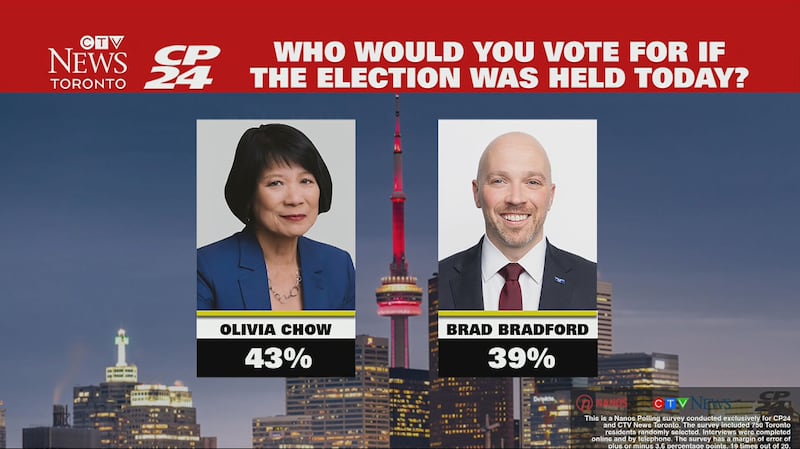 Toronto election poll
“Bradford fares better in North York, among men and voters aged 55 and older. Etobicoke/York is close, and Scarborough closer still. With 17 per cent undecided, Toronto’s race remains an open contest.”
Support for Chow and Bradford appears to be evenly split in Scarborough as more than 14 per cent of voters remain undecided.
In Etobicoke/ East York, Bradford sees about 42.2 per cent support, compared to Chow’s 39 per cent, but once again, nearly 18 per cent appear to be undecided.
Bradford has a notable lead in North York, according to the poll, with 45.6 per cent indicating that they would back Bradford, compared to 38.8 who support Chow. The percentage of undecided voters in North York sits at around 15.6.
Chow enjoys a massive lead in Toronto and East York, with 49 per cent who say they would vote for the incumbent, compared to just 30 who say they support Bradford. About 19.2 per cent say they are undecided in that area of the city.
Chow’s support among female voters is about 47.7, compared to 37.3 who are male. For Bradford, 43.9 are male and 35.1 are female.
“The numbers for Chow have been fairly consistent over the course of the campaign, and what we’re seeing at least is that Bradford has been picking up. He obviously picked up some support from from Chris Alexander, but you know we’re seeing some of the regional races kind of tighten up,” Nik Nanos said.
“Scarborough tightening up, basically a dead heat… and Etobicoke/York (is) basically a coin toss. So we’ve got those two parts of the city that are a really, really tight race. While in Toronto/ East York, Chow is clearly in the driver’s seat, and in North York, Brad Bradford has the advantage.”
He said both campaigns will have to “wage war right across the city.”
“The fact of the matter is that even in Toronto/East York, where Olivia Chow is strong, she can focus on delivering even more voters from that area because they tend to be more disposed to her,” Nanos said.
“And the same thing for Brad Bradford. North York, that particular area is good for him. He he should be trying to deliver more voters in those areas where he’s strong.”
Methodology
The Nanos Polling survey was conducted exclusively for CP24 and CTV News Toronto. The survey included 757 Toronto residents randomly selected. Interviews were completed online and by telephone. The survey has a margin of error of plus or minus 3.6 percentage points, 19 times out of 20.
Related Stories