
Chrystia Freeland has had her fingerprints on two of the biggest political plot twists in recent Canadian history: negotiating the original United States-Mexico-Canada trade deal with Donald Trump, then delivering the bombshell cabinet resignation that helped bring down Justin Trudeau’s government (and put Mark Carney in power).
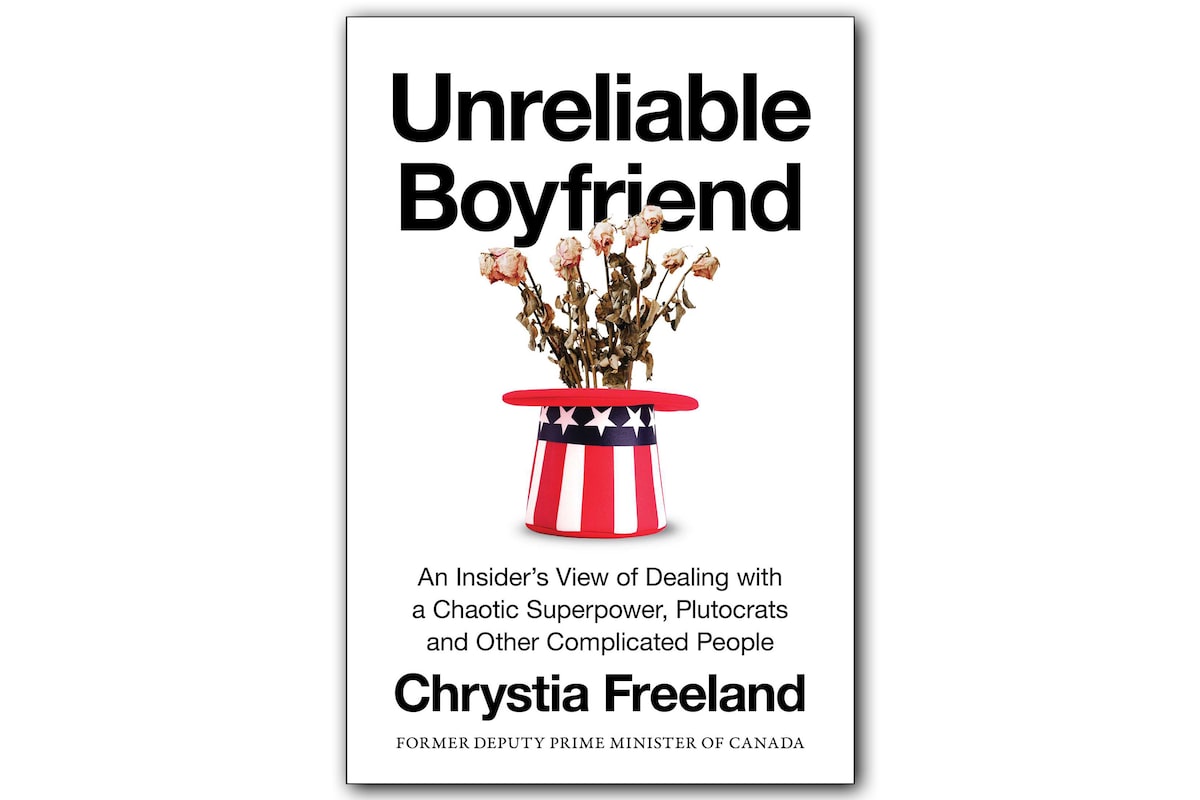
Now she’s back with Unreliable Boyfriend, a new book about the perils of Canada’s dependence on its increasingly unpredictable southern neighbour. Part memoir, part political polemic (with plenty of spicy sex metaphors), it offers a sweeping vision of Canada’s place in a rapidly changing world, along with a blueprint for securing its economic fu – oh, come on. You just want to know what she says about Justin Trudeau.
Here, a guide to the biggest behind-the-scenes revelations, economic prescriptions and – yes – piping hot political tea.
How does Trudeau come off?
For a woman who got removed from her role as finance minister on a Zoom call (and resigned from cabinet three days later), the author goes out of her way to give her former boss his flowers, particularly for his leadership and backbone during the 2018 USMCA negotiations, which have helped shield Canadian exports from some of Trump’s more recent tariffs. “History will be kind to Justin Trudeau,” Freeland writes, highlighting his greatest hits, from lifting hundreds of thousands of families out of poverty with the Canada Child Benefit to leading the country through COVID-19 while maintaining its triple-A credit rating.
Former prime minister Justin Trudeau and former deputy prime minister and minister of finance Chrystia Freeland make their way to the House of Commons on Parliament Hill in November, 2023.Spencer Colby/The Canadian Press
That said, she doesn’t shy away from casting shade where due, invoking the “cornflakes analogy” (when a relationship goes south, even the way the other person eats their cornflakes drives you crazy) to describe how Canadians fell out of love with their once wildly popular prime minister.
Trudeau was “at his best with strangers,” she says, recalling how he spent hours chatting with her father – a farmer from Peace River, Alta.– at a party. His interest in regular people was a genuine passion, rather than performative. But that gift for connection had its limits: “His talent for intimacy with strangers co-existed with a profound aloofness from anyone who might come close to being a peer…We might walk together for the cameras, but none of us, even his personal friends from childhood, had intimate political relationships with him.”
Is Trudeau the unreliable boyfriend from the title?
No. And it’s not Trump either. As the cover featuring dead flowers in an upside-down Uncle Sam hat implies, the boyfriend in Freeland’s analogy is the United States in its current incarnation. For much of the postwar period, Uncle Sam “played the part of a Father Knows Best, 1950s-style patriarch to his allied wives.” A little retro, but at least we got something out of it, namely national security and the confidence that the old guy smoking a pipe on the couch wasn’t going to walk out on the family. Since Trump’s first election in 2016, and especially since his return to the White House, that assumption of American reliability has gone out the window. A bad boyfriend is one thing, but an unreliable one leaves you never knowing where you stand.
In this analogy, Canada isn’t just another flirtation; she’s the girl next door. And the only way to change the balance of power is to stop acting quite so available. That means playing hard to get, asserting our independence and seeing other people – in economic terms, developing trade relationships beyond the United States.
Representatives participate in a signing ceremony for the new United States-Mexico-Canada Agreement in Buenos Aires, Argentina, in November, 2018.Sean Kilpatrick/The Canadian Press
Does she trash Trump?
Insofar as the whole book is about the U.S.’s increasingly authoritarian tendencies under Trump’s rule, sure. But there are no cheap shots. Freeland admits that when the cameras aren’t rolling, Trump can be “appealing and fun” and concedes that POTUS was asking a lot of the right questions about globalization, which left Western democracies dangerously dependent on China. It’s his answers – tariffs, protectionism and America First – that she takes issue with.
So what’s her solution?
For starters, her plan is to have a plan. In Freeland’s estimation, Trump’s approach to trade is driven by short-term wins rather than a coherent long-term strategy. Her alternative is “friendshoring,” a concept previously championed by former U.S. treasury secretary Janet Yellen. It offers a middle path between Trump’s protectionism and the anything-goes globalization of the past several decades: The world’s democracies would trade freely with one another while reducing their strategic dependence on authoritarian regimes, particularly China and Russia. Think globalization, but with a more discerning guest list. (This values-based system differs somewhat from Canada’s approach under Carney, who has pursued closer economic ties with China despite its authoritarian government.)
How does Carney come off?
If it was awkward to compete against a longtime family friend (and the godfather to her eldest son) for the Liberal leadership in 2025, that doesn’t come up. Freeland’s assessment of Carney’s performance as Prime Minister is highly complimentary – “excellent,” in her words. “I am proud my decision helped him get the top job,” she writes, “even though I ended up paying a pretty steep political price.”
Freeland looks over as Mark Carney speaks during the English-language Liberal Leadership debate in Montreal, in February, 2025.Christinne Muschi/The Canadian Press
Their relationship goes way back: Carney studied economics at Harvard with Freeland’s husband, Graham Bowley (as one does), and the two families have remained close ever since. When Team Trudeau first approached Freeland about leaving New York, where she was living with her young family and working as a journalist, to enter politics, she sought advice from Carney and his wife, Diana Fox Carney.
Any other hot tea?
Let’s avoid spoilers and just say that a certain former Liberal prime minister once paid a special visit to Freeland’s house in an effort to convince her to abandon Trudeau.
In the world of politics, isn’t a book like this usually a precursor to a leadership run?
Freeland currently has her hands full running the Rhodes Trust at the University of Oxford and serving as an economic adviser to Ukrainian President Volodymyr Zelensky. But you don’t write a 400-page political manifesto laying out your vision for Canada’s future without inviting at least a little speculation about your own role in it. In the book, Freeland shares an anecdote about how Trudeau once told her she would lead the country one day. On a scale of predictable outcomes, a political second act for the former finance minister seems at least as likely as Trudeau making out with Katy Perry on a yacht.