
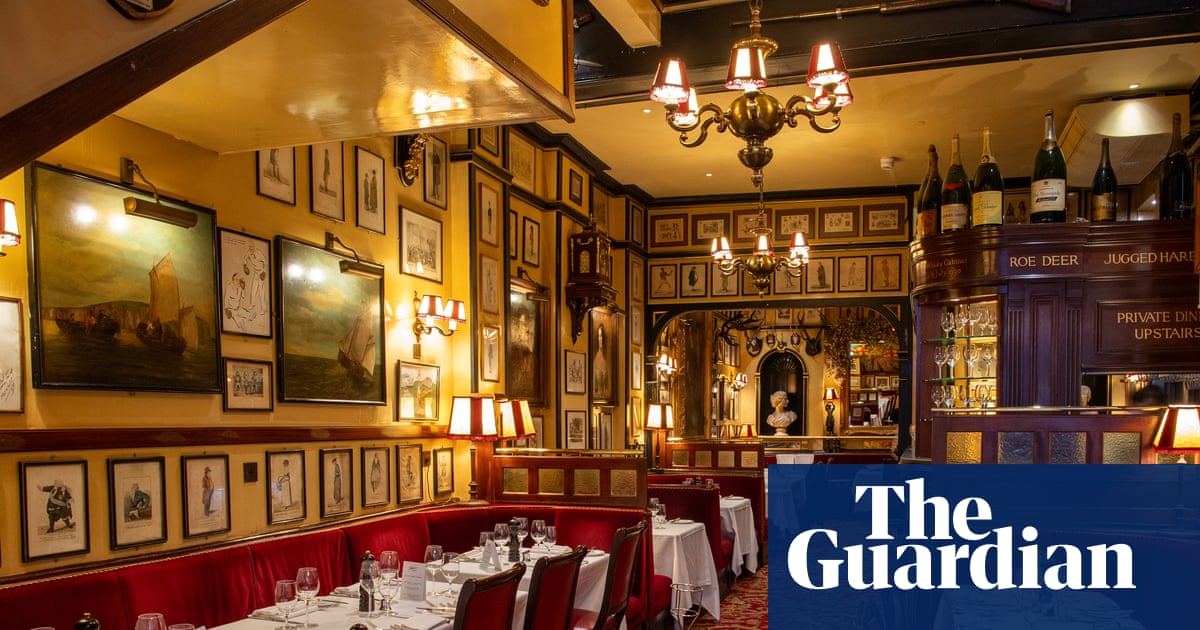
When Thomas Rule served his first oyster to diners on Maiden Lane in London’s Covent Garden, “mad” George III was on the throne of England, John Adams was US president and William Pitt the Younger had just come up with a wheeze called income tax to pay for the Napoleonic wars.
More than two centuries later, Rules, the restaurant Thomas founded in what became the capital’s theatreland, has outlasted nine British monarchs and 45 prime ministers – but has changed hands only three times. The interior of its four-storey home, stuffed with historic playbills and vintage caricatures and gilded antlers, is little changed from the 19th century, nor has the tone of its determinedly meaty menu – think rabbit rillettes, shin of veal and roast guinea fowl.
Established in 1798, Rules was once frequented by the likes of Charles Dickens, Laurence Olivier and Charlie Chaplin. Photograph: Jill Mead/The Guardian
Rules was beloved by Dickens and Thackeray, inspired Graham Greene and was a favourite of Charlie Chaplin, Laurence Olivier and Ava Gardner. But even London’s oldest restaurant can feel vulnerable to the winds of change, leading the man who bought Rules in 1984 to take perhaps the most significant step in its long history. JP Mayhew has now donated the restaurant’s historic home to the National Trust, assured that the heritage charity will “protect this place in a way that no one else could”.
“With many years of hard work, and some extraordinary strokes of luck, Rules has survived everything from redevelopment plans and changing tastes to the blitz ,” Mayhew said. By taking on the historic and listed 34-35 Maiden Lane, he added , the National Trust would “[safeguard] its bricks and mortar, its famous interior and its invisible atmosphere too. I am grateful to them for believing in this idea and for protecting this building and two centuries worth of stories for people to enjoy forever”.
The interior of its four-storey home, stuffed with historic playbills and vintage caricatures and gilded antlers, is little changed from the 19th century. Photograph: Jill Mead/The Guardian
The £11m “landmark” gift is one of the most valuable in the National Trust’s recent history, and will mark its first entry into the restaurant business – although its portfolio includes 39 historic pubs and a number of country house hotels, including Cliveden in Buckinghamshire.
Not that the heritage charity will be taking on the napkin-folding and the slow cooking of pork cheeks. While Mayhew is donating the historic building and its contents, he sold the restaurant business to Ricky McMenemy, its longstanding general manager, in 2022; McMenemy will become a commercial tenant of the National Trust.
Diners can expect little change to the menu, said Lucy Porten from the National Trust: ‘It’s not a National Trust menu … there will be no scones.’ Photograph: Jill Mead/The Guardian
“Our involvement, day to day, will probably be very light touch,” said Lucy Porten, a national curator for the charity. “It will always be run as a restaurant. We will look after [the building and its contents], but we recognise that they will have to evolve if they are going to continue to meet diners’ needs.”
Diners, however, can expect little change to the menu, she said – and crucially, no scones. “It’s not a National Trust menu, this is a very successful business in its own right. There will be no scones. That’s not their business.” Nor will there be preferential access or prices for National Trust members, “because it is a business, and it has to be successful,” she added. Instead, the charity is exploring options for virtual visits and other ways people could “feel like they are visiting the space” from afar.
It was several years ago when Mayhew first approached the National Trust about a possible gift. Porten said while “excited by the offer”, they looked carefully at whether it was the right organisation to take on the building.
The storied restaurant has outlasted nine British monarchs and 45 prime ministers. Photograph: Jill Mead/The Guardian
Porten said: “The nature of the National Trust, and the fact we have this extraordinary ability to take on places inalienably, for ever, means that we have to think about what’s right for now, but also to think about looking after them for future generations. That’s quite a big thing … It had to be quite a balanced response and decision.”
Part of its value to the trust, she said, lay in helping the charity “tell different histories which are hard for us to tell at our other properties”.
“You get a sense of all the delicious food which has been enjoyed here, the fine wines that have been consumed, the good company that’s been enjoyed. There’s something in the air about the conversations and the celebrations, the flirtations, the deals that have been struck, the heartbreak. All that hangs in the air, in a very magical way, [as] the backdrop to lots of different historical moments and lives.
“It’s an extraordinary slice of the social history of London, and to have been here for so long – in this site and doing this business – is a very rare and special thing.”