
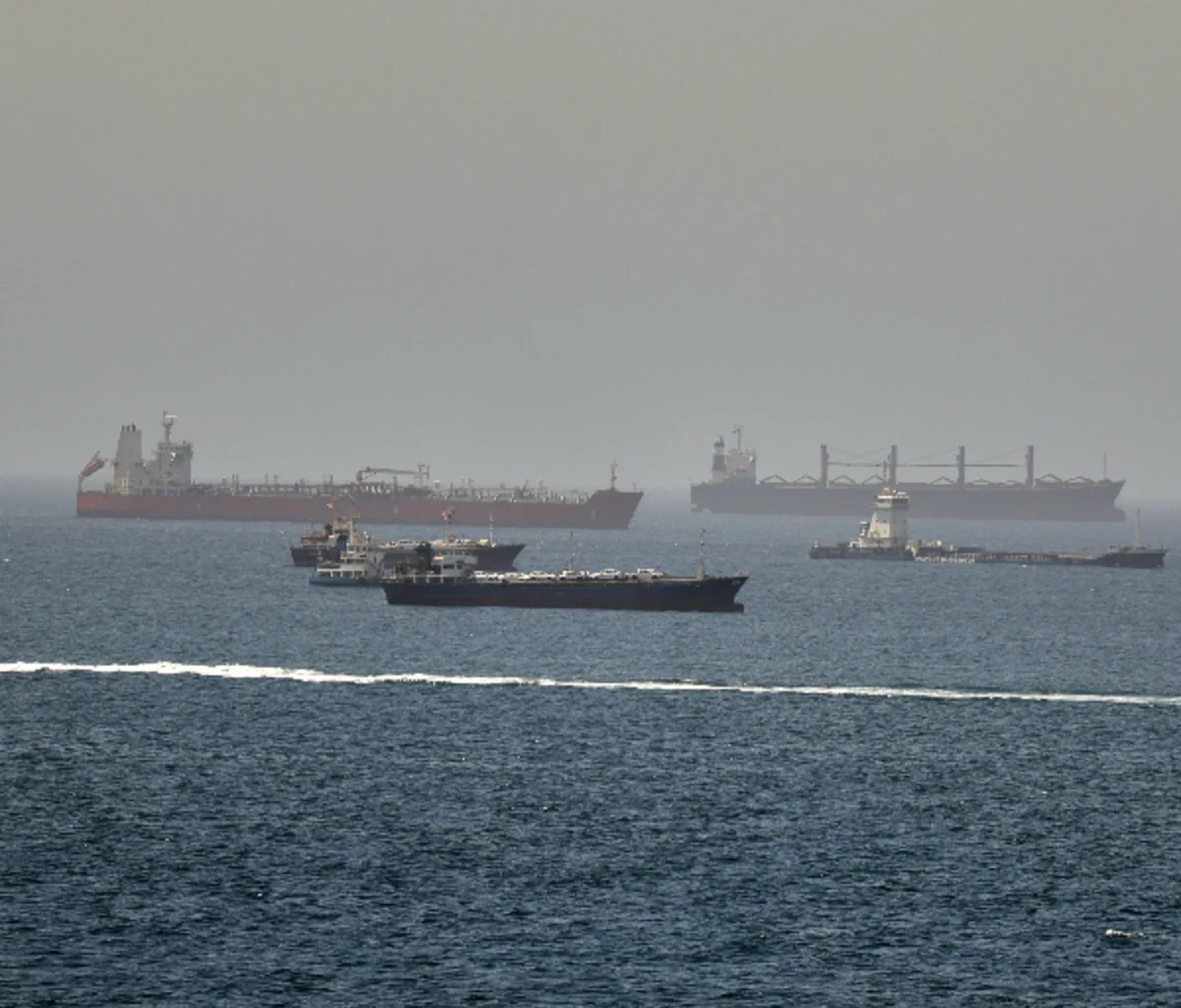

Tankers and cargo vessels are seen in the Gulf of Oman, along shipping routes linking the Strait of Hormuz and the Arabian Sea, Tuesday. (AP)
Iran is escalating threats against commercial shipping in the Strait of Hormuz, while its Houthi allies in Yemen are stepping up attacks on Saudi Arabia and exchanging threats with President Donald Trump, raising the risk that the widening Middle East war could be poised to expand to additional fronts.
Trump said Tuesday he would make a decision on Iran “very soon,” as the administration faces mounting threats to energy shipments, attacks on Saudi infrastructure and allegations of Iranian efforts to target military sites in Britain.
The Associated Press reported Tuesday that Iran appears to be targeting commercial vessels conducting ship-to-ship oil transfers in and around Hormuz, potentially undermining efforts to keep oil moving through the strategic waterway.
The Institute for the Study of War, which provided the assessment, also warned Iran may be developing its anti-ship missile capabilities.
The U.K. Maritime Trade Operations Centre reported that at least three vessels were attacked by unidentified projectiles in the strait Sunday, although no group immediately claimed responsibility.
Mohsen Rezaei, secretary of Iran’s top security body, told Iranian state television Saturday that Iranian forces were striking an average of five “smuggling ships” every night, according to the AP.
Rezaei appeared to be referring to vessels involved in U.S. efforts to move oil through the strait before transferring it to larger tankers waiting in the Gulf of Oman.
The Financial Times reported Tuesday that six vessels were targeted Sunday alone, the most intense day of attacks on shipping near Hormuz since the war began in late February.
Oil flows through the strait have fallen sharply from prewar levels, while attacks threaten to increase shipping costs and further disrupt global energy supplies.
The shipping threats coincide with a dispute with Britain over an alleged plot targeting RAF Fairford, a military air base used by U.S. bombers during strikes against Iran.
British Prime Minister Andy Burnham said the suspected plot was “almost certainly” directed by Iran’s Islamic Revolutionary Guard Corps, while MI5 chief Ken McCallum said Tuesday the incident was “not unique,” the AP reported.
Iran summoned British Ambassador Hugo Shorter and warned it could “seriously reconsider” bilateral relations unless London provided evidence linking Tehran to the alleged plot, according to Iranian state media.
Seven men arrested in the investigation have been released on bail, but no one has been charged.
Meanwhile, Iran-backed Houthi rebels in Yemen are opening another potential front by intensifying attacks on Saudi Arabia.
The AP reported that Saudi Arabia is investigating how its air defenses failed to intercept a barrage of missiles and drones fired by the Houthis, including an attack on Riyadh’s King Khalid International Airport that killed at least 13 people and wounded more than 300.
The airport has remained closed following the attacks, with Saudi authorities extending the shutdown until Saturday, Oct. 17, Reuters reported.
Trump accused the Houthis of resuming attacks at Iran’s behest and deliberately trying to drive up oil prices ahead of the Nov. 3 U.S. midterm elections.
“Somebody should explain to them that I’m not running in the Elections … but I’ll be there after the Elections, and I will never forget!” Trump wrote Tuesday on Truth Social, according to Reuters.
Trump also said he might ask Turkish President Recep Tayyip Erdogan to help defend Saudi interests, adding that he believed the Turkish leader would do as he asked.
The Houthis, meanwhile, warned that any U.S. involvement in attacks against them would prompt a “swift and painful” response against American interests in the region, CBS News reported, citing Houthi political bureau member Mohammed al-Bukhaiti.
The Saudi-led coalition launched new airstrikes Tuesday on the Houthi-held Yemeni capital of Sanaa, according to the AP, after warning residents to evacuate an area near a fuel facility.
Houthi military spokesman Gen. Yahya Saree threatened a “harsh and painful” response against Riyadh if Sanaa were attacked.
The fighting threatens the Bab el-Mandeb Strait, another critical maritime route connecting the Red Sea and Gulf of Aden.
The Houthis seized key areas along the strait last month, while the Saudi-led coalition has been trying to retake them.
Trump’s next move against Iran remains uncertain, with the president telling reporters Tuesday, “We’ll make a decision on Iran very soon,” according to Newsmax.
Trump described Iran as a “failed country” and claimed it had 300% inflation and was struggling to pay its personnel.
He did not specify whether his impending decision would involve renewed military action, negotiations or another approach.
The latest developments leave Washington confronting simultaneous threats to shipping through Hormuz, Saudi security, and military facilities abroad.
© 2026 Newsmax. All rights reserved.