
Israel will hold elections in two weeks, and the leading candidates to become the next prime minister are presenting different visions of the nation’s character. The entire world already knows the voice, mannerisms, and modus operandi of Benjamin Netanyahu, who has led and shaped Israel for a generation. Today, we’re featuring a symposium on Netanyahu’s legacy, with contributions from Michael Oren, Haviv Rettig Gur, Sohrab Ahmari, and more.
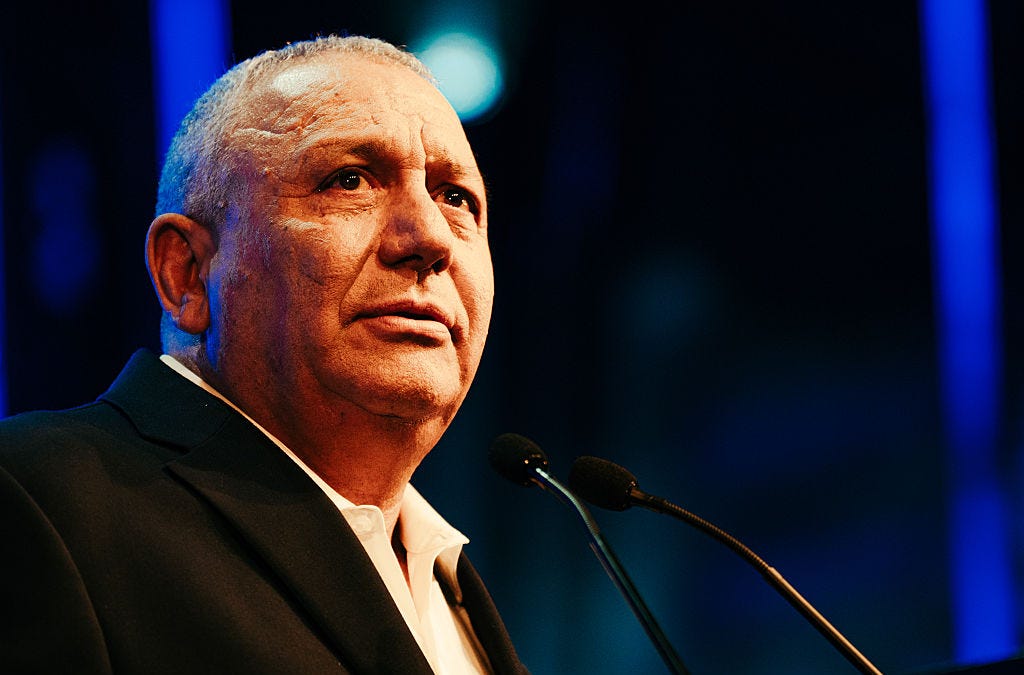
But what about the man who is favored to unseat him? Below, we examine the life and perspectives of Gadi Eisenkot, the former military chief whose young opposition party is leading the polls. Yonah Jeremy Bob, a Jerusalem Post reporter and a chronicler of Israel’s halls of power, tells the unlikely story of Eisenkot’s rise, and describes where the breakout challenger may lead his country.
—The Editors

I first met Gadi Eisenkot in March 2017 at Israel’s parliament, the Knesset. At the time, he was the chief of the Israeli military and he was explaining to legislators that the Israel Defense Forces (IDF) were handling a new challenge from Hamas. The terrorist group was operating freely within the tunnel network it had built beneath Gaza, the extent of which had first been revealed in an assault on Israel a few years before.
As he explained the crisis, Eisenkot struck me immediately as amiable and much more subtle in expression than you might expect from a typical commanding general. And that ability—to be commanding in practice but project the aura of an everyday person—is part of the magic that could make him Israel’s next leader.
As of this week, his Yashar party is topping the polls in the election to be held on October 27, with about 22 percent of the vote compared with 20 percent for Netanyahu’s Likud party. Although the most likely election scenario is a deadlock leading to a second round between Eisenkot and Netanyahu, Eisenkot is widely viewed as having a better chance to build a majority coalition after the election, as a large share of seats will likely go to parties that oppose Netanyahu on similar grounds.
Eisenkot, 66, has a public image that is relatable to less-elite Israelis, including his lack of fluency in English. He is capitalizing on being the un-Netanyahu—someone with little in-your-face charisma but who underneath projects a depth of power that is undeniable.
Eisenkot is from Eilat, which is known globally as a prized resort. But internally in Israel, for locals who live there, it is known as a more depressed development town. He would be the first prime minister of Moroccan descent, as opposed to the European-Israeli background typical of his predecessors.