
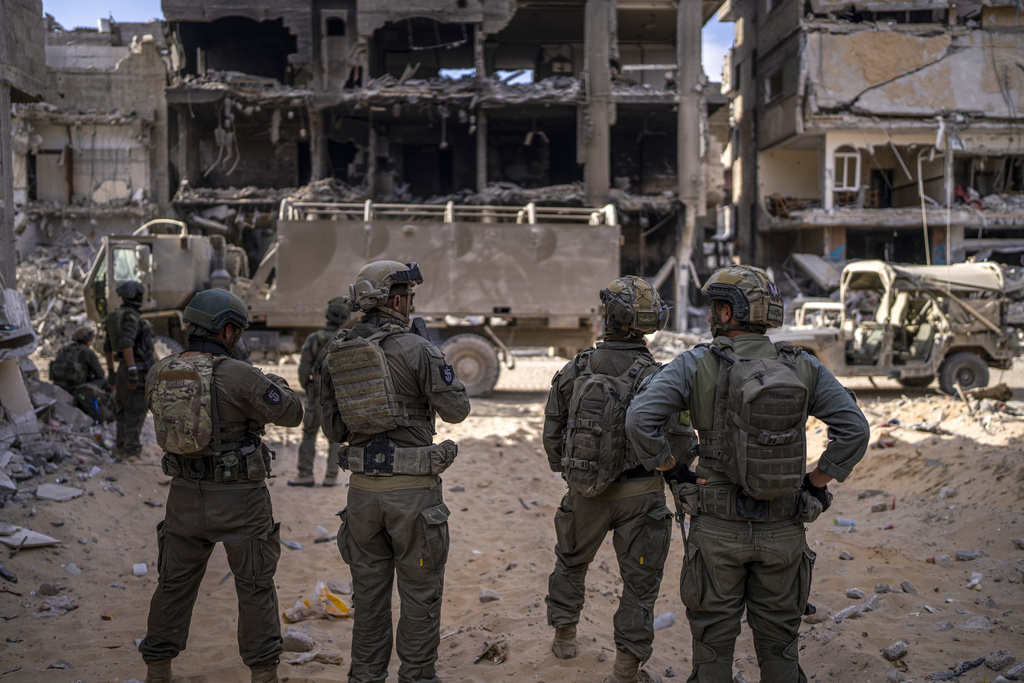
JERUSALEM, Israel – Retired U.S. military officer and author John Spencer has spent years studying the world’s most destructive urban battles, from Stalingrad to Baghdad. After traveling to Gaza seven times with the Israel Defense Forces, Spencer tells CBN News that Israel faced a battlefield unlike anything ever seen in modern warfare.
“Hamas had 20 years documented and billions of dollars invested into every inch of the Gaza Strip, preparing it for war,” Spencer explained.
He points to the scale of the group’s underground tunnel network hundreds of miles beneath one of the world’s most politically scrutinized battlefields. He noted that Hamas spent years, even decades, preparing tunnels, explosives, and fighting positions throughout Gaza.
“Today’s estimate is over 600 miles of tunnels… It’s massive. It’s just unique in the history of war,” he said.
Another critical factor: civilians trapped inside the battlefield. Spencer witnessed IDF forces taking extraordinary measures to protect civilians during his trips inside the Gaza Strip.
“The IDF actions that I’ve observed seven times personally, deep in Gaza City with the IDF formations, not asking them what they’re doing, watching what they’ve done, have executed the operation with greater care for civilian life than they’ll ever get credit for,” he insisted.
Those actions included advance warnings, tracking civilian movement, evacuation efforts, and restrictions on the use of certain weapons.
Spencer made a telling statement based on his study of urban warfare: “Israel has implemented more civilian harm measures…than any military in the history of war. That’s a fact.”
Despite Spencer’s claim, Israel faces perhaps the most damaging accusation – genocide – a charge Spencer rejects.
“I think it’s one of the biggest lies ever propagated and spread around the world that we’ve seen in the last 75 years,” he asserted.
***Please sign up for CBN Newsletters and download the CBN News app to ensure you receive the latest news from a Christian perspective.***
Under international law, genocide requires specific intent to destroy, in whole or in substantial part, a protected group. Spencer argues that Israel’s conduct which he has documented, points in the opposite direction.
He explained, “Genocide requires there to be an intent to destroy… It’s anti-intellectual in this very specific case to say that Israel is trying to commit a genocide, has committed a genocide.”
One image, though, has shaped perceptions perhaps more than any other: the destruction of Gaza. As an urban warfare expert, Spencer contends that while the devastation is undeniable, the destruction alone doesn’t explain how or why it happened.
He told us, “Having studied war, urban warfare specifically, over a decade, I know what it looks like when there is an urban defender that you have to go in and dig out.”
Spencer compares Gaza with battles against ISIS in places such as Mosul and Fallujah in Iraq, where entrenched fighters turned civilian neighborhoods into battlefields. Plus, he adds, Hamas had something ISIS did not: two decades to prepare.
The terror group in Gaza, says, is “very unique in the amount of explosives that Hamas embedded into every structure, into the tunnels.”
Their preparations included weaponized civilian infrastructure, putting entrances beneath or near buildings with weapons and explosives placed throughout the urban landscape.
Spencer believes those factors help explain why photographs of destruction, amply shared by global media outlets, cannot by themselves tell the story of what happened.
“Everybody sees it and says that there was a bomb dropped on that building,” he remarked. “That’s actually not the truth. There’s a long list of reasons when the fighting was happening in those different neighborhoods and those different cities.”
That points to another element Israel has struggled to fight against: the battle over narrative.
Spencer cites the explosion at Gaza’s al-Ahli Hospital early in the war as an example of how an accusation can spread worldwide before facts are established.
“You have to communicate daily. You have to fight disinformation… You have to put out information every day… that can fight the lie,” he emphasized.
For Spencer, that battle isn’t simply about Israel. It’s about whether facts still matter.
When we asked what he would say to Christians trying to sort through competing claims about Gaza, his answer came back as a biblical principle.
“I think that even the Bible has some very powerful quotes about the truth and the devil’s tongue. We have to… really do critical thinking today… Who gave us that information? What are they not telling us? What’s the context that they’re leaving out to try to convince us, to invoke our emotion, and to flip the world where evil is good and good is evil?” he asked.
Spencer believes the lesson of Gaza is not for Christians to ignore difficult questions or civilian suffering. It’s that those questions should be asked with facts, context, and determination to discover the truth.
That’s because in modern warfare, the battle goes beyond soldiers, rockets, and bombs. It’s also fought over what the world believes happened.
