
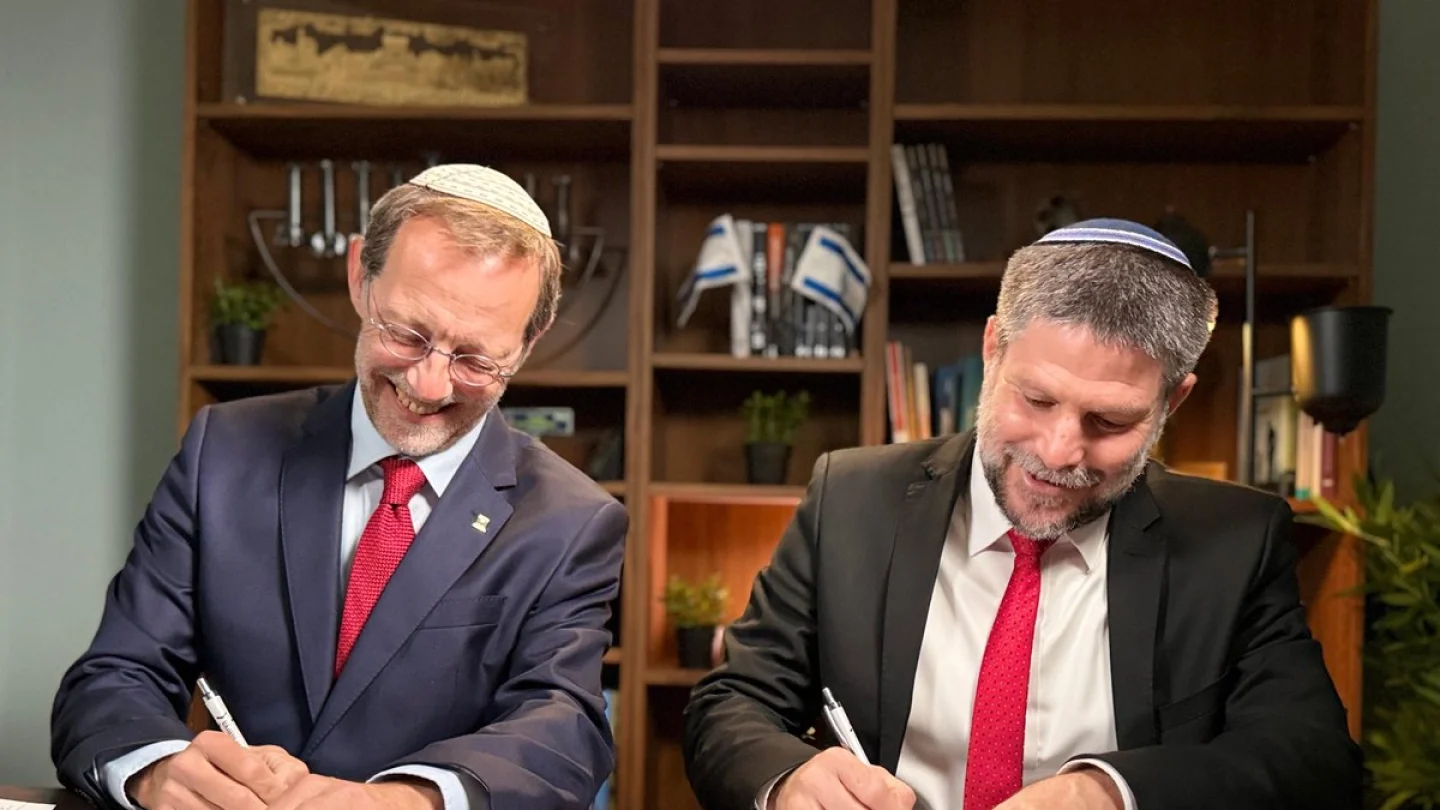
(Oct. 14, 2026 / JNS)
The Religious Zionism (RZP) and Zehut parties enter Israel’s Oct. 27 election on a joint ticket, bringing together Finance Minister Bezalel Smotrich and former Likud MK Moshe Feiglin. Their alliance combines two strands of the Israeli right: Smotrich’s emphasis on religion and settlement, and Feiglin’s Jewish nationalism and libertarianism. Announced on Sept. 1, the agreement seeks to prevent either party’s votes from being lost below the electoral threshold. Both retain their separate identities under a technical bloc that allows them to split after entering the Knesset.
The parties
Smotrich’s party grew out of the National Union–Tkuma joint list. Although RZP inherited a formal rabbinical committee from its predecessor, its contemporary leadership operates primarily through Smotrich and the party’s elected institutions. Senior Religious-Zionist rabbis continue to advise its leaders on major political and ideological questions.
The party adopted the Religious Zionism name in 2021. It advocates strengthening Jewish education and the state’s Jewish character, expanding settlements in Judea and Samaria, and opposing territorial concessions. Its joint list with Otzma Yehudit and Noam won 14 seats in 2022, seven belonging to Smotrich’s party. He subsequently became finance minister and an additional minister in the Defense Ministry, gaining substantial authority over civilian affairs in Judea and Samaria.
Feiglin founded Zehut (“identity” in Hebrew) in 2015 after serving in the Knesset with Likud. The party paired support for Israeli sovereignty over Judea and Samaria with free markets and greater individual choice. It received 2.74% of the vote in April 2019, falling short of parliamentary representation. Following the death of his grandson, Sgt. Yair Levin, in battle in Gaza, Feiglin declared his intention to run in January 2025.
For Feiglin, the party’s commitments to “liberty” and “identity,” its two ideological pillars, are closely connected. “Fundamentally, if you don’t have your identity, you don’t have your freedom,” he told The Jerusalem Post in January 2025. Since Oct. 7, he has argued that stronger Jewish identity must also underpin a change in Israel’s governmental and security doctrine.
The joint slate is dominated by RZP candidates, with Smotrich first and Feiglin second. Settlements and National Missions Minister Orit Strock follows, with judicial-reform leader Simcha Rothman fourth. Tzvika Mor, leader of the Tikva Forum and father of former hostage Eitan Mor, is fifth, followed by reservist commander Itamar Eitam. Zehut also fields Rabbi Yitzhak Zaga in eighth place and reservist officer and “Generation of Victory” leader Omer Patziniach Waldman in 10th.
The platform
Religious Zionism and Zehut both advocate Israeli sovereignty and settlement in Judea and Samaria and oppose Palestinian statehood. Smotrich has pursued that agenda in office, advancing the E1 settlement project between Jerusalem and Ma’ale Adumim, with the stated aim of preventing a Palestinian state. Furthermore, an estimated 259 new outposts, including 186 farming outposts, were established since Smotrich entered office in 2022; the government has also approved more than 100 settlements, including through retroactive legalizations.
Feiglin supports Smotrich’s settlement program in Judea and Samaria, but wishes to expand it to Gaza. He advocates annexing Gaza, removing its Palestinian population and rebuilding Israeli settlements there..
Both parties seek to reduce judicial constraints on elected government. Religious Zionism’s September program would separate the attorney general’s advisory and prosecutorial functions, allow ministers to appoint their legal advisers and restrict who can petition the High Court. An override clause would let the Knesset reinstate legislation struck down by the court.
“The government will be able to govern, the Knesset will be able to legislate,” Smotrich said when announcing the plan. Zehut separately proposes electing Supreme Court justices directly every 10 years and barring the Court from overturning Knesset laws.
RZP generally advocates free-market economics, emphasizing lower taxes, reduced regulation, greater competition and dismantling monopolies. Its approach also incorporates state intervention, including childcare subsidies, proposed taxes on bank profits and public investment in settlements and religious institutions. Smotrich has combined market liberalization with targeted spending to advance social, religious and national priorities.
Zehut’s economic program, by contrast, leans more capitalist, aiming to reduce taxes, regulation and state control. It proposes a low, uniform income-tax rate, lower corporate taxes, removal of import barriers and an end to agricultural production quotas. Its housing proposals would dismantle the Israel Land Authority’s monopoly, privatize land and distribute it to Jewish citizens, while transferring planning powers to local authorities and communities. It presents these changes as a means of lowering living costs.
On education and religion, Religious Zionism emphasizes Jewish education and the state’s Jewish character. Zehut favors parental and community control, proposing publicly funded school vouchers. Zehut also advocates reducing compulsory core-curriculum requirements, while denying vouchers to schools that forgo core studies entirely.
Military service reveals a further distinction. Smotrich supports exemptions for full-time yeshiva students while requiring other eligible Haredi men to enlist. In May, he conditioned support for exemption legislation on Haredi leaders endorsing that requirement. Zehut advocates at least one month of compulsory basic training for all men, regardless of background, with annual refresher service, and a transition toward a professional army.
Both RZP and Zehut advocate strengthening Jewish sovereignty and expanding Jewish worship rights on the Temple Mount, challenging longstanding restrictions on Jewish prayer. Smotrich has called for a synagogue on the Mount, although he does not personally visit it. Zehut explicitly calls for Jewish prayer rights, recognition of the Mount as Judaism’s holiest site and removal of the Islamic Waqf, which currently administers it. Feglien frequently visits the Temple Mount and advocates for increased Jewish visits to the site.
The partners
Although Religious Zionism and Zehut are running for election on a joint ticket, they retain separate agendas. Smotrich has declined to specify which ministries RZP will demand, instead emphasizing settlement expansion, Israeli sovereignty in Judea and Samaria and the party’s judicial-reform program, which he has made a condition for joining the next coalition. Feiglin has declared his intention to demand the Defense Ministry, arguing that Israel needs a fundamental change in security strategy. Zehut candidate Yitzhak Zaga has said the party would refuse to join a government led by Prime Minister Benjamin Netanyahu unless it committed to conquering Gaza, expelling its residents and reestablishing Jewish settlements there.
Both parties have committed to recommending Netanyahu as prime minister. On Oct. 6, Likud signed a surplus-vote agreement with the list, allowing it to cooperate in allocating remaining Knesset seats after the initial distribution.
Both parties have rejected joining a government led by the opposing “change” bloc, although neither has explicitly ruled out cooperation with every party within it. Beyond Likud, the most likely partners for RZP-Zehut are Shas, United Torah Judaism, Otzma Yehudit and the new Amcha Yisrael (“People of Israel”) Party.
In polling over the last two weeks, RZP-Zehut has averaged six seats. Such a result would leave Zehut with only one seat and RZP with five, but the coalition dynamics could still give both negotiating leverage. Most polls indicate neither bloc is likely to win the required 61 seats. An Oct. 12 Channel 14 poll showed the coalition narrowly winning 61 seats; such an outcome could make smaller parties like RZP-Zehut pivotal to coalition formation and strengthen their demands for legislative and administrative concessions.