
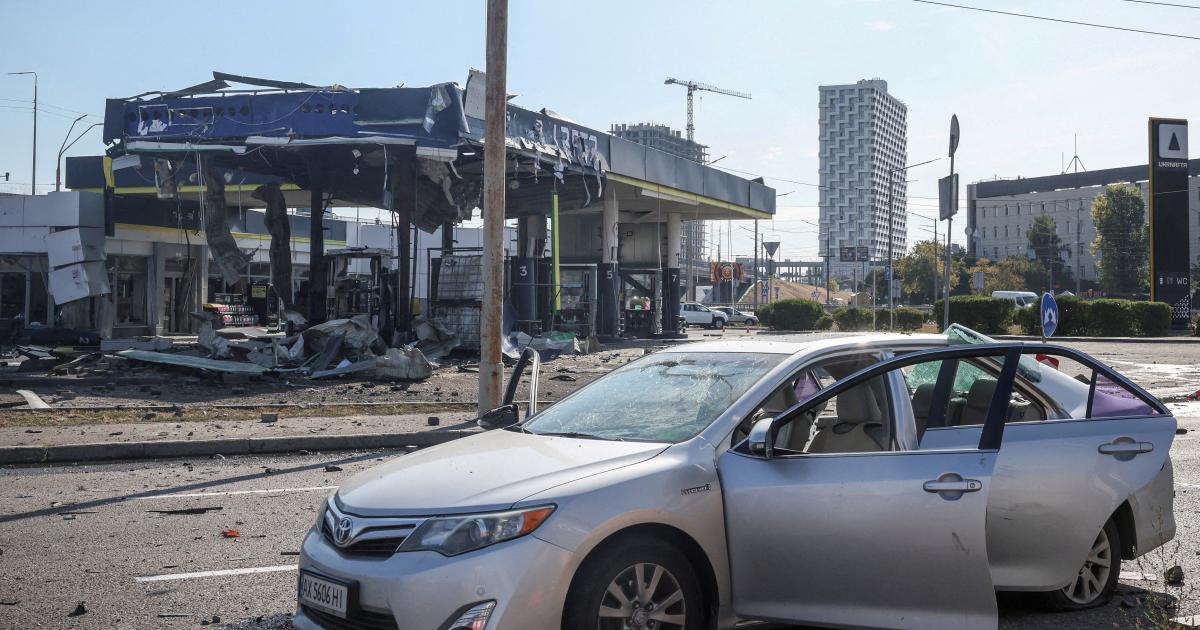
Ukraine is facing its most precarious moment since the early days of the war. Since late July, Russia has used its growing stockpile of ballistic missiles and a new generation of jet-powered drones to dramatically intensify its long-range attacks. It is now targeting Ukrainian population centers all over the country, with a focus on logistics, transportation, and commercial infrastructure. According to Ukrainian intelligence reports, the Russian government is planning an even more intense campaign against energy and water supplies this winter in an attempt to decisively break Ukraine’s economy and society.
On October 9, U.S. President Donald Trump seemed to make Ukraine’s situation even more perilous when he announced a deal with Moscow to unilaterally lift sanctions on Russian diesel and called on Ukraine to suspend strikes on Russian oil refineries. Those strikes have been one of Ukraine’s most potent forms of counterpressure in recent months. But Trump’s unexpected announcement is not necessarily a major setback for Ukraine. It comes amid a broader shift by the Trump administration in recent weeks to move away from pursuing an elusive comprehensive peace agreement in favor of a mutual cease-fire on strikes against energy infrastructure—a shift that could ultimately be beneficial to Kyiv. Moreover, in his angry retort to Ukrainian President Volodymyr Zelensky’s criticism of the diesel deal, Trump revealed a potential way forward: as long as Ukraine stopped hitting Russian refineries, the president said, “you can do whatever you want to Russia.”
Ukraine should take Trump at his word. If upheld by Moscow as well as Kyiv, an energy cease-fire would be a crucial step toward containing the war. Framed in the right way, it would also leave open other forms of pressure by Ukraine that could help compel Russian compliance. Ideally, a reciprocal halt in long-range air and missile attacks could then be replicated across other sectors—maritime, commercial, and transportation—thus forming the basis of a broader aerial cease-fire.
Thus far, Russian President Vladimir Putin has given no indication that he is prepared to halt or even curtail his strike campaign. He sees the widespread destruction of Ukrainian cities and infrastructure as his most direct path to victory. But Putin is also under pressure from the widening war. In part, his accelerating air campaign reflects weakness on the frontlines, where Russia has achieved negligible progress throughout 2026 and Ukraine has even begun to make some gains in the Donbas. Russia also faces growing costs at home from Ukraine’s long-range strikes, which have disrupted energy and commercial infrastructure and heightened public anxiety over a prolonged war.
The United States and Europe can capitalize on Russia’s mounting challenges if they allow Ukraine to apply targeted pressure to convince Moscow to agree to pause or significantly limit its reckless air campaign. To be effective, this approach needs to be combined with focused diplomacy aimed at that specific objective. In fact, there are tools available for this purpose, and the barriers to putting them quickly into play are far more surmountable than has been commonly recognized.
The key will be credibly signaling that critical Russian military and economic assets will be at risk if Russian forces continue pummeling Ukraine’s civilian economy and society. Only then might Putin conclude that his current approach has reached the point of diminishing returns—and then pivot, as he has done at other junctures in the war. At the same time, this diplomatic play must be hitched to a broader effort by Kyiv’s Western partners to help it urgently shore up its air defenses and finances ahead of winter. Such a strategy may not immediately succeed, but failing to try would all but ensure that Ukraine suffers an extraordinary degree of damage that will be much harder to reverse.
PRESSURE POINTS
The Trump administration’s repeated failure to advance its stated goal of brokering peace between Russia and Ukraine has led many observers to write off diplomacy as a waste of time. Over the past 21 months, the Trump administration has gotten nowhere in its attempts to mediate a comprehensive peace settlement. Russia’s war aims and Ukraine’s requirements—on such thorny issues as territory, Ukrainian security arrangements, and Russia’s future relations with the West—are simply too far apart. Washington also missed opportunities to build meaningful leverage over Russia, instead lavishly courting it with potential commercial deals and other incentives while pressuring Kyiv to accept Moscow’s conditions.
Yet that experience has helped drive the administration’s current efforts to achieve more plausible and narrowly defined goals. Following their visits to Moscow and Kyiv in early September, Trump’s envoys, Jared Kushner and Steve Witkoff, pivoted toward a more limited energy cease-fire. Since then, the president has also reiterated his support for such a deal. Trump’s interest in an energy cease-fire is largely self-serving—he has attributed spikes in fuel prices to Ukraine’s strikes on Russian oil refineries—but this shift could serve Kyiv well, especially if it becomes the basis for a coordinated drive to secure broader reciprocal limits on air and missile attacks.
The core challenge is convincing Russia to embrace such an agreement. To date, Putin has rejected calls for restrictions on aerial strikes of any sort. He views the damage he is inflicting on Ukraine as outstripping the pain Russia is sustaining from Kyiv’s attacks. But the United States and European countries have several ways to change this calculus. Crucially, the United States and Europe must enable Ukraine to strike missile launchers and other military targets inside Russia—or at least allow it to credibly threaten to do so. Thus far, Ukraine has largely focused its long-range attacks on energy infrastructure, because targeting Russia’s hardened military installations and mobile launch systems is technically much more complicated. But it is exactly these harder-to-replace assets that Putin is most concerned about losing.
An energy cease-fire would be a crucial step toward containing the war.
In fact, it would not be difficult for the United States to facilitate strikes on military assets. For months, Ukraine has pressed the Trump administration and the SpaceX CEO Elon Musk to enable Starlink access over a swath of Russian territory opposite the Ukrainian border from which most ballistic missiles are launched. Kyiv needs such access to allow its drone teams to target mobile launchers. As soon as Ukraine acquires this ability, Russia would likely be compelled to pull the rest of these systems farther away from the border, thereby considerably reducing the ballistic threat to Ukraine. Thus far, Trump and Musk have both deflected Ukraine’s request—each one claiming the decision rests with the other. But neither has foreclosed greenlighting such access.
Kyiv’s case for acquiring Starlink access over Russia might be more persuasive if Ukrainian officials focused on how it could be deployed as negotiating leverage, as part of a wider U.S.-led diplomatic strategy to secure an aerial cease-fire—especially if it were an element of an agreement with Washington to refrain from striking Russian oil refineries. Specifically, Trump could authorize access without public fanfare while signaling to Moscow that he is doing so only until an aerial cease-fire is in place. There is reason to think such a tactic would succeed. Earlier this year, Musk worked with Ukraine to create a registration system that effectively limited Starlink use to Ukrainian drone operators, a step that for a short period sent Russian forces into operational disarray along the front. Washington missed a chance to exploit that moment of Russian weakness to push Moscow toward a tactical de-escalation, however, because U.S. attention shifted just weeks later to the war against Iran.
The German government has a similar card to play. Kyiv has long sought to get Germany’s Taurus air-launched cruise missile, which would allow it to target fixed sites hundreds of miles into Russia, such as defense plants that produce jet-powered drones and ballistic missiles. Thus far, German Chancellor Friedrich Merz has resisted sending the Taurus system to Ukraine, arguing that it would be escalatory and would require a level of on-site technical assistance that would make German forces party to the conflict. But Merz might be persuaded to relent—or at least to authorize Ukrainian troops to start training on the system—if he believed that doing so would create momentum toward an aerial cease-fire, ideally in lockstep with a move from Trump on Starlink. In turn, other European partners could also contribute to such a plan by leaning in more with intelligence and technical expertise to enable Ukraine to target launchers inside Russia.
EUROS AND PATRIOTS
Any such leveraged diplomacy, of course, will depend on Ukraine’s partners showing that they remain committed to addressing Ukraine’s immediate war needs and that Russia will not succeed in its stepped-up campaign to break the country this winter. And this means having a coherent immediate strategy for shoring up both Kyiv’s air defenses and its economy, irrespective of U.S. involvement or support.
Above all is the question of Patriot interceptors. For Ukraine, the Patriot’s PAC-3 variant is by far the most effective protection against Russian ballistic missile attacks. Yet Kyiv’s stockpile has dried up as the United States husbands an arsenal that has been significantly depleted by the Iran war. Kyiv’s European partners have been scouring the world for Patriot missiles but have so far been unable to meet Ukraine’s modest request of 300 interceptors to get through the winter. Countries with robust Patriot stocks, such as Greece, Japan, South Korea, and Spain, have been reluctant to transfer them to Ukraine for a variety of security and legal reasons.
Here, Europe should take a page from an earlier U.S. playbook. During the Biden administration, U.S. officials cajoled recalcitrant partners and engineered creative multiparty swaps and backfill agreements—many of them subsidized by the United States—to free up critical munitions for Ukraine. For example, the United States bought 155-millimeter artillery shells from South Korea and PAC-3 interceptors from Japan to backfill American munitions for Ukraine. This time around, Ukraine can finance the purchases itself through the loan package it is receiving from the EU.
On the economic front, Ukraine’s most acute needs could be met if the EU agreed to frontload the disbursement of the tranches of its 90 billion euro loan that are scheduled for next year. EU leaders have made clear that Kyiv must first meet Brussels’ reform conditions to secure the tranches of the loan already promised this year. But the EU will also most likely need to find additional resources because the loan itself, expected to last through 2027, will fall short of meeting Ukraine’s needs.
In August, the Netherlands, Poland, Spain, and Sweden again proposed the option of tapping into Russia’s frozen sovereign assets, an estimated $240 billion of which reside in the EU, mostly in the Belgium-based financial services company Euroclear. The legal and political obstacles to taking custody of those assets for onward transfer to Ukraine may be too formidable to resolve in time to help Kyiv in the coming year. But Ukraine’s partners have come up with creative solutions in the past. In 2024, the G-7 designed a $50 billion loan to be serviced by the future windfall profits generated by the frozen Russian assets. The EU’s 90 billion euro loan is another creative example: it is financed from EU borrowing on capital markets, to be repaid by Ukraine only if Russia pays reparations; otherwise, the EU has reserved the right to reimburse itself with the frozen Russian assets. The EU and likeminded partners—notably Canada, Japan, and the United Kingdom—can revisit and expand both mechanisms to generate additional funding for Ukraine while steering clear of political poison pills.
COORDINATED COERCION
Ultimately, each of these steps needs to be coordinated to have maximum influence on Putin’s thinking. The fact that the Trump administration invited top European officials to join last week’s talks with Ukrainian negotiators in Miami is a sign that such transatlantic coordination is possible, even if Washington’s ties with Europe are otherwise strained. On the other hand, reports that the Trump administration has threatened to cut off intelligence support and supplies of air defense missiles and other critical munitions for Ukraine underscore the reality that Washington is at best a capricious interlocutor. In any case, European leaders who have constructive working relations with the White House, such as Finnish President Alexander Stubb, should continue arguing that granting Starlink access, among other steps to pressure Moscow, would advance Trump’s stated aim of de-escalating the conflict.
Putin is committed to his overall war aims, and no amount of external pressure is likely to force him to abandon those. But he is an opportunist and has shown himself adept at making tactical adjustments in pursuit of his broader ambitions. In early 2022, he gave up his ground attack on Kyiv when it became evident that it would fail. Later, he pulled the Black Sea Fleet away from Ukraine’s shores after Kyiv proved it could sink valuable Russian naval assets; in 2022, he also entered the Black Sea Grain Initiative, which for nearly a year allowed the safe passage of grain shipments from Ukrainian ports and was brokered by the United Nations and Turkey, under pressure from African nations suffering from grain shortages.
For Putin, these were not goodwill gestures but measures of self-preservation designed to advance his broader aim of subjugating Ukraine. With the right kind of leverage applied by the United States and Europe, there is no reason to assume he would rule out a similar pullback from attacks on Ukrainian civilian populations and economic infrastructure. He would be even more inclined to view an aerial cease-fire as advantageous if he saw an expansion of Ukraine’s ability to upend life in Russia’s major population centers—a goal Kyiv no doubt is intent on pursuing, as shown by its effective recent strikes on Russian data centers.
Of course, there is the possibility that, even faced with these new costs, Putin will still refuse to budge. But in that scenario, enabling Ukraine to target Russian missile launchers and defense production sites—combined with continued economic pressure—will be even more essential to helping Ukraine counter Russian escalation. In addition to relieving immediate pressure on Ukrainian cities by making it harder for Russia to launch strikes, it will also undercut Russia’s military capacity. That would be beneficial even if it falls short of containing the air war.
Paradoxically, the adaptability that has enabled many of Putin’s successes also gives Kyiv and the West more space to maneuver than they realize. Trump, Zelensky, and European leaders need to organize their actions in a way that relieves pressure on the Ukrainian economy while showing growing willingness to exploit critical Russian vulnerabilities. Only then might Putin consider that he is better off making a tactical adjustment—in this case, agreeing to an aerial cease-fire—than maintaining the present course. He would do so not to concede but to find a more effective way to achieve his broader aims. In that adjustment period, Kyiv and its partners will gain urgently needed breathing space to regroup, fortify, and prepare for the next round.
Loading…