
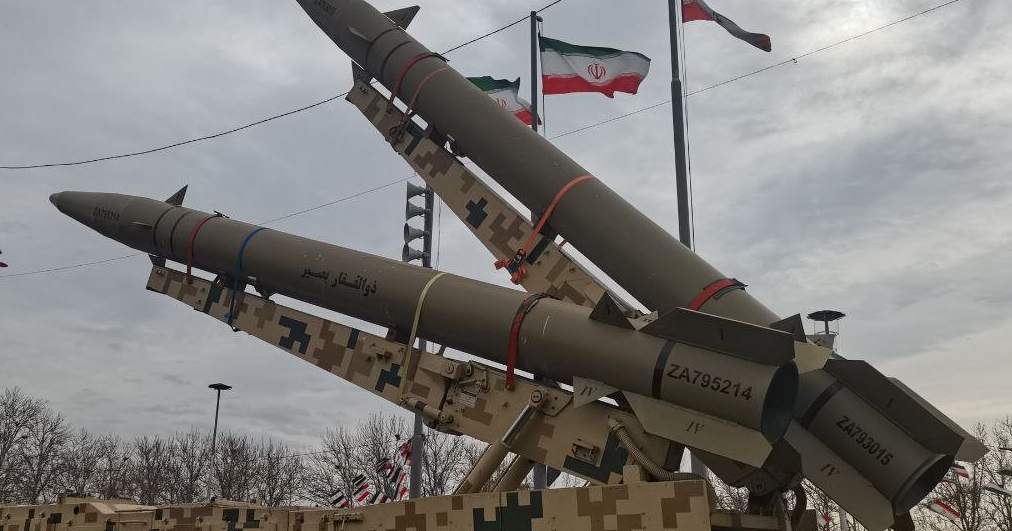
Twelve vessels were attacked between October 5 and 11, including six on Sunday alone, and on Tuesday a tanker and a container ship were struck by unknown projectiles, according to UK Maritime Trade Operations (UKMTO), marking one of the most intense periods of attacks since the war began.
Rear Admiral Ali Azmaei of Iran’s Islamic Revolutionary Guard Corps Navy warned Tuesday that Iranian forces would sink US warships approaching the Strait of Hormuz, saying they were “counting down” to a possible confrontation in the strategic waterway.
The escalation comes as the US blockade has effectively halted Iran’s crude oil exports, while other Persian Gulf producers have increasingly succeeded in moving their oil through the strategic waterway, threatening to erode one of Tehran’s remaining sources of leverage. Brent crude settled at $105.69 per barrel Tuesday, snapping three consecutive sessions of gains, as traders weighed continued Middle Eastern supply disruptions against other market developments.
Charlie Brown, a maritime security expert with United Against Nuclear Iran (UANI), believes the timing may be linked to President Donald Trump’s announcement that Washington would not launch new attacks against Iran before the November 3 midterm elections.
“I think Trump signaled it, right? He said he wouldn’t attack until the election,” Brown told Iran International.
“So, you know, now they’re taking that as word, I guess. And testing it and taking advantage of the situation.”
Brown said the absence of direct American retaliation for the latest strikes may be encouraging Tehran to push further.
Two senior Iranian officials separately told Reuters that Tehran had changed the type and pace of its attacks, with one goal being to influence the US midterm elections and frustrate efforts to lower global oil prices.
“Every attack that goes without a response probably encourages a follow-on attack,” he said.
The calculation extends beyond the military confrontation. Although the United States is less dependent on Persian Gulf oil than many Asian economies, disruptions affect global energy prices and American consumers.
Brown suggested Tehran may be exploiting that vulnerability at a politically sensitive moment, when rising gasoline prices could increase pressure on the White House.
An October surprise?
Shahram Kholdi, a historian of Iran, sees a potentially more ambitious calculation: an attempt to engineer an “October surprise” that could put Trump under pressure ahead of the elections.
Kholdi believes Tehran may have used the relative lull in hostilities to preserve its remaining military capabilities, replenish weapons stockpiles and prepare for a politically advantageous moment to escalate.
“It seems to me that they are headed towards that October surprise moment,” he told Iran International.
But Kholdi warned that the strategy could backfire if Tehran moves beyond commercial shipping and attempts to strike American naval assets with advanced missiles.
The danger, in his assessment, is that Tehran may mistake temporary American restraint for an unwillingness to retaliate.
Iran threatens recovery in Persian Gulf oil flows
The latest attacks threaten to reverse a recovery in Persian Gulf oil shipments that had begun to weaken Tehran’s ability to disrupt global energy supplies.
Despite the war, producers had managed to increase exports through Hormuz, aided by US protection measures, larger tankers and costly arrangements to move cargo through the threatened waterway.
Oil flows out of the Persian Gulf averaged approximately 15.5 million barrels per day in September, their highest level since the war began, according to recent data by Kpler.
But shipments have since fallen sharply. Just 2.9 million barrels passed through Hormuz on October 11, the lowest daily volume recorded this month, according to Kpler.
The figures underscore the vulnerability of the recovery, although daily flows can fluctuate significantly and do not alone establish how much of the decline resulted directly from the attacks.
Brent crude settled at $104.77 per barrel Tuesday after three consecutive sessions of gains, as traders weighed continued Middle Eastern supply disruptions against other market developments.
Tom Sharpe, a former Royal Navy commander, said the earlier recovery in oil volumes had masked the dangers facing commercial vessels.
“We’re at sort of pre-war levels of oil, but in far fewer ships,” he told Iran International.
Sharpe described large tankers making high-risk passages with enhanced American protection, sometimes sustaining strikes before reaching safer waters and transferring cargo to other vessels.
In some cases, he said, crews are also transferred after completing the most dangerous part of the journey.
“It’s not working. Iran is still striking,” Sharpe said of the enhanced protection measures.
According to the Joint Maritime Information Center, US-facilitated vessel movements through Hormuz averaged approximately 29 per day over a recent 72-hour period, compared with a historical average of roughly 138 daily transits.
Undermining confidence in shipping
Brown said Iran does not need to stop every vessel to undermine confidence in the safety of the waterway.
Exceptionally high tanker charter rates have encouraged some operators to continue despite the danger, but others may decide the financial rewards are not worth risking their vessels and crews.
“There will always be some that take the risk because the profits are so big right now,” he said.
The threat has also spread beyond the strait, with vessels attacked near Oman’s Sohar anchorage and elsewhere in the Persian Gulf.
Brown believes Iran continues to receive Russian and Chinese intelligence assistance, potentially including satellite imagery and vessel-tracking information that does not rely on ships’ Automatic Identification System signals.
“I’m confident that that’s still happening on a daily basis,” he said.
The escalation comes amid renewed diplomatic contacts between Tehran and Washington, with Iranian officials saying the United States has accepted some of Tehran’s conditions for de-escalation but that its response remains insufficient.
Trump said Tuesday that Washington would make a decision on Iran “very soon.”
“We’ll make a decision on Iran very soon,” Trump told reporters, describing Iran as a “failed country” with no economy, inflation of 300 percent and a government unable to pay its troops.
The United States continues enforcing its maritime blockade, while Trump has said Washington will not resume strikes against Iran before the November 3 elections.
Sharpe noted that the surge in attacks on shipping is occurring alongside intensified strikes by the Iran-backed Houthis against Saudi Arabia.
“There’s an Iranian and Houthi escalation going on here that’s not being matched. How long will that carry on for?” he said.
The simultaneous pressure on Persian Gulf shipping and Saudi infrastructure risks widening the confrontation at a time when diplomatic efforts have yet to produce a settlement.
The stakes for Tehran are particularly high.
Kpler data shows no Iranian crude oil or condensate loaded onto tankers throughout September, leaving the Islamic Republic increasingly dependent on its ability to threaten shipments from neighboring producers to maintain leverage over Washington.
But the strategy carries a significant risk: an attack causing substantial casualties or striking US military assets could trigger the kind of direct American retaliation Kholdi warned Tehran may be underestimating.