
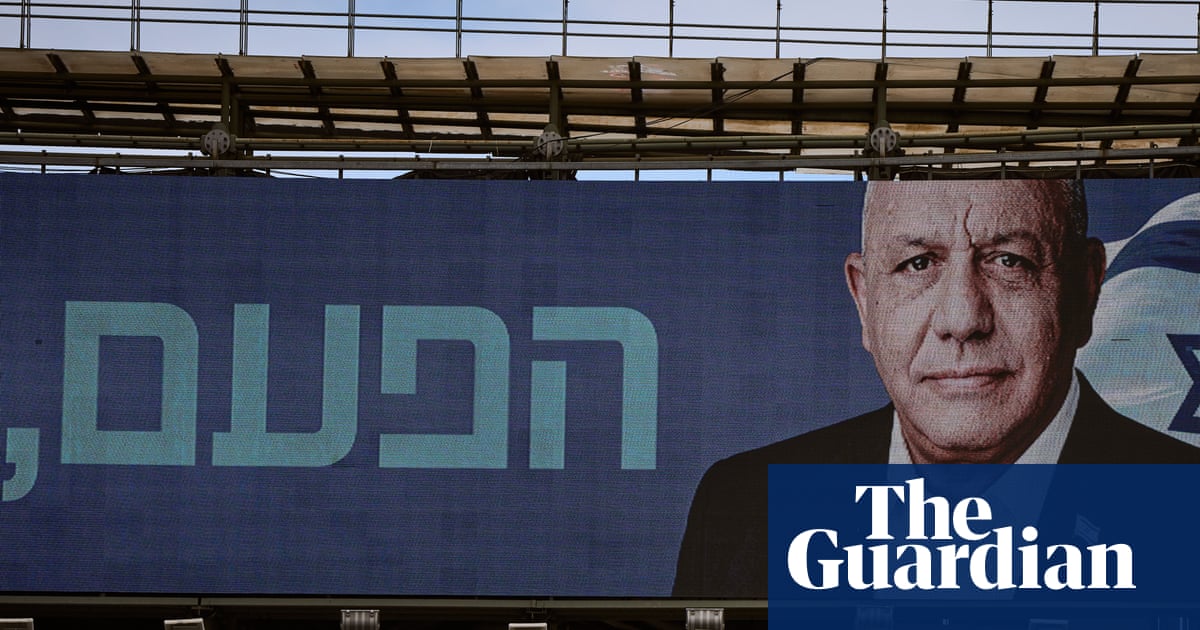
He has been called the man who is everything the Israeli prime minister, Benjamin Netanyahu, is not.
Gadi Eisenkot, a former general and the main opposition candidate in Israel’s elections this month, is unpolished where Netanyahu is slick.
To Israelis he is both menschy (decent) and schlumpy (unkempt), his crumpled appearance contrasting with Netanyahu’s hair rinse, makeup and obsessive need to control his media depiction.
In the Israeli commentator Anshel Pfeffer’s framing, he is the anti-Bibi among a roster of wanna-Bibis.
And in an era of Israeli politics that has been defined by betrayals, dirty tricks and public and private smears, Eisenkot’s brand is rectitude. He only entered politics four years ago, and the name of his party – Yashar – means “straight” or “honest”.
Gadi Eisenkot at a roadside bomb shelter near Reim, southern Israel, on the third anniversary of the 7 October 2023 attacks. He is pushing for a full investigation of the intelligence failures that led to the attacks. Photograph: Nir Elias/Reuters
But on key issues, an Israel under Eisenkot may not look very different, as he has been non-committal on crucial issues – including the two-state solution and Israeli settlement of the occupied West Bank.
“He’s not sleek. He’s not corrupt. I think he’s going to be looking more inwards than outwards. Because he’s a military guy, he’s interested in calming the waters,” said Mairav Zonszein, a senior analyst for the International Crisis Group.
“[But] he’s hedging a lot.”
For many voters, Eisenkot’s appeal is less about ideology than the vibe around him.
Key to his appeal, said Dahlia Scheindlin, an Israeli pollster and political analyst, is his “very modest background”.
While Netanyahu is the son of a Polish-born academic, Eisenkot’s family were Mizrahi Jews from Morocco. He joined the army as an infantryman, and worked his way through the ranks to become the Israeli military’s chief of staff.
Eisenkot insisted in 2024 that Israel was unlikely to win ‘total victory’ over Hamas. Photograph: Amir Cohen/Reuters
“The fact that he’s from a working-class background, from a peripheral area, contributes to an overall sense that voters see in him somebody who is more with the people,” Scheindlin said.
“He’s seen as empathetic. He’s seen as straightforward. That’s why I think they probably focus-tested the names of the party, and people probably thought he seemed very honest.”
But if ideology remains an important predictor of how Israelis will vote, what precisely does Eisenkot believe in?
On the domestic front, he is pushing for a full investigation of the intelligence failures that allowed Hamas’s deadly 7 October 2023 attack. More divisive is his support for the end of the military draft exemption for the ultra-Orthodox, long a source of friction in Israeli society.
Eisenkot opposes the planned E1 settlement block that is seen as a potential obstacle to any future Palestinian state. Photograph: Amir Cohen/Reuters
On the biggest issues, not least a two-state solution that would create a Palestinian state – he is ambiguous.
“I’ve never said that the solution is two states for two peoples,” Eisenkot said on the campaign trail. “There is a very deep religious-national conflict here, and anyone who thinks an agreement can be reached now is gravely mistaken.”
On the broader issue of Jewish settlements in the West Bank, Eisenkot is also evasive. He opposes the planned E1 settlement block that is seen as a potential obstacle to any future Palestinian state, but he supports settlement in general.
Where Eisenkot separates himself from the current government, is over Netanyahu’s decision to place the far-right, pro-settler minister Bezalel Smotrich in charge of the occupied West Bank, where there has been a surge of settler violence, prompting widespread international condemnation and sanctions.
Eisenkot (right) criticised Netanyahu for saying that Israel needs to become a ‘super-Sparta’. Photograph: Abir Sultan/EPA
Eisenkot has said he would immediately “reverse” that situation and put the army back in charge of the West Bank.
Sceptics say Eisenkot and his allies are pushing for a return to an old, failed strategy: managing the conflict with the Palestinians – not solving it – with an aim of mitigating international pressure on Israel.
“What Eisenkot and the rest are basically saying,” said Prof Yossi Mekelberg of the Chatham House thinktank, “is we’ll be better CEOs. We’ll manage the country better, not take it in a different direction … They are not really talking about the Palestinian issue.”
Eisenkot is unequivocally not a dove in his views on the use of military force. As Israel’s northern front commander during the 2006 second Lebanon war, he was the architect of the notorious Dahiya doctrine, promising that Israel would wield “disproportionate power … and cause immense damage and destruction” – a policy that would see its fullest expression in the current Gaza war.
On Gaza, he has been more of a military realist, insisting two years ago that Israel was unlikely to win “total victory” over Hamas, and calling for a strategy that prioritised the lives of hostages still held by Hamas. His son Gal Meir Eisenkot, 25, died of his wounds in late 2023 after an operation in Gaza to recover the bodies of Israeli hostages.
Eisenkot’s philosophy governing the use of state violence is not the same as Netanyahu’s, who he criticised last year for saying that Israel needs to become a “super-Sparta” – a militarised state, feared by its neighbours.
But while observers say an Eisenkot administration would be likely to crack down on settler violence in the West Bank, they wonder if it would go much further.
“I think that is the low-hanging fruit and about half of Israeli society feels it would be good to crack down more [on violent settlers],” said Scheindlin. “It would help his foreign relations,” she added, but wondered whether there would be “a second step”.
And even if Eisenkot wins sufficient votes to take the lead in putting together a coalition, there is question of how long such a government could survive – and what room he would have for making policies.
“There will be a change if there is a different government,” said Mekelberg, “But I think it’s about managing expectations.
“He would not be a prime minister who is facing corruption allegations [like Netanyahu]. I see it potentially as a government of containment, where there is an opportunity to build relations with the world again and not just [have ministers making] statements that lead you to the international court of justice and the international criminal court.”
While Eisenkot has captured a moment for those who oppose Netanyahu, Scheindlin wondered how much is down to his character – and how much is projection.
“I think Israel can get back to a normal path as long as there’s somebody who actually cares about the people. And people have projected on to him that he really cares about the people.
“The more people see him, the more they project on to him the things that they want to see: he’s the one who will bring ‘professionalism’; he is the one who enjoys the aura of being ‘above politics’ because he comes from the army.”
Shai Bazak, an Israeli former diplomat and communications figure and former adviser to Netanyahu, argued that Eisenkot’s main selling point may well be that he will not take dramatic action.
“After a very charismatic and dominant leader, people deliberately choose someone less charismatic because they simply want peace and quiet,” he told Politico. “They do not want all the drama any more.”