
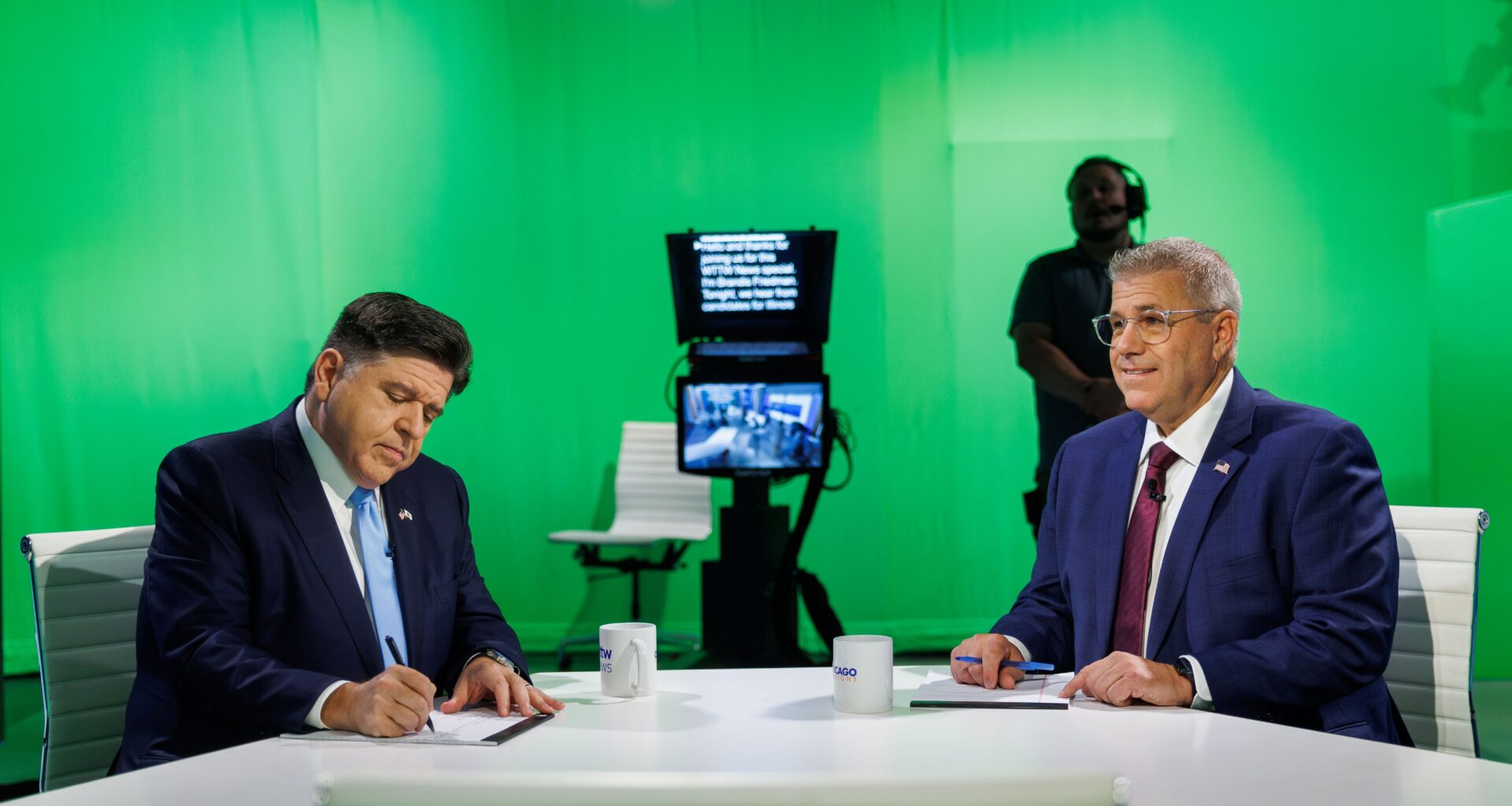
The lone scheduled face-to-face meeting between the major-party candidates for Illinois governor was largely viewed as the biggest opportunity for poorly funded Republican challenger Darren Bailey to make his case for defeating Democratic Gov. JB Pritzker.
Instead, the chippy Tuesday night affair reverted to anticipated themes, with Bailey repeatedly attacking and interrupting Pritzker, while the governor countered by casting the Republican as a conservative extremist and a follower of President Donald Trump.
Bailey, a downstate farmer seeking to reverse his loss to Pritzker four years ago, sought to turn the governor’s frequent invocations of Trump into a game. He said Pritzker was using the president as a diversion to avoid having to “own the failures and the problems of Illinois” and urged viewers to take a drink of “your water, or your iced tea or your lemonade” every time Pritzker said Trump’s name.
The hourlong forum was held at WTTW’s studios on Chicago’s Northwest Side and was scheduled to be rebroadcast on downstate public television stations in the coming days, with less than three weeks left before the Nov. 3 general election.
It was the first time the two had shared a stage since they debated twice in the final month of the 2022 campaign. Independent candidate Collin Corbett, a former Republican political operative, did not meet WTTW’s criteria to participate.
Bailey, whose two runs for governor have been endorsed by Trump, has tried to escape the president’s unpopularity in populous northeastern Illinois by focusing his campaign on local issues such as crime and property taxes while avoiding his evangelical Christian conservative opposition to abortion and LGBTQ+ rights.
Though both candidates trotted out familiar themes that stretched back over four years and Bailey’s unsuccessful 2022 challenge to Pritzker, some issues were new.
Pritzker said he expected lawmakers to act during the fall veto session after the November election on legislation to keep the Chicago Bears in Illinois, as the team considers an offer from Indiana’s GOP-led government to move to Hammond.
To make the legislation more palatable to Chicago lawmakers, the measure would give the Bears the option to either stay in the city or develop the former Arlington International Raceway property in Arlington Heights, which the team purchased as a potential stadium site for $197 million in 2023.
Bailey, however, contended Indiana Gov. Mike Braun had assured him the NFL team was moving across the border.
“I’m just glad I’m not going to be known as the governor that lost the Bears,” Bailey said. “It’s already done. (Indiana) Gov. (Mike) Braun’s assured me of that.”
For his part, Pritzker pointed to his recent meeting with NFL Commissioner Roger Goodell, Bears minority owner Pat Ryan and legislative leaders in Chicago as an indication that a deal could be reached.
“I believe that in November we’re going to be able to get something done to keep the Bears in the state of Illinois,” Pritzker said. “But I’m not going to do it at the expense of the taxpayers.”
Speaking to reporters after the debate, the governor went a step further, reviving the possibility that the team could stay not just in the state but in its namesake city.
“We understand reasonably well what it is that they want. Sometimes their views have shifted, but that’s OK,” Pritzker said. “We’re trying to negotiate something, and I think we’re closer now than we have been before. And I do think that we can give the Bears the option of being in the city of Chicago or being in Arlington Heights, and I think that’s the best way to get this done.”
On Wednesday, Pritzker said separate proposals approved this spring in the House and Senate that aim to keep the Bears in Illinois remain on the table in negotiations. One would allow the Bears and other developers of so-called megaprojects to negotiate with local governments for an annual payment in place of regular property taxes. The other would create a local stadium authority, a mechanism to build a privately funded, publicly owned stadium and avoid property taxes altogether.
“This is how business deals get done,” Pritzker said after making a campaign stop at the University of Illinois Chicago to receive endorsements from several healthcare groups, including the Illinois State Medical Society, Mental Health PAC and Planned Parenthood Illinois Action. The Bears are “trying to figure out what’s the best deal they can get that looks like (payment in lieu of taxes)? What’s the best deal they can get that looks like a stadium authority? … Can either one of those pass the legislature? All those things have been discussed and are being discussed.”
Illinois voter guide to the 2026 midterm elections in November
During Tuesday’s debate, Bailey, who co-founded a private religious school near his downstate home of Xenia, suggested he would sharply reduce state oversight of public schools.
“Less government might have a lot to do with that,” he said, pointing to and criticizing the property tax-dependent way schools are funded in the state. He also said it might be better to allow “local school boards and local communities to decide how they want to educate their children.”
Pritzker said the state has put more than $3 billion in additional dollars into public schools during his tenure and noted local school boards levy property taxes, citing Bailey’s record of backing real estate tax hikes as a local school board chair. But Pritzker also signaled Chicago Public Schools is unlikely to get the $150 million in additional state funding built into its budget.
“We can’t just magically come up with $150 million,” Pritzker said.
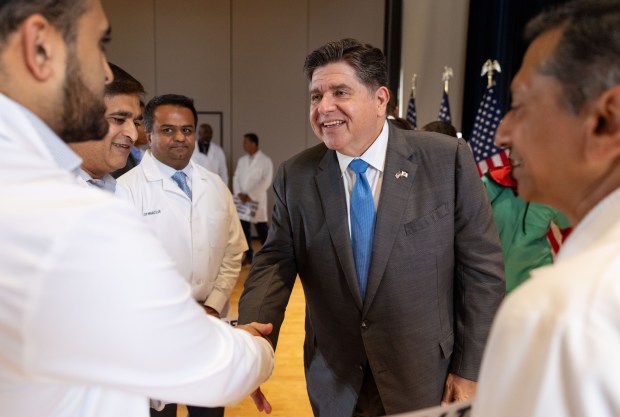 Gov. JB Pritzker greets health care workers after accepting endorsements during a campaign event Oct. 14, 2026, at the University of Illinois Chicago. (Brian Cassella/Chicago Tribune)
But it was the shadow of the national economy under Trump, including rising food and gas prices caused by the war in Iran and the president’s tariffs, that continued to hang over Bailey during the Tuesday debate.
At one point, the Republican contended that a line of questioning about how the state should cope with tariffs on agricultural products and with Medicaid cuts that threaten hospital closures “sounds like this is a debate about the presidency of the United States with President Trump.”
“That’s something that the president deals with,” Bailey said. “We need to be focused on what we can do here in Illinois.”
Pritzker countered that Bailey had failed to stand up to Trump policies that will cut Medicaid benefits for half a million Illinoisans and federal food aid for 120,000 people in the state.
“What Darren Bailey is not saying to you is how he has pushed back. He has not. He thinks it’s OK. He sat silently while Donald Trump has taken these things away from people in the state of Illinois,” Pritzker said. “I think people deserve healthcare.”
But even as Bailey has sought to distance himself from Trump, in an appearance before the Chicago Tribune Editorial Board on Wednesday he contended his relationship with the president would be beneficial in contrast to Pritzker, whose “refusal to work with the president is drastically hurting all of Illinois.”
“We are in a position here in Illinois that I don’t know why the fact that I’m a Republican and why I’ve been endorsed by (Trump) matters,” Bailey said. “So, if nothing else, OK, why not get a hold of somebody that has an in and can maybe get something done faster to help Illinois?”
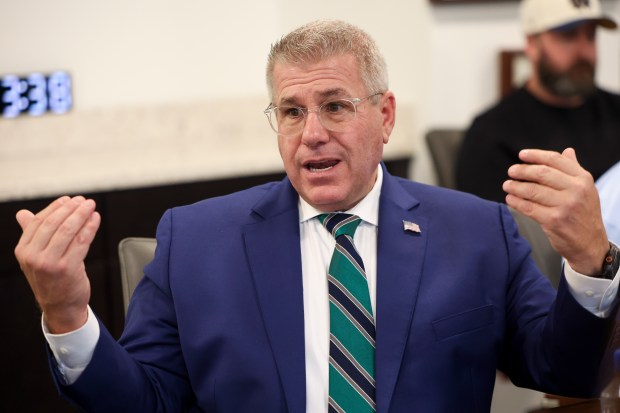 Republican gubernatorial nominee Darren Bailey participates in an editorial board endorsement meeting at the Chicago Tribune office Oct. 14, 2026. (Eileen T. Meslar/Chicago Tribune)
While Bailey’s campaign has lacked the money to get its message out beyond social media and digital ads, two topics he’s tried to hit hard are crime and local law enforcement’s interactions with immigrants in Illinois without proper paperwork.
During the debate, Bailey restated his opposition to the state’s elimination of cash bail for nonviolent offenders and to sanctuary policies on immigrants that limit cooperation between state and local police and federal immigration authorities.
The Republican acknowledged that Operation Midway Blitz, the deadly Trump-backed immigration enforcement surge that began largely in the Chicago area last fall, “didn’t go very well” and that “mistakes were made.” But he blamed Pritzker for having “stood up and rallied the people to go to the streets … and create division” over the federal operation.
Pritzker, criticizing federal agents for detaining U.S. citizens because of their race, ethnicity or language, said: “I do not think that is the country that any of us want.”
A new subject this time was Pritzker’s potential bid for the 2028 Democratic presidential nomination.
“I’m not running for president like JB is,” Bailey said. “I’m running for what I can do as governor here in the state of Illinois.”
Pritzker told Bailey he was “flattered that you think that I could get elected president of the United States.”
“But I’m running for reelection as governor of the state of Illinois because I believe that we need to fight for the working families of this state … and to make sure that Darren Bailey does not get elected because he wants to roll the red carpet out for Donald Trump,” Pritzker said.