
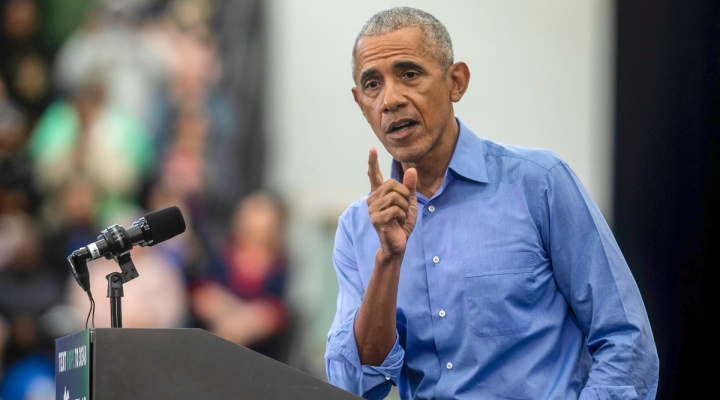
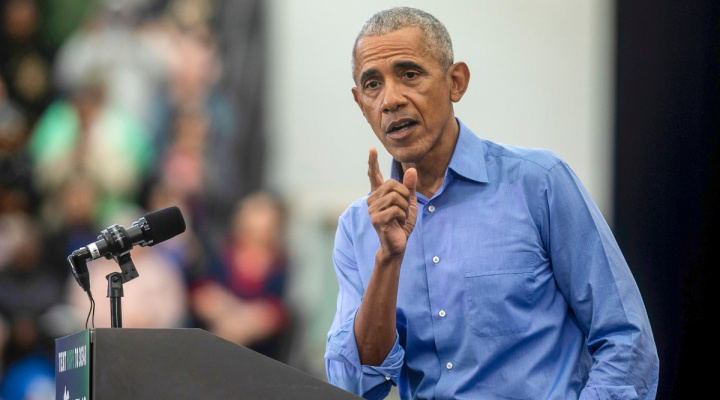
Former US President Barack Obama talks in front of a large crowd during a rally inside a gymnasium at Renaissance High School in Detroit on Saturday, Oct. 29, 2022. Photo: USA TODAY Network via Reuters Connect
Former US President Barack Obama criticized Israel’s treatment of Palestinians and its conduct in Gaza during remarks in Belfast, Northern Ireland, on Tuesday, while acknowledging the centuries of persecution that drove the Jewish people to seek security and establish a state in their ancient homeland.
Speaking during a conversation with journalist Susan McKay at Queen’s University Belfast, where he received an honorary doctorate, Obama argued that Israel’s military and technological superiority cannot, by itself, guarantee lasting security. His comments renewed the debate over how Israel can defend its citizens against persistent threats while pursuing a sustainable future in the region.
“The Jewish people, for millennia, were oppressed, discriminated against, killed,” Obama said, noting that Europe was responsible for much of that persecution. Jews, he added, “understandably sought a refuge.”
However, Obama criticized Israel’s founding, saying that Jews fleeing persecution in Europe “took land” from the Palestinians, suggesting that the Jewish state was founded on theft.
Further, Obama accused Israel of having “ceded moral ground,” arguing that a policy of relying on military strength without making concessions could produce short-term gains but undermine longer-term prospects for peace.
His remarks come against the backdrop of the Oct. 7, 2023, massacre, when Hamas terrorists attacked Israel, killing civilians and taking hostages. Obama cited the hostility directed at Israel following the massacre as evidence of the need for a genuine cessation of hostilities and renewed efforts toward a long-term solution.
Obama’s suggestion that Israel acquired land through illegitimate mass theft sparked anger among many supporters of the Jewish state. The original settlements in the modern state of Israel were acquired through land purchases from private Ottoman landlords. Although the eventual 1948 war resulted in the displacement of over 700,000 Palestinians from the land, many of which left on their own before the fighting started, approximately 800,000 Jews were also expelled from surrounding Arab countries and forced into the nascent state of Israel.
The former president also delivered a message to Palestinians, emphasizing that violence cannot overcome Israel’s military advantage.
The Palestinians, Obama said, must recognize that they will not “outkill” or “outweaponize” Israelis, and should instead consider nonviolent strategies for achieving political change.
Obama also acknowledged the reality that millions of Israelis and Palestinians will continue to live in the region, arguing that both peoples must consider how future generations can coexist.
His comments placed the burden of difficult choices on both sides, although his criticism of Israel’s conduct raises questions about how international expectations of restraint should be balanced against the responsibilities of a government confronting terrorist threats.
For Israel, the challenge is not simply whether to exercise military restraint, but how to prevent another Oct. 7-style attack while protecting its citizens and preserving the country’s long-term security. The massacre underscored the consequences of allowing a hostile terrorist organization to maintain the capacity to launch large-scale attacks against Israeli communities.
Obama’s record on Israel while in the White House was marked by strong military and intelligence cooperation alongside deep political disagreements that fueled perceptions among many Israelis and pro-Israel advocates that he was insufficiently supportive of the Jewish state. During his two terms in office, Obama’s administration provided Israel with billions of dollars in military assistance, strengthened cooperation on missile defense, and signed a landmark $38 billion, 10-year security assistance agreement in 2016.
However, his support for the Iran nuclear deal, repeated clashes with Prime Minister Benjamin Netanyahu over Palestinian statehood and Jewish settlements, and the administration’s decision to abstain from a December 2016 UN Security Council resolution condemning Israeli settlements complicated his standing among Israel’s supporters. A 2013 poll found that 36.5% of Israeli Jews viewed Obama as friendly toward Israel, while 51% considered his approach neutral.