
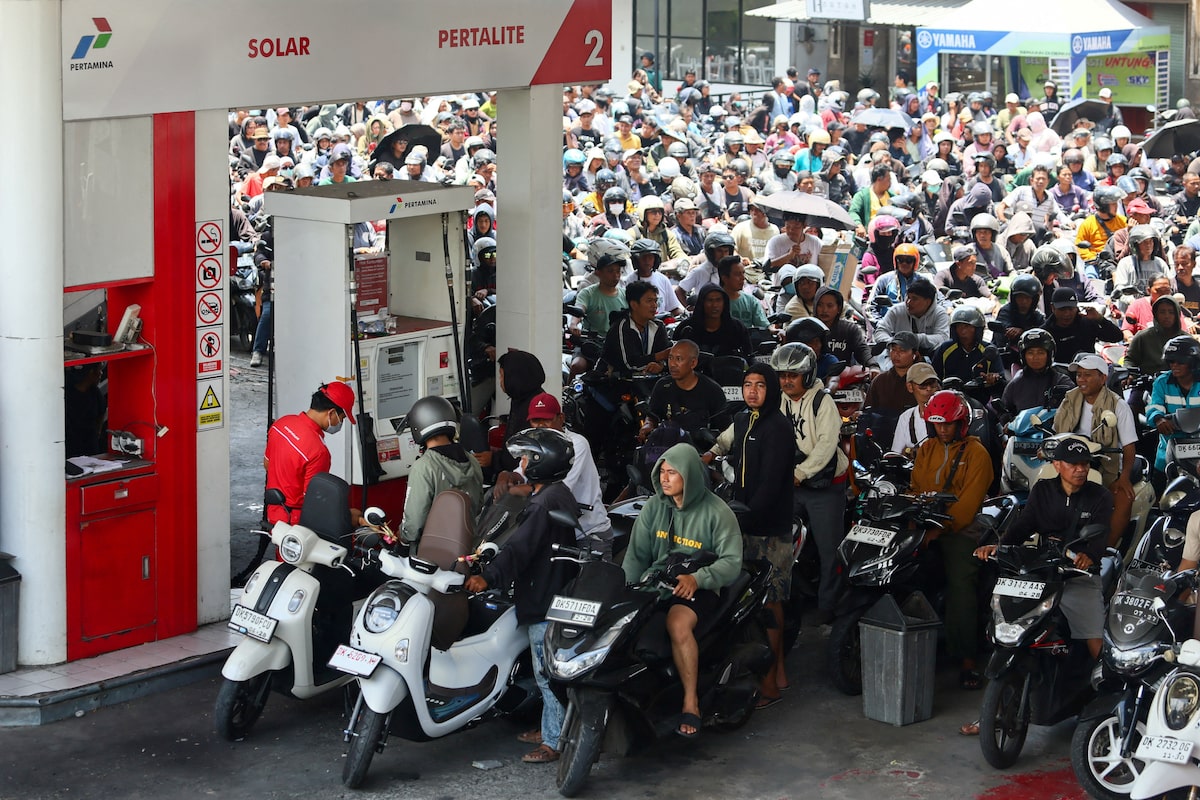
Motorcyclists queue to refuel at a petrol station in Badung, Bali, Indonesia, on Oct. 15. Prolonged supply disruptions have placed significant strain on global supplies of fuel, particularly diesel.Johannes Christo/Reuters
The International Energy Agency agreed on Thursday to release more than 20 million barrels of diesel to help a global market struggling with shortages and surging prices that are driving up inflation.
Oil markets are being roiled by a combination of the expanding war in the Middle East, enduring shipping risks through the Strait of Hormuz and Ukraine’s escalating attacks on Russian refineries. While those geopolitical events are far from Canada’s shores, oil producers and prices in the country are not immune.
Prolonged supply disruptions have placed significant strain on global supplies of diesel in particular. The hit to Canadian wallets has been significant, with the average retail price for the fuel hitting a record high of $2.67 a litre this week, according to federal government data.
Skyrocketing diesel prices have already had broad global economic consequences, from higher costs of goods to effects on incomes and inflation, according to the International Energy Agency (IEA).
While diesel prices have eased from the all-time highs of more than US$200 a barrel reached in September, global benchmarks remain nearly double the price of crude oil and their precrisis levels, the Paris-based energy watchdog said in its latest oil market report, released Wednesday.
The price of global oil benchmark Brent crude was at US$105.81 on Thursday. And with geopolitical pressures showing no signs of letting up, diesel prices are unlikely to dip any time soon, analysts say.
Trump says Ukraine needs a new president, blames Zelensky for high diesel prices
Supplies will remain tight even with the IEA’s strategic diesel release, said Susan Bell, an analyst with Rystad Energy, and high prices will be required “to keep demand in check.”
Part of the problem is the protracted conflict in the Middle East, which began on Feb. 28, when the U.S. and Israel launched co-ordinated military strikes on Iran. In response, Iran largely closed the Strait of Hormuz, a crucial shipping lane for roughly a fifth of the world’s oil and gas supplies.
With peace deals proving futile, the crisis has since widened. Saudi Arabia’s exports have been dealt multiple blows by Iran-backed Houthi rebels, who have seized islands along Red Sea shipping routes, blown up a crucial oil pipeline and attacked the headquarters of the Saudi state-owned oil company, Aramco.
The IEA said in its report that the escalation of attacks on energy infrastructure and tanker traffic is “threatening to derail” September’s recovery of Middle East oil supplies. Last month, crude oil exports from Gulf producers, led by Saudi Arabia, had surged by 4.4 million barrels to 13.9 million barrels a day.
Analysts say a de-escalation of the conflict is unlikely. Both Rystad and TD Cowen forecast the average price of North American benchmark West Texas Intermediate will sit around US$85 per barrel for 2026.
G7 countries agree to release 100 million barrels of oil, beginning with diesel
With U.S. President Donald Trump facing the ire of voters fed up with sky-high prices at the pump ahead of the midterm elections, “Iran has made it very clear that they want to keep oil prices high,” TD Cowen analyst Menno Hulshof said in an interview.
And as the conflict widens and becomes more complicated, it also gets “more and more difficult to fix” the resulting supply issues, he said.
“Confidence in seeing oil prices normalized in a reasonable time frame is waning,” Mr. Hulshof said.
Even if supplies from the Middle East do bounce back, prices will remain high as the market prices in the likelihood of skirmishes and the cost of ship-to-ship transfers required to get product through the Gulf, said Ms. Bell, with Rystad.
The high prices have Canadian producers generating significant revenue – particularly in the oil sands, where daily operating costs are relatively low, Ms. Bell said.
Opinion: Trump’s diesel deal with Putin is Russian roulette
Indeed, the Capped Energy Index on the TSX has reached record highs this week, and closed at $30.40 on Thursday.
But Ms. Bell added that Canadian energy companies are “in a very tricky spot” when it comes to capital planning.
“On the one hand you’d think, ‘Okay it makes sense to develop the resource and spend,’ but on the other hand, pipeline egress is going to be a challenge for the next few years,” she said.
Adding to the global diesel supply woes is Moscow’s July decision to ban exports of the fuel after months of Russian refineries being targeted by Ukrainian drones.
Last week, Mr. Trump said he had reached a deal with Russian President Vladimir Putin to lift the export ban in an effort to lower prices. On Sunday, Mr. Trump said Russia and Ukraine had agreed to halt attacks on energy targets – which Moscow promptly ignored, launching a series of missile and drone strikes on Ukrainian energy sites such as power stations. In response, Ukraine struck a Russian oil refinery on Thursday, after President Volodymyr Zelensky said Kyiv was “done” supporting the ceasefire.
With reports from Reuters