
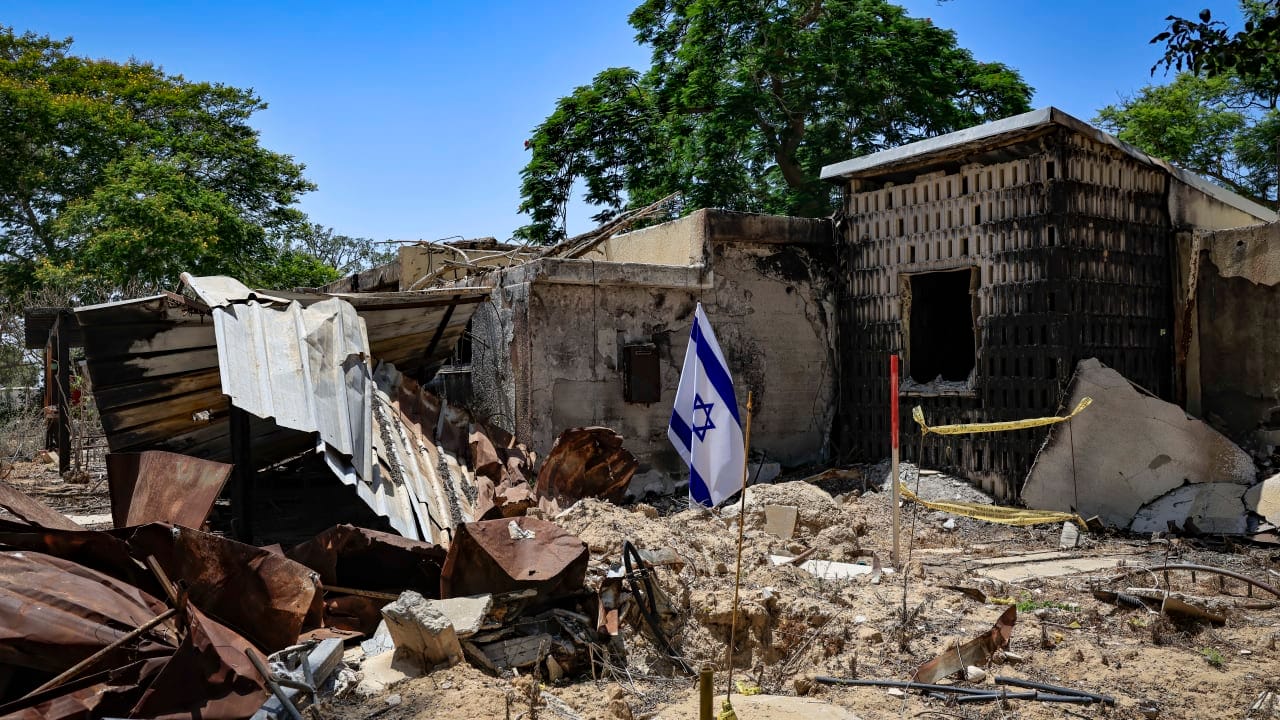
Israelis will vote on security on October 27. The Torah portion read 10 days earlier tells them what security is, and who has failed to deliver it.
Ten days before Israelis vote, the Torah portion of Noah tells of two catastrophes: the flood and the Tower of Babel. Twice humanity undoes itself: first by tearing itself apart and then by forcing itself into one mold.
The destruction is not done by an enemy at the gate. It is inflicted from within.
The Torah charges the flood generation with a word no Israeli can hear without flinching: “hamas.” The Malbim explains it as the robbery of justice and fairness: stolen courts and stolen fair dealing, the two things that stand between ordinary people and the strong.
Israel has met “hamas” from outside with courage, at a terrible price. This election asks about the other kind.
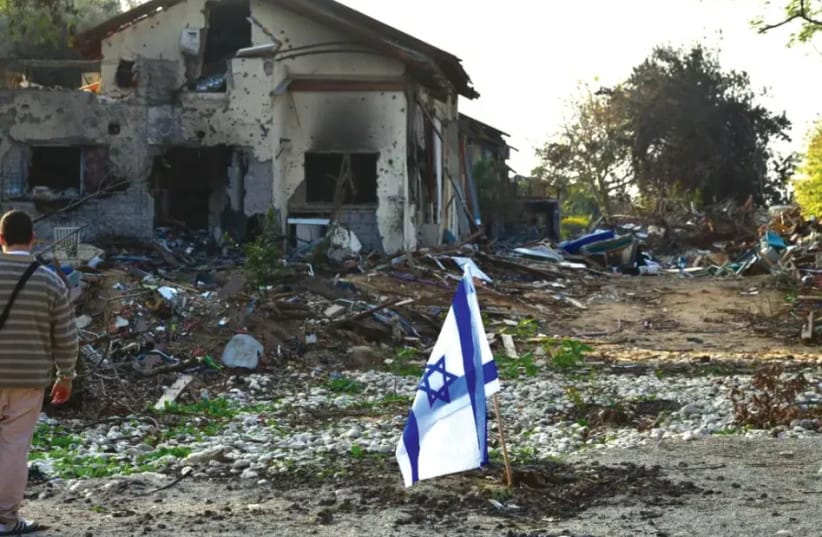 A tour with the families of the abductees in Kibbutz Beeri (credit: AVSHALOM SASSONI)
Israelis will vote, as always, on security.
A reservist friend of mine, a Mizrachi father of three, told me: “I don’t vote Likud because I admire [Prime Minister Benjamin] Netanyahu. I vote because I want my kids to sleep, because I don’t trust the alternatives to keep us safe, and because I’m tired of being spoken about like I’m a problem.”
He is not a problem. He deserves an answer, not a lecture.
What makes a country secure, not merely powerful?
Power is the capacity to strike, and Israel has it in abundance. Security is a society’s capacity to absorb a blow, hold together, and sustain itself. Power did not save Be’eri or Nir Oz.
The prophet Isaiah teaches that peace, quiet, and lasting security are the work of righteousness. Security is not where a nation begins but what it harvests.
Israel’s founders built the state on “the foundations of freedom, justice, and peace.” Three stones. Test any government against them.
The first is freedom, which lives or dies by the rule of law, binding the ruler as tightly as the ruled. Without it, freedom is a favor, withdrawn at will by whoever holds power.
Babel is the Torah’s portrait of its absence: one language, one purpose, and a power from which nothing would be withheld. That is not a strong government, but an unrestrained one. Nobody living under it is free.
The outgoing coalition set about building that tower, changing how judges are chosen and legislating that from January 2027 the attorney-general’s opinions will not bind the government. The tower was visible from Gaza.
In March 2023, Yoav Gallant, then the defense minister, warned that the rift over the judicial overhaul posed “a clear and immediate danger” to the security of the state. The next day Netanyahu announced his dismissal.
In July, the head of the Shin Bet (Israel Security Agency) warned him of war, judging that our enemies saw weakness. On October 7, our enemies acted on what they saw.
Avi Gil, Netanyahu’s military secretary that morning, broke his silence last week: recommendations for targeted operations in Gaza were not accepted.
He also said the prime minister prioritized his coalition over a deal to bring home living hostages. Netanyahu claimed Gil chose not to wake him.
I cannot tell you whose account is true. Neither can you, because three years on, there is still no state commission of inquiry.
THE SECOND stone is fairness: a society invested in the other is the opposite of “hamas.” When Reuben and Gad asked to settle beyond the Jordan River, Moses asked whether they would sit at home while their brothers went to war. They promised to march at the front.
In July, while reservists served round after round, the coalition passed legislation to protect draft evaders from arrest. In September, the Supreme Court struck the law down as an unconstitutional injury to equality.
Meanwhile, one Israeli in six lives in poverty. Men and women do not fight hardest for a tower built on their backs. They fight hardest for a home where everyone counts.
The third stone is peace, and here the record is starkest: for 15 years, Netanyahu’s governments claimed they could “manage the conflict,” containing Hamas with periodic blows and Qatari cash he allowed into Gaza from 2018, by his own reported account, to keep the Palestinians divided.
Molad’s study, The Failure of Deterrence, concluded that this concept “planted the seeds of the catastrophe.” Quiet bought is not peace built.
Tamir Heyman, former head of Military Intelligence and now head of the Institute for National Security Studies, described an unwritten security doctrine taking hold since October 7: war as a permanent condition; peace no longer a goal but a means; separation from the US as “inevitable and even essential;” and the state’s Jewish identity placed above its democratic one.
The Declaration of Independence David Ben-Gurion read says the opposite: a Jewish state built on freedom, justice, and peace, with equal rights for every citizen.
Ben-Gurion taught that the state is built in the quiet between wars; this doctrine builds it by and for war. It was never put to the people. It is being put to you now.
Washington is already answering: 60% of American adults view Israel unfavorably, and in June, US Vice President JD Vance said that in Israel’s place, he “might not be attacking the only powerful ally” it has left.
Israel used to count on both American parties. Thanks to this government, it cannot count on one.
Three foundation stones, and on every one the record runs the wrong way. That is the opposite of security.
After the flood, God set a rainbow and promised never again to destroy the world. He undertook what He would not do, and nothing about what we should do. The rainbow is no guarantee of our safety. It is a transfer of responsibility.
I have spent enough years close to politics, including as chief executive of Britain’s Conservative Party, to be wary of politicians’ promises, and I cannot promise you the opposition is equal to every task.
But the test is not who sounds toughest.
Ask three questions: Who will restore institutions every citizen can trust? Who will share the burden fairly, so the reservist no longer carries it alone? Who will rebuild the alliances and political horizon that turn power into lasting security?
Noah’s father named him with a prayer: that this child would bring comfort from the toil of their hands. Every Israeli parent prays the same: that the children sleep, the sirens stop, and the uniform can finally be hung up.
My reservist friend deserves that comfort. He will not get it from the man who has promised it since 2009 and delivered the polar opposite.
On October 27, when we vote on security, we must vote for the real thing: the foundation stones that enable us to be a free people in our land.
The writer is co-founder of The London Initiative, a former chief executive of the Conservative Party, and a former chairman of the Jewish Leadership Council.