

North Carolina’s official policies on two hot-button issues — data centers and marijuana — are widely out of step with what North Carolina voters say they want, according to a new WRAL/WSOC Poll.
The Republican-led state legislature for years has refused to allow a vote on bills that would legalize or decriminalize marijuana for recreational use. The state Senate has passed bills in several recent years to legalize medical marijuana, under what sponsors say would be the strictest rules in the country. But the state House has never allowed that legislation up for a vote.
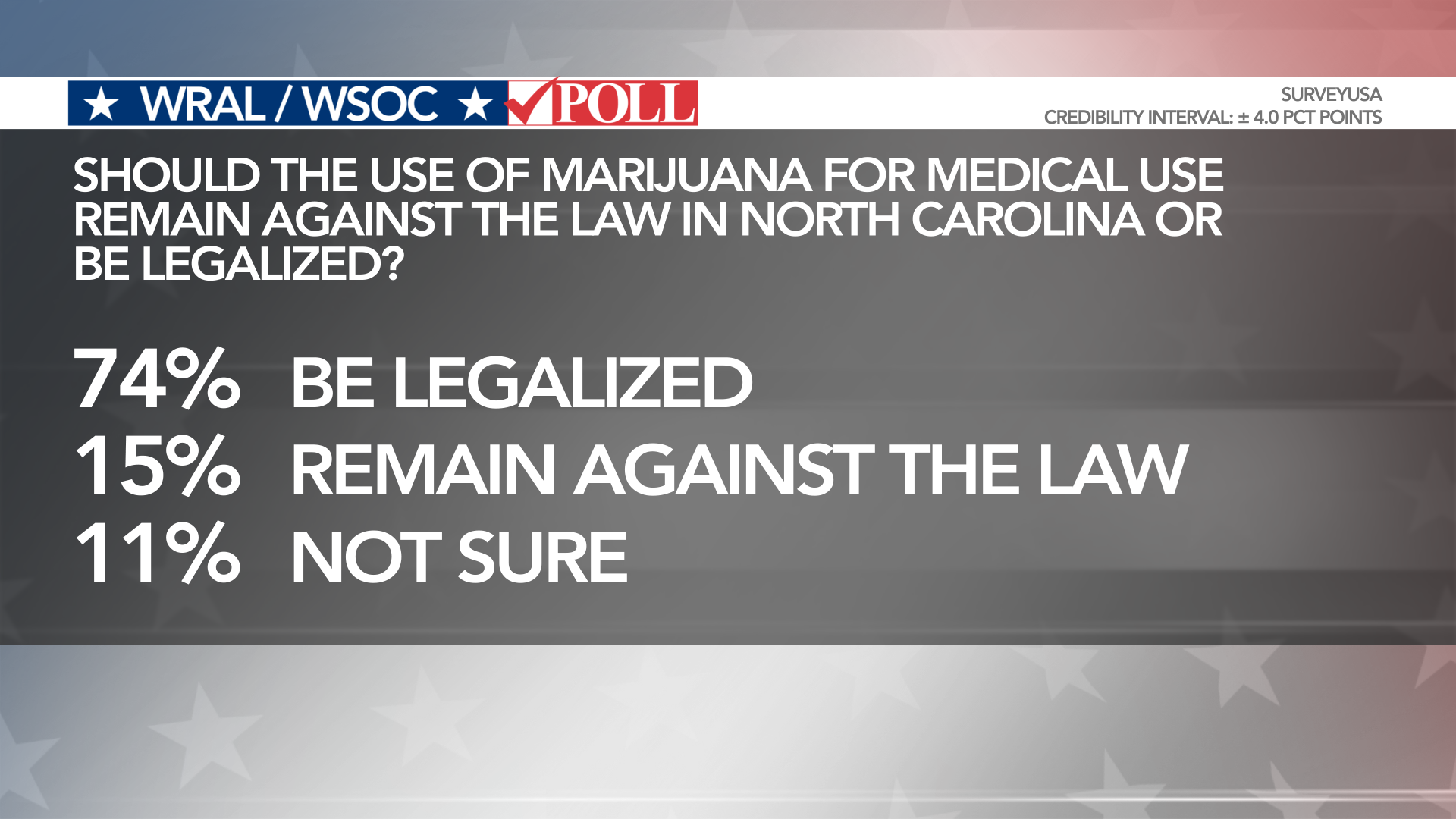
The new poll, out Friday, found that only 15% of North Carolina voters oppose medical marijuana, and 74% want it legal — including majorities of every age group, political party, region of the state, and racial or ethnic demographic.
As more states legalize marijuana, more people are becoming familiar with the drug — particularly if they know someone using it for medical reasons, said Ken Alper, the president of Survey USA, which conducted the poll. “They’re much more comfortable with it than they would have been 10 or 20 years ago,” Alper said.
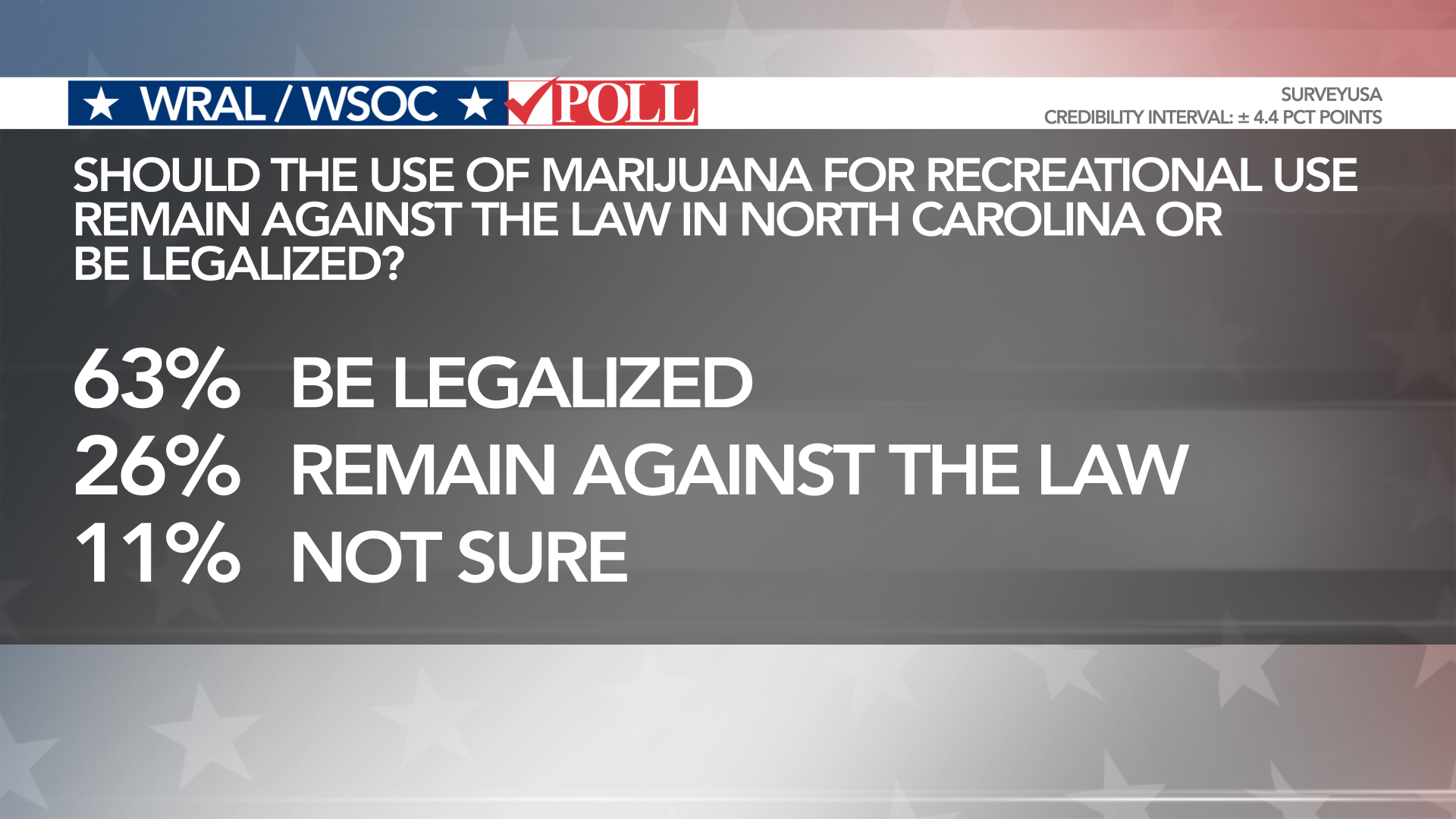
Similarly, the poll found that full legalization of marijuana — not just for medical purposes, but for recreational use, too — is supported by 63% of the population. The poll shows 52% of Republicans, 73% of Democrats and 65% of independents support marijuana legalization.
The only demographic in which a majority of voters don’t support legal marijuana is among those age 65 or older. But even those voters aren’t necessarily opposed to the idea. The poll found a tie, at 42% each, for support or opposition among senior citizens with another 16% undecided.
 © WRAL
North Carolinians are likely becoming more open to the idea of recreational marijuana legalization because they’ve seen it done in other states and “society hasn’t collapsed,” Alper said.
Marijuana is illegal under federal law, but dozens of U.S. states have legalized it. And nearly all states have legalized medical marijuana prescriptions for certain ailments. North Carolina is among the remaining states to resist any form of legalization.
 © WRAL
A state advisory council formed by Democratic Gov. Josh Stein is recommending that North Carolina lawmakers legalize marijuana through a tightly regulated system that would allow retail sales to adults — a shift that the group says will make consumption safer and bring millions of dollars in revenue to the state.
The more states that legalize marijuana, the more likely the federal government will be to relax its laws, said Chris Cooper, a Western Carolina University political scientist.
“The one thing everybody agrees on is that the current system is confusing: what’s legal, what’s legal where, and the rationale behind that,” Cooper said.
Data centers face resistance
Fewer than half of respondents — 43% — said they supported at least some development; 6% said the state should encourage more data-center development while 37% would allow data centers but only if they were required to pay full costs of the energy, water and infrastructure they require.
Meanwhile 42% opposed their development, with 29% saying North Carolina should oppose additional data-center development in the state. Another 13% said the state should support the moratoriums that are in place in several parts of the state. Sixteen percent said they don’t know enough to have an opinion.
Support for at least some data-center development was at 53% among Republicans, while 58% of Democrats opposed the development.
Data center development is so divisive that high-profile political candidates are likely to punt on the issue, Cooper said.
“What we’re going to see a lot of is folks running for federal office saying, ‘Let’s give the power to local governments,’” Cooper said. “That’s going to be the rhetorical strategy going forward: Not folks saying we need a ban, not saying folks we should embrace it, but let local people decide.”
Decisions on whether to allow data centers to be built can require a balance between promoting economic growth and protecting local residents, state lawmakers said this year as they debated restrictions for data centers without banning development altogether. Those legislative efforts never became law. The House passed them but the Senate never allowed them up for a vote.
Data centers can add millions of dollars to a county’s tax base, allowing local leaders to lower property tax rates for everyone else, or spend more on services like public safety and education. But critics have raised concerns that they could use too much water or electricity, and that the loud hum they produce is annoying to people who live nearby. The tech industry, meanwhile, opposes the regulation as it looks for ways to store enormous amounts of data as the use of artificial intelligence grows.
Lawmakers had proposed requiring large data centers to cover electricity and infrastructure costs associated with building and operating them, while also tightening rules on where they can be built, who can own them and how much water they use. They also sought to ban local governments from paying companies incentives to build data centers.
Some local governments around North Carolina have banned data centers, while others have enacted moratoriums to come up with policies to guide their development. Some communities have sought to lure data centers with economic incentives. Democratic Gov. Josh Stein earlier this year called for eliminating the tax loopholes that allow the companies that own data centers to avoid paying sales and use taxes on the energy they purchase or their building materials. Lawmakers approved a state spending plan in July that ended some of the data center tax credits, but not all of them.
Duke Energy has proposed special billing rules for data centers and other large electricity users, known as a “large-load tariff.” The proposal would require upfront payments for equipment built specifically for those customers, long-term contracts and minimum monthly bills even if they use less power than expected. The North Carolina Utilities Commission must approve the agreement before it takes effect.
Stein and Attorney General Jeff Jackson said Wednesday that the proposal offers important protections but leaves gaps. Jackson said it doesn’t require large customers to pay for new power plants needed to meet their demand. Duke says the agreement would strengthen protections against shifting data center costs to households and other customers.
WRAL News reporter Liz McLaughlin contributed to this report.