
Get Task & Purpose in your inbox
Sign up for Task & Purpose Today to get the latest in military news each morning.
Army Spc. Nicholas Cabo was visiting a Sam’s Club near a small airfield outside Fort Hood, Texas, when a small plane buzzed overhead.
“I was like, ‘oh, drone,’ and so I stopped and looked. I’m like, ‘it’s coming,’” Cabo recalled.
Finally, he spotted the source of the noise.
“I saw the plane,” Cabo said. “I was like, ‘oh crap, it’s just in my head.’”
Cabo was one of three soldiers at Fort Hood awarded Purple Hearts on Oct. 1 for a ballistic missile attack on a U.S. military base in Saudi Arabia last March. Days after the award ceremony, the Army released a rare firsthand account from all three soldiers of both the attack and their experiences after returning home to Texas. All three said they were lucky to survive the missile strike, and each described struggles in the months after, including isolation, detachment from work and even moments of stress at the sight of a small airplane.
Staff Sgt. Kalob Mitchell, Sgt. Xavier Jones, and Spc. Nicholas Cabo were air defense soldiers with the 56th Air Defense Artillery Regiment when the unit was struck on March 27 by Iranian ballistic missiles at Prince Sultan Air Base, Saudi Arabia.


“We’re sitting there talking, and then all of a sudden, we didn’t hear anything, no sound at all. Everything went black.”
Air defense units — traditionally positioned as rear-echelon roles — have been among the most active frontline combatants of the Iran war, facing hundreds of drone and missile attacks across the region, often targeted directly at them.
The March attack, the three soldiers said in the Army account, began with a loud, harsh mechanical screeching that many modern military personnel would recognize. Alarm Red sounded, and a voice boomed out across the Saudi airbase with three distinct repetitions of the word “incoming.”
The missiles arrived moments later, as Mitchell, Jones, Cabo, and other soldiers sheltered in a bunker.
One exploded yards away, throwing all three soldiers against the opposing interior wall. All three lost consciousness from the impact.
“We’re sitting there talking, and then all of a sudden, we didn’t hear anything, no sound at all. Everything went black,” Mitchell said.
Mitchell regained consciousness as another soldier woke him up, according to the audio recordings released by the Army. He checked on Jones and Cabo, who had also survived the blast.
“I think it was just the adrenaline because after we woke up, I checked myself,” Cabo said. “I just saw that my leg was a little bit bleeding, so I didn’t really mind it. It wasn’t anything like crazy bleeding.”
But across the bunker, two soldiers were seriously wounded. One had a severe leg injury and was bleeding profusely. Another had suffered a neck injury.
“We just heard screams and went to go help those guys,” Cabo said.
Despite being injured themselves, Mitchell, Jones and Cabo applied a tourniquet to the wounded soldier’s leg and treated their other injuries. They also helped calm a third soldier who was disoriented after the strike.
When other soldiers brought litters to the bunker, the three helped carry the casualties.
Cabo believed their actions may have saved one soldier’s life.
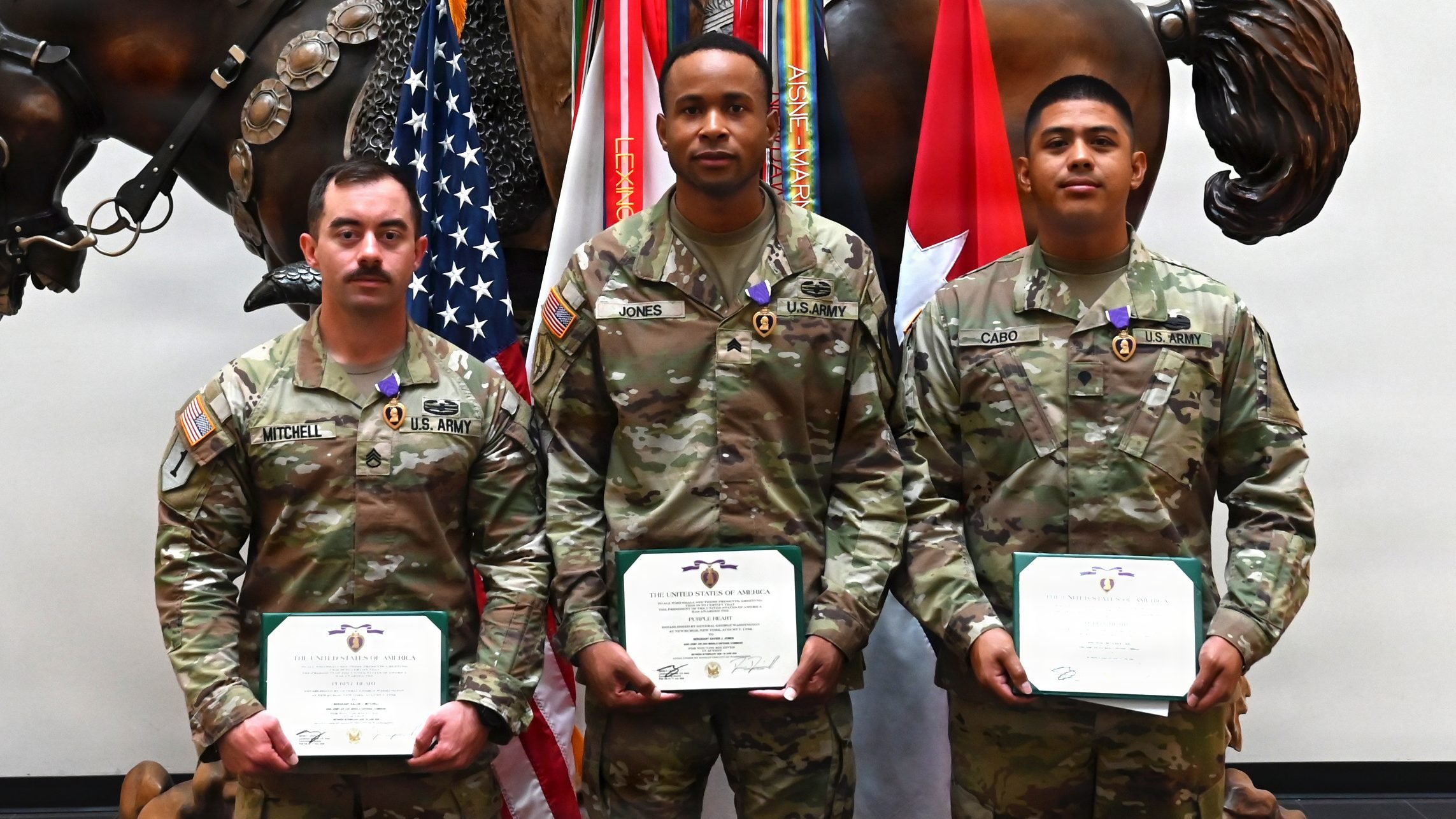 Staff Sgt. Kalob Mitchell, Sgt. Xavier Jones and Spc. Nicholas Cabo, after receiving the Purple Heart during a recognition ceremony on Oct. 1. Army photo by Derika Upshaw.
“That guy probably would have died because he was bleeding a lot from his right leg, and good thing Sgt. Mitchell just came up really quick, then called for us and we helped him out,” Cabo said.
At the Fort Hood ceremony for the soldiers, their commander said he’d received a note from one of the injured soldiers.
“Sir, your soldiers saved my life. I thank God every day that these gentlemen survived,” the note said.
In one sense, the soldiers said, they had to consider themselves lucky. The warhead on the missile that impacted near them was smaller than others that had hit the base.
“It was about 250 kilograms of explosive versus what some of the bigger ones they had hit us with, which were about 750,” Mitchell said. “And all it would have took was it being one of those, and we wouldn’t have been here.”

At home, small airplanes sound like drones
Each also described unexpected difficulties upon returning home.
Cabo described receiving treatment at three hospitals, first in Germany, then Virginia and eventually Fort Hood. Although his medical records followed him, he said, managing appointments alongside his regular military duties was stressful. He also described moments of paranoia, like the airplane over the Sam’s Club.
Jones said he has felt detachment from some parts of daily life.
“I’m trying to get back to reality, trying to get anxiety back down, trying to just not be as alert, trying to reintegrate,” Jones said in the release. “I was at work a couple of weeks before I took leave, and it just was … it felt different. Like it felt non-serious, and it just was throwing me off because seeing everybody have fun. We had fun too, but … it was just different.”
The soldiers described difficulty sleeping and withdrawing from social activities. Jones said he had largely stopped going out, even though he previously enjoyed doing so.
The soldiers encouraged others struggling after deployment to seek treatment, although Mitchell acknowledged the stigma surrounding medical care in the military.
Top Stories This Week
“I feel like it’s kind of instilled in the military, like don’t go to sick call. You’ll be seen as a problem child,” Mitchell said. “But these are real issues, and they need to be addressed. So be honest with the medical staff and get the help you need.”
All three soldiers were awarded Purple Hearts at a ceremony on Oct. 1 at the III Armored Corps headquarters building at Fort Hood.
The Army told Task & Purpose this week that the service has awarded 184 Purple Hearts to active-duty soldiers and reservists wounded or killed in support of U.S. combat operations in Iran. The Pentagon says 865 troops have been injured in the war, of which 649 were soldiers in the Army or Army Reserve.
According to Pentagon figures, 21 troops have died while deployed to the Iran war, 11 from hostile fire. All 11 of those killed directly by Iranian action died in or as a result of missile strikes like the one Cabo, Jones and Mitchell survived.
“I guess I’d say that it kind of puts it in perspective that we went, we did our job to the best of our ability and we almost paid the ultimate price,” Mitchell said.
Add Task & Purpose as a preferred source on Google to see more of our reporting.
Austin Campbell is an Air Force veteran and a contributing reporter with Task & Purpose, with an emphasis on accountability and investigative journalism.