
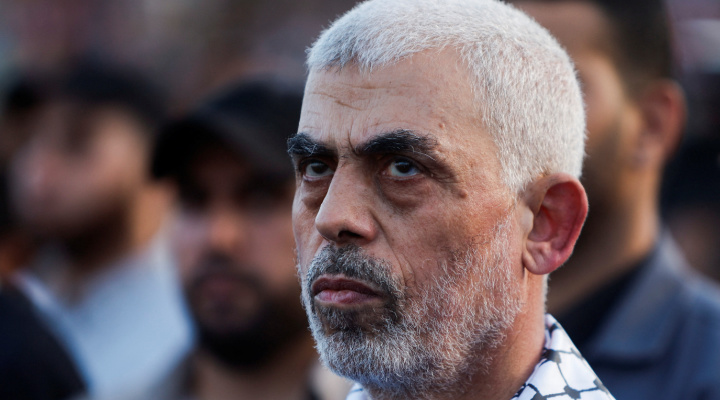
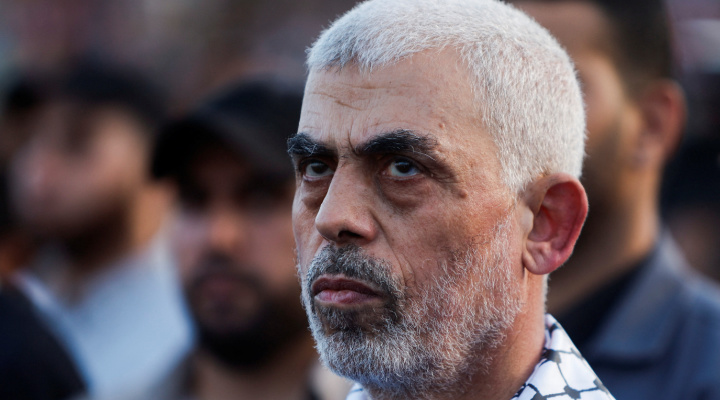
Hamas leader Yahya Sinwar looks on as Palestinian Hamas supporters take part in an anti-Israel rally over tension in Jerusalem’s Al-Aqsa mosque, in Gaza City, Oct. 1, 2022. Photo: REUTERS/Mohammed Salem
The Israel Defense Forces (IDF) on Friday released newly disclosed documents written by Yahya Sinwar, one of the chief architects of the Oct. 7, 2023, invasion of and massacre across southern Israel, exposing the top Hamas leader’s chilling plans to maximize the attack’s psychological impact two years after his death.
Marking the second anniversary of Sinwar’s elimination, Israeli officials released a handwritten document detailing the terrorist leader’s instructions for carrying out the Oct. 7 massacre and recording its atrocities, alongside new details about the operation that killed him in Rafah, in the southern Gaza Strip.
“The elimination of Sinwar in October 2024 marked a turning point in the conduct of the Hamas terrorist organization in the Gaza Strip,” the IDF said in a statement.
“In the short term, his absence was felt in the organization’s decision-making processes and coordination capabilities. Subsequently, changes became apparent in the military wing’s operational patterns, alongside leadership gaps, an erosion of command capabilities, and difficulties maintaining organizational cohesion,” the statement read.
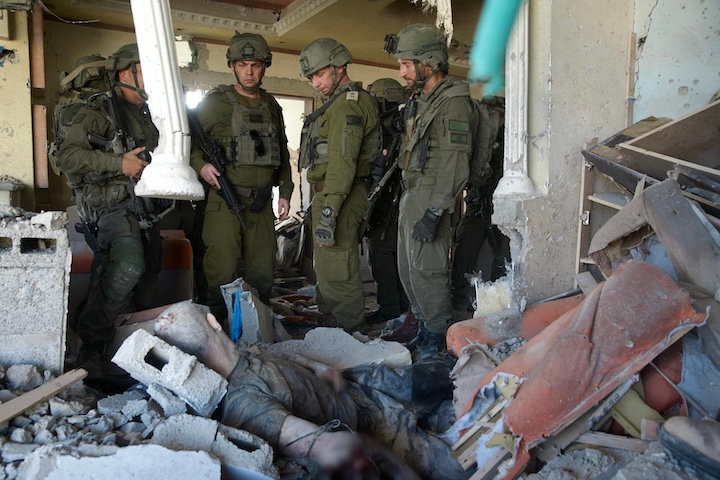
L-R: Former Operations Directorate chief Maj. Gen. Oded Basiuk, former Southern Command chief Maj. Gen. Yaron Finkelman, and Gaza Division chief Brig. Gen. Barak Hiram stand over the body of Hamas leader Yahya Sinwar in southern Gaza’s Rafah on October 17, 2024. The image was published by the army on October 16, 2025. Photo: IDF.
According to the released documents, Sinwar instructed Hamas’s elite Nukhba Force to broadcast footage of their actions to as many media outlets as possible to spread terror across Israel, including images of “stepping on IDF soldiers’ heads, shooting at point-blank range, slaughtering people with knives, exploding IDF tanks, prisoners kneeling with their hands on their heads,” and more.
“We need to plan in advance for events that will produce horrific images: several car bombs exploding inside a post or building, causing massive destruction. Heartbreaking scenes. Enormous fires. Five or ten such images will make their hearts sink,” the terrorist leader wrote in one document.
“Allah took them by surprise and filled their hearts with fear. Two or three operations should be planned to set entire neighborhoods, a kibbutz, or similar areas ablaze,” Sinwar continued. “They will spray gasoline or diesel fuel from a specialized tanker, set the area on fire, and broadcast the footage.”
The IDF also released footage from the operation in Rafah that led to Sinwar’s death, documenting the military’s movements on the ground during the mission to eliminate the Hamas leader.
Two years ago, Israeli soldiers conducting a security operation in Tel Sultan, an IDF-controlled area of Rafah in the southern Gaza Strip, spotted three terrorists, and opened fire, striking one in the arm. Only later did the troops discover that one of the wounded terrorists was Sinwar.
It turns out Sinwar had fled with the two other terrorists after being wounded before the group split up, with the Hamas leader taking refuge in a nearby building.
IDF forces subsequently surrounded the area with tanks and deployed drones to search the terrain and monitor the structures where the terrorists might be hiding.
After entering the building where Sinwar had taken refuge, IDF soldiers came under attack when two grenades were thrown at them, prompting the troops to unleash heavy fire on the building, including tank shells, machine-gun rounds, and small-arms fire.
That evening, an IDF drone entered the damaged building and spotted a body, but search teams did not enter the structure until the following morning, when they were able to positively identify Sinwar and confirm his death.
In a separate document released by the IDF, Sinwar also discussed the possibility of other terrorist organizations in the West Bank and across Iran’s “Axis of Resistance” joining the attack.
“There may be signs of the enemy’s collapse from the outset, and the actions of our people inside Israel, in Jerusalem and the West Bank, along with Hezbollah’s intervention, could help bring this about,” Sinwar reportedly wrote. “We must be prepared to expand the attack to its fullest extent.”
These latest documents came one day after the IDF made public a letter attributed to Sinwar’s son, Ibrahim, and addressed to his father at the start of the Gaza war, when he was just 10 years old.
“Beloved father, I miss you very much! I want to hug you and see you victorious, and I want to proclaim, ‘Allah is the greatest,’ hold a Kalashnikov, and shoot Jews,” Ibrahim wrote in the letter, according to the IDF.
“When will you come back and sleep with your arms around me? I am constantly making pistols, tanks, and Kalashnikovs out of paper and cardboard,” the letter continued.
‼️ EXPOSED: A LETTER WRITTEN BY YAHYA SINWAR’S 10 YEAR OLD SON
“I want to hold a Kalashnikov and shoot Jews.”
In a letter to his father, Ibrahim wrote that he makes “guns, tanks, and Kalashnikovs out of paper and cardboard” in his spare time and expressed his desire to shoot Jews.
The letter, accompanied by drawings of weapons, tanks and missiles, reflects how Hamas’ ideology of hatred and violence impacts the younger generation in Gaza.
— Israel Defense Forces (@IDF) October 15, 2026
Israeli soldiers recovered the letter in the Gaza Strip in 2024, along with drawings by Ibrahim depicting an assault rifle, Israeli tanks near the Gaza border, and rockets being fired toward Israel.
“The letter and drawings illustrate how Sinwar’s murderous ideology is reflected in the education of his children, and expose the influence of Hamas’s values of hatred and violence on the younger generation in the Gaza Strip,” the IDF said in a statement.