
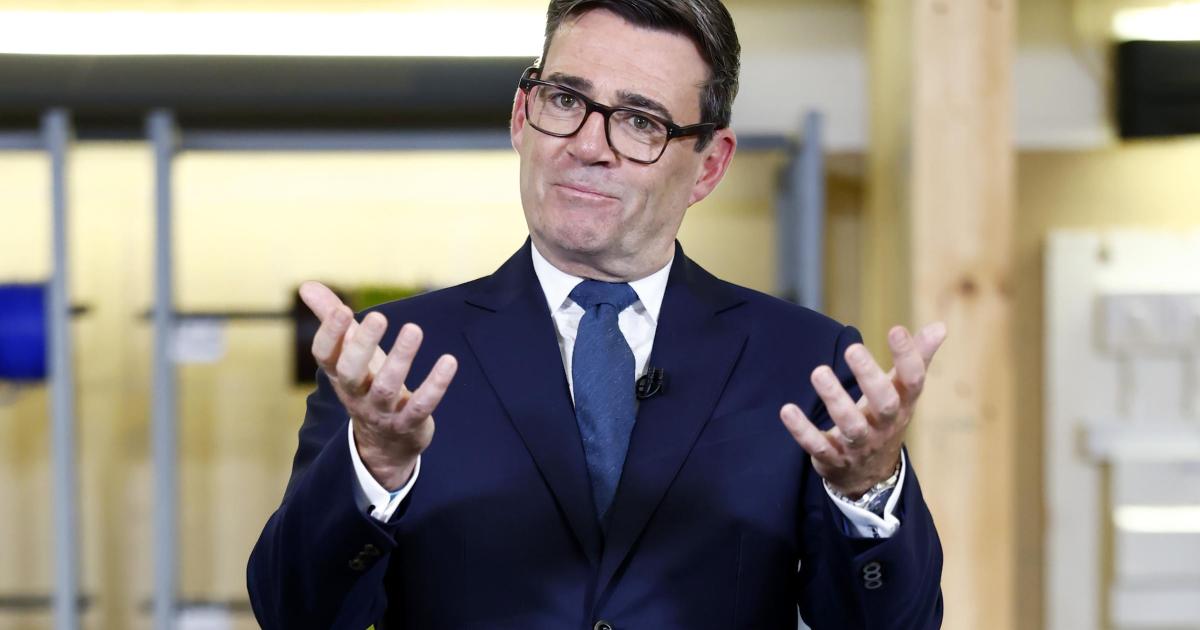
Burnham made his first substantive trip north of the Border since entering No 10 on Friday, despite previously pledging to come to Scotland on a “listening tour” in August.
In the speech, held at the New College Lanarkshire campus in Motherwell, Burnham invited First Minister John Swinney to work together to push more powers out of both Westminster and Holyrood.
Andy Burnham in Motherwell on Friday (Image: Jeff Mitchell)
The Prime Minister said that too much time has been “wasted” on “debating what differentiates us rather than saying right, what can we agree on, and let’s talk about that rather than talking about the other stuff”.
READ MORE: SNP see hung Westminster parliament as ‘most realistic’ route to indyref2, MP says
But when asked by the media to categorically rule out a second Scottish independence referendum during the length of his premiership, Burnham refused to do so.
Andy Burnham in Motherwell on Friday (Image: Jeff Mitchell)
He said: “I’ll come back to what I said at Liverpool, you heard my views.
“I am somebody who believes in all forms of unions. Trade unions, definitely, and I think unions of countries are better because you can face a challenging world in a more confident and stronger way, in my view, when you collaborate and you work together.”
Burnham continued: “That is my view. I communicated it to the first secretary [sic] very clearly, and he has a different view.
“But let’s accept there’s a different view there and then work on together what we can agree on.
“My view won’t be changing, but let’s now move forward where we can make some progress.”
READ MORE: John Swinney responds to Andy Burnham’s devolution offer to SNP
The Prime Minister also told the media that “we all have to move beyond the constitutional questions”.
In the Commons in September, Burnham said that the rules governing when a repeat of the 2014 referendum could be held should be “exactly the same” as those for an Irish reunification referendum.
However, he soon walked back on this claim and instead insisted that a referendum remains “off limits”.
The SNP went on to invite Burnham to their party conference in Aberdeen – taking place at the same time as the Prime Minister’s visit to Scotland – to agree a “legal process” for a second independence referendum.
During the Labour Party conference in Liverpool last month, Burnham hit out at Swinney’s prediction that he would be the “last Prime Minister of the United Kingdom”, saying he was “utterly determined to prove him wrong”.
Responding, Economy Secretary Stephen Flynn told journalists at the SNP conference in Aberdeen: “What I just listened to was the Prime Minister of the United Kingdom be asked whether he would rule out an independence referendum and he declined to do so.
Stephen Flynn (Image: Jane Barlow/the Press Association)
“I firmly believe he declined to do so because he’s a reasonable man who recognises his own hypocrisy if he was to continue along the lines of saying that there can and should be a debate about a second referendum on membership of the European Union, while seeking to deny one to the Scottish people in respect of our future.
“So he has again today outlined that he is not opposed to that second independence referendum, very much building on what he, of course, said in the House of Commons.
“I think this is a very significant moment in Scotland’s constitutional journey.”
READ MORE: Scottish Government awards £600,000 to digital Gaelic spoken language project
The Scottish Greens said Burnham’s speech served as a “distraction from his anti-democratic block on a second independence referendum” which “offered little substance”.
Scottish Greens co-leader Gillian Mackay said: “It is not for Andy Burnham to decide that we should ‘move beyond the constitutional question’.
Gillian Mackay (Image: PA)
“It is notable that he refused to rule out an independence referendum during his time as Prime Minister – this is a challenge for the independence movement to create the biggest possible demand for one and keep the pressure on Westminster.”
Mackay pointed towards the recent Holyrood election in which the largest number of pro-independence MSPs were elected, saying that Burnham “cannot continue to promise greater devolution while ignoring the will of the Scottish people”.
She continued: “The Prime Minister is ignoring the reality that Scotland doesn’t have many of the powers it needs to make the decisions that would deliver fundamental change.
“While Andy Burnham is trying to frame this as two governments working together, we have heard empty promises like this from Westminster before.
“The people of Scotland deserve a choice in the future of their country through an independence referendum, but the Prime Minister seems content to try and impose his vision on us rather than listen to what voters want.
“It is simply more of the same from a Labour Government that continues to disrespect the will of the Scottish people.”
Meanwhile, Scottish Conservatives leader Russell Findlay responded: “Burnham has again opened the door for John Swinney to demand another divisive referendum.”
Roz Foyer, general secretary of the Scottish Trades Union Congress (STUC) – Scotland’s largest trade union body – said: “The Prime Minister is to be commended for seeking to put aside party political point scoring and to work together with the Scottish Government for the benefit of working-class communities.
“His offer to devolve further powers to Scotland in terms of employment support is welcome and he’s correct to signal the potential for significant additional devolution within Scotland.”
Roz Foyer (Image: STUC)
Foyer continued: “We share in the vision of using procurement to build home grown, good quality jobs and that power must grow from the bottom up rather than the top-down.
“For that to materialise, further funding must be directly put into the hands of local communities so they can see the economic growth that serves them, not profiteers.
“In doing so, this gives agency and a voice to workers who have been robbed of hope and prosperity for far too long.”
Foyer went on to say that if the Prime Minister is serious about giving back control to workers, he “could have gone further and made proposals for the deeper devolution he describes”.
“He should start with devolution of further powers to the Scottish Parliament, including over migration and employment law, to help build an economy of strong trade union rights and address the chronic skills gap impacting our workforce,” she said.
“He would also do well to devolve further borrowing powers to the Scottish Government so we can offer the frontline investment within our infrastructure that badly needs the required funding to reindustrialise the nation.”