
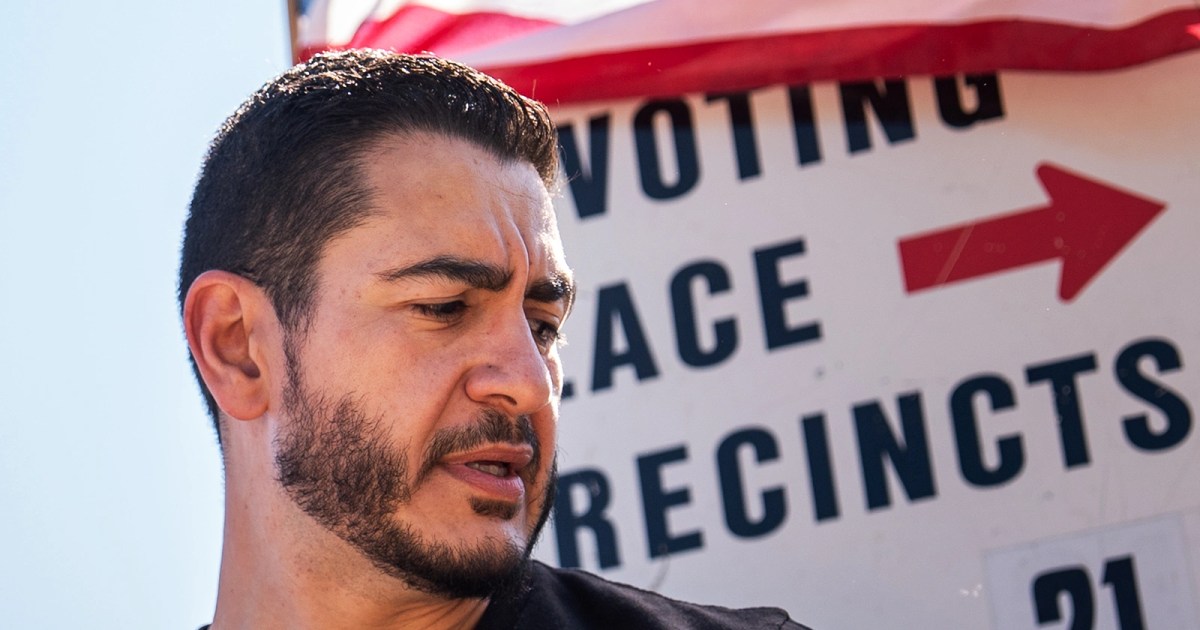
MARQUETTE, Mich. — Abdul El-Sayed, the Democratic U.S. Senate nominee in Michigan, signaled Thursday that he would question Israel’s status as an ally of the United States no matter who wins Israel’s elections later this month.
Asked during an interview with MS NOW whether his objections were to Prime Minister Benjamin Netanyahu’s government or to the state of Israel itself, El-Sayed suggested his opposition went further than current leadership.
“I mean, I think we’ve got to get serious, right?” he responded. “Netanyahu is one part of it, but the Israeli military has done heinous things, like heinous things, full war crimes, genocide. So I think we got to just get serious about whether or not we as a country should be subsidizing that government.”
He said he supports “equal rights to peace, dignity, and self-determination” for both “Jewish Israelis and Palestinians,” before pointing to Israel’s lobbying of the U.S. to join the war with Iran.
“But right now, that government has done terrible things with our money in their name, they pulled us into a war we had no business fighting,” he added. “So, to me, an ally is somebody who cares about you and you care about them. I don’t think they care about us. That’s what I’ve seen.”
When pressed on the matter — whether the ouster of Netanyahu would change his views — El-Sayed deferred to after the Israelis selected their next leader.
“Let’s see who the next prime minister is,” he said in an interview with MS NOW, before arguing that “structurally, there are a lot of issues with that ostensible allyship.”
Netanyahu’s main challenger, Gadi Eisenkot, a former chief of the Israeli military, leads a centrist party called Yashar, which translates to “Straight” in English. He has indicated a greater willingness than Netanyahu to more fully engage with the Trump administration on its various regional diplomatic initiatives in Gaza, Lebanon and Syria. Like most other Israeli opposition leaders, Eisenkot has said he would continue an aggressive military posture against militant groups all across the Middle East.
He has positioned his party as a home for voters who are concerned about the direction Netanyahu and his far right and religious coalition is leading Israel. His platform attacks issues where Netanyahu is vulnerable, such as calling for an official investigation into the Oct. 7 attacks, which Netanyahu has resisted. Eisenkot has rejected a Palestinian state in the near term but has pledged to curb settler violence and restrain some settlement expansion in the West Bank.
The International Court of Justice is currently hearing a case brought by South Africa that accuses Israeli forces of genocide. Israel vehemently has rejected the accusation, saying it is based on “biased and false claims.” Israel has said it does what it can to protect civilians and has accused Hamas of using civilians as human shields.
El-Sayed made the remarks after the third stop of his “It shouldn’t be this hard” bus tour — during which he was joined by Rep. Alexandria Ocasio-Cortez, D-N.Y. — with less than three weeks until Election Day in one of the nation’s most competitive Senate races. He faces former Republican Rep. Mike Rogers for the seat being vacated by retiring Democratic Sen. Gary Peters, and the outcome could help determine which party controls the Senate for the final two years of President Donald Trump’s term.
El-Sayed’s views on Israel have become a flashpoint in the race, and he has struggled to win over some Jewish Democrats who are wary of his positions and rhetoric. El-Sayed has said he doesn’t support additional U.S. aid to Israel and doesn’t believe Israel should exist as a Jewish state. During last week’s debate, he wouldn’t say whether Israel or Iran posed the larger threat to the U.S., calling it a “ridiculous question.”
Asked by MS NOW on Thursday whether he would consider Israel to be a U.S. ally and whether the ousting of Netanyahu would change his position on the U.S.-Israel relationship, El-Sayed questioned how much of a friend Israel is, citing the impacts of the Iran war.
“They use us to go and fight a war we have no business fighting,” he said. “We’re paying more in gas. We’re paying more in groceries so that they could help to clear the air to try and annex southern Lebanon. How is that helping? What kind of allies? I’m just saying, like, what kind of ally is that?”
During another part of the interview, El-Sayed said Israeli leadership “just use” the U.S.
“Allies are supposed to care about you implicitly, not just use you. The government of Israel has done nothing but use us,” he said. “They use us for our tax dollars. They use us to run cover at the United Nations. They use us to run cover at the [International Criminal Court] and [International Court of Justice] for their war crimes.”
The Oct. 27 vote will be Israel’s first national election since the Hamas-led attacks of Oct. 7. Netanyahu, who has served as prime minister for more than 18 years across three stints, is seeking another term.
More articles
El-Sayed said he would wait to see who wins, but he sounded skeptical.
“I’m not hearing any commitment to Palestinian self-determination from anybody. I’m not hearing any commitment to ending the, like, the policy when it comes to settlements. I’m not hearing any remorse for the utter, like, annihilation of Gaza. So let’s see, right? Let’s see,” he said.
“I think right now, structurally, there are a lot of issues with that ostensible allyship. And I think the American public needs to have a conversation about it,” he added. “Like — and here’s the problem, right — too often the American public thinks one thing, right? You look at poll and poll, poll after poll after poll after poll. You all have reported on it, and then American politicians say something else. Why? And I think we should be asking, like, why?”
He continued, “Why is it that American politicians aren’t having the same conversation as the American public? I’m trying to have the conversation with the American public.”
Asked what his message is to Jewish Democrats who are on the fence about supporting him, El-Sayed turned the question back on the Rogers campaign.
“If you are committed to religious pluralism, take a look at the race that they’re running, and ask yourself if that helps anybody who is a religious minority in this country,” he said.
“If you’re committed to reproductive rights, if you’re committed to democracy itself, there is one candidate on the ballot who’s committed to those things,” he added. “Now, we may have differences when it comes to Israel, but the things that you notice are a lot bigger. I’m committed to the safety and security of the Jewish community like I’m committed to the safety and security of all of our communities.”
If elected, El-Sayed would be the first Muslim senator in American history. He said he is “committed to making sure that no matter how you pray, you’ve got a place here in America.”
“Nobody can tell you what you can or can’t do because of your faith. I know what it’s like to be discriminated against for how I pray, just turn on the TV,” he added. “And so I think the things that unite us are so much bigger than the things that divide us. But when it comes to a conversation about foreign policy, we might disagree. But I hope that the things that bring us together are bigger than the things that divide us.”
Rogers has tried to capitalize on the hesitancy of some Jewish Democrats who are wary of El-Sayed.
“What the polls aren’t picking up is our effort in the Democrat Jewish community,” Rogers said last week at a campaign stop in Sterling Heights, a Detroit suburb. “There’s about 100,000. Those numbers are swelling up. It’s huge for us. The numbers are growing every day, even after last night, lots of calls, they want to get in and be a part of it. You’re never going to see that in a poll.”
Felicia Schwartz contributed to this report.
Peggy Helman is an associate producer at MS NOW.