
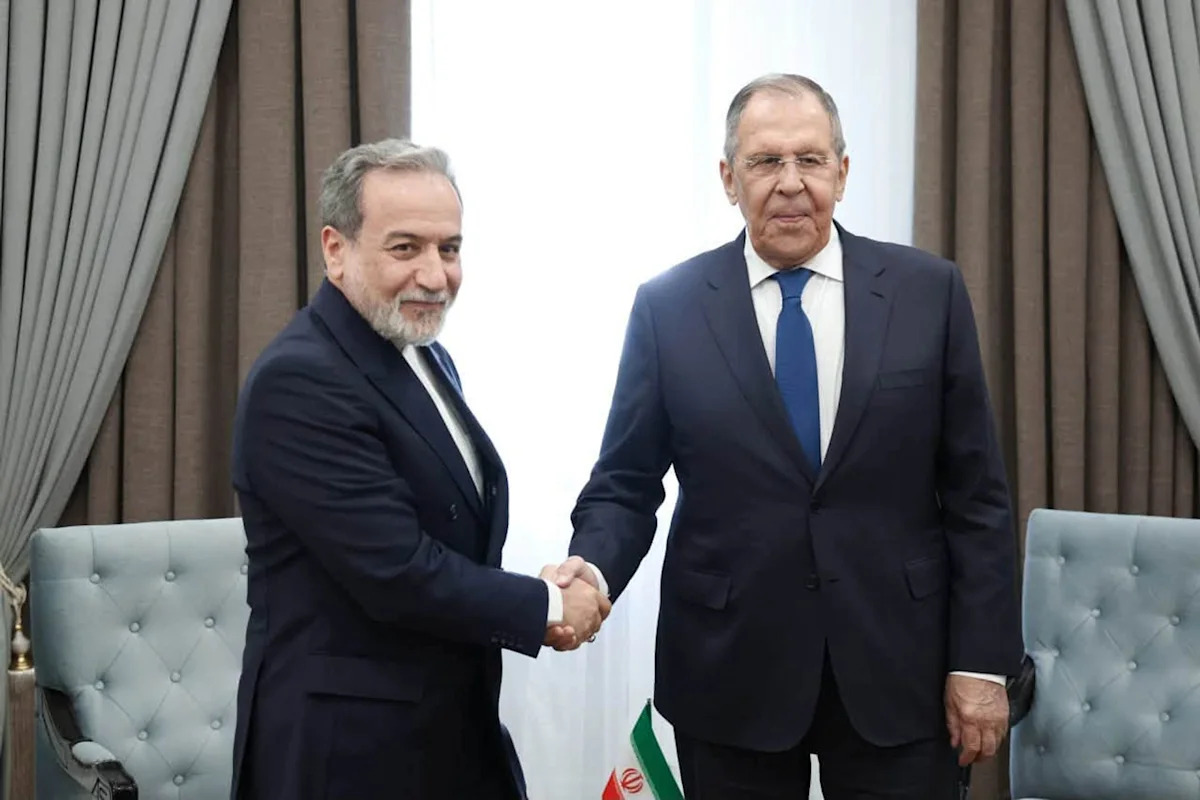
Russian Foreign Minister Sergei Lavrov visited Tehran on Monday amid ongoing military tensions between the United States and Iran.
Lavrov met his Iranian counterpart Foreign Minister Abbas Araghchi, while talks were planned with President Masoud Pezehkian in the evening.
“Iran, Russia and many other countries share the view that the region’s problems cannot be resolved by military means and must be addressed through diplomacy and political solutions,” said Araghchi at a joint press conference with Lavrov in the Iranian capital.
Iran’s Foreign Ministry said the agenda for Lavrov’s visit includes talks on the implementation of bilateral agreements and consultations on regional developments.
According to a translation, the Russian minister spoke of “fruitful, open and sincere negotiations.” Russia intends to remain faithful to its commitments within the framework of bilateral cooperation, he added.
The Russian Foreign Ministry said the discussions are expected to cover joint logistics and energy projects.
Discussions are also planned on the situation in The Gulf and ways out of the international crisis, which Moscow attributes to “illegal aggression by the US and Israel against Iran.”
The Iranian leadership fears a new military escalation, with politicians and generals expecting an attack by the US or Israel. However, US President Donald Trump stated in early October that he did not intend to attack the country again before the midterm congressional elections on November 3.
The Kremlin is a key ally for Iran’s leadership, and Tehran is hoping above all for military support.
Iran has been trying to acquire modern fighter aircraft and air-defence systems from Russia for several years, but Moscow’s ability to provide military support is limited by the war in Ukraine.
In early 2025, Russia and Iran signed an agreement on a strategic partnership which aimed at deepening military and economic cooperation over the next 20 years. Unlike Russia’s agreement with North Korea, however, it does not contain a mutual defence clause in the event of war.