

Iran has approximately 128,000 hectares of vineyards, just 31,000 fewer than Australia, whose wine exports were worth around €1.3 billion ($1.45 billion) in 2025.
The disparity reflects the disappearance of an industry from Iran’s economy following the revolution, when the newly established Islamic Republic banned the production and sale of alcoholic beverages.
Grapes continue to be cultivated across Iran, including in Fars, Qazvin, Hamedan and Urmia, while Iranian raisins remain present in international markets. But an industry that could have generated exports, employment and tourism has remained absent for nearly five decades.
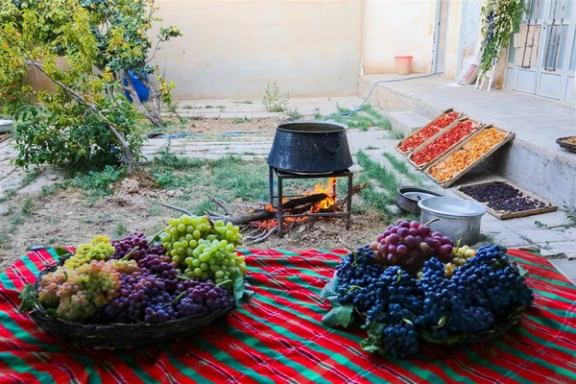 Freshly harvested grapes are displayed alongside traditional food preparation and drying trays in Ruyan, Semnan province, northern Iran, August 31, 2026.
Historic wines of Shiraz
The name “Shiraz” is now one of the most recognizable in the global wine industry, although the grape variety has no proven genetic connection to the grapes historically cultivated in Shiraz, southern Iran.
The shared name has long fueled a theory that the Syrah grape originated in Shiraz, Persia, before reaching France. In 1832, Scottish viticulturist James Busby brought Syrah vines from France to Australia, where the variety eventually became known as Shiraz.
Genetic research later established the grape’s French origins, although the precise evolution of the Australian name remains disputed. The historical association with Persia has nevertheless endured.
Wine is deeply embedded in Persian culture and literature. Words such as mey and badeh, both meaning wine, and saqi, meaning cupbearer, established an enduring presence in Persian poetry.
Wine produced in Shiraz enjoyed commercial recognition during the Safavid period, when English and Dutch merchants transported some of it through the Persian Gulf to India and other parts of Asia, primarily for their own consumption.
In 1665, Shah Abbas II granted the French East India Company permission to produce wine in Shiraz for its employees.
The tradition continued into the Pahlavi era. Before the 1979 revolution, wine production and sales were legal in Iran, with commercial wineries operating in the country.
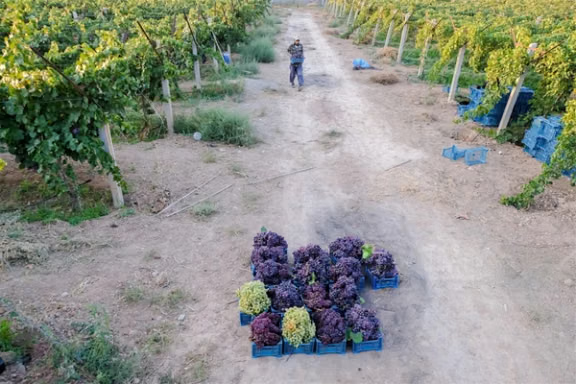 Freshly harvested grapes in crates at a vineyard in Ruyan, Semnan province, northern Iran, August 31, 2026.
The industry that might have been
Wine is more than the product of a vineyard. The industry extends from agriculture to factories, laboratories, glass bottle manufacturing, packaging, transportation, marketing, exports and tourism.
During the same decades that Iran’s wine industry ceased operating, countries including Australia, Chile and New Zealand expanded their presence in the international market through investment in technology, education and branding.
According to the International Organisation of Vine and Wine (OIV), Australia had approximately 159,000 hectares of vineyards in 2025 and exported wine worth about €1.3 billion ($1.45 billion).
The comparison does not mean Iran and Australia have identical winemaking potential. Commercial winemaking requires suitable grape varieties, specialized equipment, established production standards and access to international export networks.
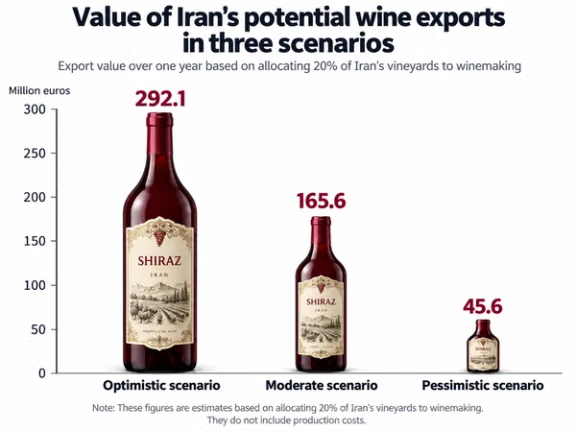
A hypothetical model based on OIV statistics and Australian industry data suggests that if 20 percent of Iran’s existing vineyards were dedicated to growing grapes suitable for winemaking, annual wine production could reach approximately 125 million liters.
The estimate assumes an average harvest of seven metric tons of grapes per hectare and a conversion rate of 0.7 liters of wine per kilogram of grapes.
Under a hypothetical scenario in which Iran exported half of that production, divided equally between bottled wine at about $5 per liter and bulk wine at about $0.80, annual exports would be worth around $186 million at 2025 prices.
The figure is illustrative rather than a forecast. The calculation does not account for the cost of converting vineyards and building a wine industry, or the value of grape and raisin production displaced in the process.
Even with those limitations, it illustrates how part of Iran’s existing agricultural capacity could have developed into an export-oriented industry.
Such an industry could also have generated employment across grape-growing regions, supporting agricultural workers, food-processing businesses, packaging plants, transportation companies and exporters.
A wine tourism destination?
In many parts of the world, winemaking has become an important contributor to tourism, attracting visitors and generating income beyond the vineyards themselves.
Bordeaux in France, Tuscany in Italy and Napa Valley in the United States are among the best-known examples of regions where vineyards have become tourist attractions alongside their role in wine production.
Shiraz, the capital of Fars province in southern Iran, would have had many of the ingredients for developing a comparable form of tourism, although revenues generated by established international wine regions cannot simply be applied to Iran.
The city and surrounding region already boast internationally recognized attractions, including Persepolis, the ancient ceremonial capital of the Achaemenid Empire, Pasargadae, the tombs of the Persian poets Hafez and Saadi, historic Persian gardens and distinctive local cuisine.
Vineyards, winery tours and opportunities to experience local food and wine could have complemented these attractions.
The name “Shiraz” itself could also have represented a valuable commercial advantage, although its international recognition in wine today is largely the result of Australia’s successful industry.
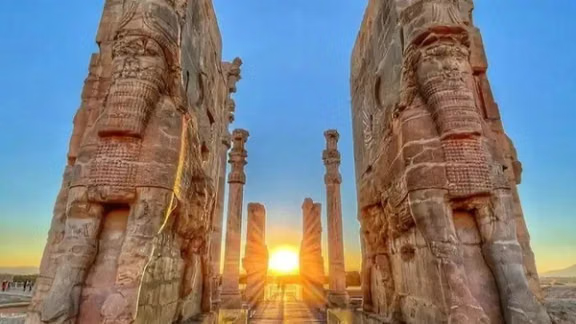 The Gate of All Nations (also known as the Xerxes Gate) at the ancient ceremonial capital of Persepolis in Fars Province, Iran.
Combining the international familiarity of the Shiraz name with the legacies of Hafez and Saadi, Persepolis, Persian gardens and the region’s long history of winemaking could have helped establish a distinctive identity for local tourism.
Other grape-growing regions of Iran such as Qazvin province and the city of Takestan, as well as Hamedan and Urmia, could have established wine-producing regions based on their climates and traditions of grape cultivation.
Iran’s lost opportunity extends beyond the wine that might have been produced. It encompasses nearly five decades in which investment, jobs, exports and tourism around such an industry were unable to develop.
Perhaps a glimpse of what such an industry might have become can be found in one of the most celebrated verses of Hafez, the 14th-century Persian poet whose name remains inseparable from Shiraz:
Come, let us scatter flowers and pour wine into the cup.
Let us break through the roof of heaven and devise a new design.