
Canada’s annual inflation rate rose to 3.1 per cent in September, Statistics Canada said on Monday, which according to some economists leaves the Bank of Canada in a difficult position ahead of its rate announcment later this month.
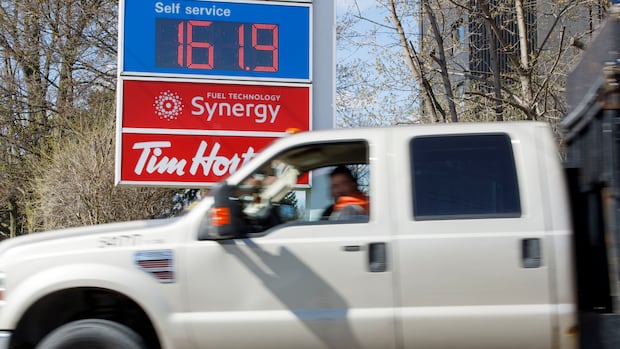
The consumer price index was up 0.1 per cent last month compared to August, as war in the Middle East pushed benchmark oil prices to their highest level since May, the agency said. The switch to less expensive winter blends of gasoline provided some relief in September, however, even as pump prices jumped 27.8 per cent year-over-year, following a 22.8 per cent annualized increase in August.
“We have inflation in gasoline prices, which every Canadian already knew, but we don’t have a lot of inflation anywhere else,” CIBC chief economist Avery Shenfeld told CBC News on Monday.
“Essentially, if you strip out the gasoline price increases, the various measures of underlying trend inflation are around two per cent.”
Excluding gasoline, consumer prices increased 2.2 per cent year-over-year in September.
According to pump price data from Kalibrate, the average price for a litre of regular gasoline across the country was $1.824 as of Friday. That’s up nearly 33 per cent from a year ago. Diesel prices are up nearly 80 per cent over the past year, according to the data.
WATCH | Why diesel prices are high:
Here’s why you’re paying more for diesel
Crude oil exports through the Strait of Hormuz are slowly recovering, so why is the price of diesel skyrocketing? The National’s Eli Glasner breaks down what’s causing the increase, and why diesel prices likely won’t drop anytime soon.
Grocery prices rose by 1.7 per cent year over year in September, StatCan said. However, this was down from the 2.8 per cent increase in August. September marked the smallest yearly increase since May 2024, the agency said.
The reduced food inflation was due to cheaper fresh vegetables and a decline in the “sugar and confectionary” category.
“Despite the year-over-year slowdown in prices for groceries, prices have increased 33.0 per cent since September 2020,” StatCan said.
Shelter prices rose 1.8 per cent year over year, up from 1.5 per cent in August.
Statistics Canada’s core inflation measures eased slightly on a monthly basis in September. These metrics, which strip out extreme price swings, are closely watched by the Bank of Canada.
A Bloomberg survey of 12 economists had predicted the September consumer price index would rise 3.18 per cent year over year.
‘Uncomfortable balance’
Economists say the fresh data means the Bank of Canada must strike a balance ahead of its meeting later this month: A rate hike to tame stubborn energy-linked inflation could exacerbate softness elsewhere in the economy, like the jobs market.
Bank of Canada Governor Tiff Macklem recently warned that persistently high global energy prices due to ongoing conflict in the Middle East could drive up the central bank’s inflation outlook ahead of its Oct. 28 rate announcement.
The U.S. benchmark oil price has climbed over 70 per cent year-to-date. The December contract for West Texas Intermediate crude eased about one per cent on Monday, slipping to $97.70 US per barrel.
“If oil prices stay around $100 [US], we expect inflation to gradually drift up from where it is today: three per cent,” Macklem told reporters on Saturday in Bangkok.
“The question we’re going to be asking ourselves is: Is inflation likely to come back down towards our [two per cent] target on its own? Or are we going to have to raise interest rates to influence the path, nudge the path for inflation back towards the target?”
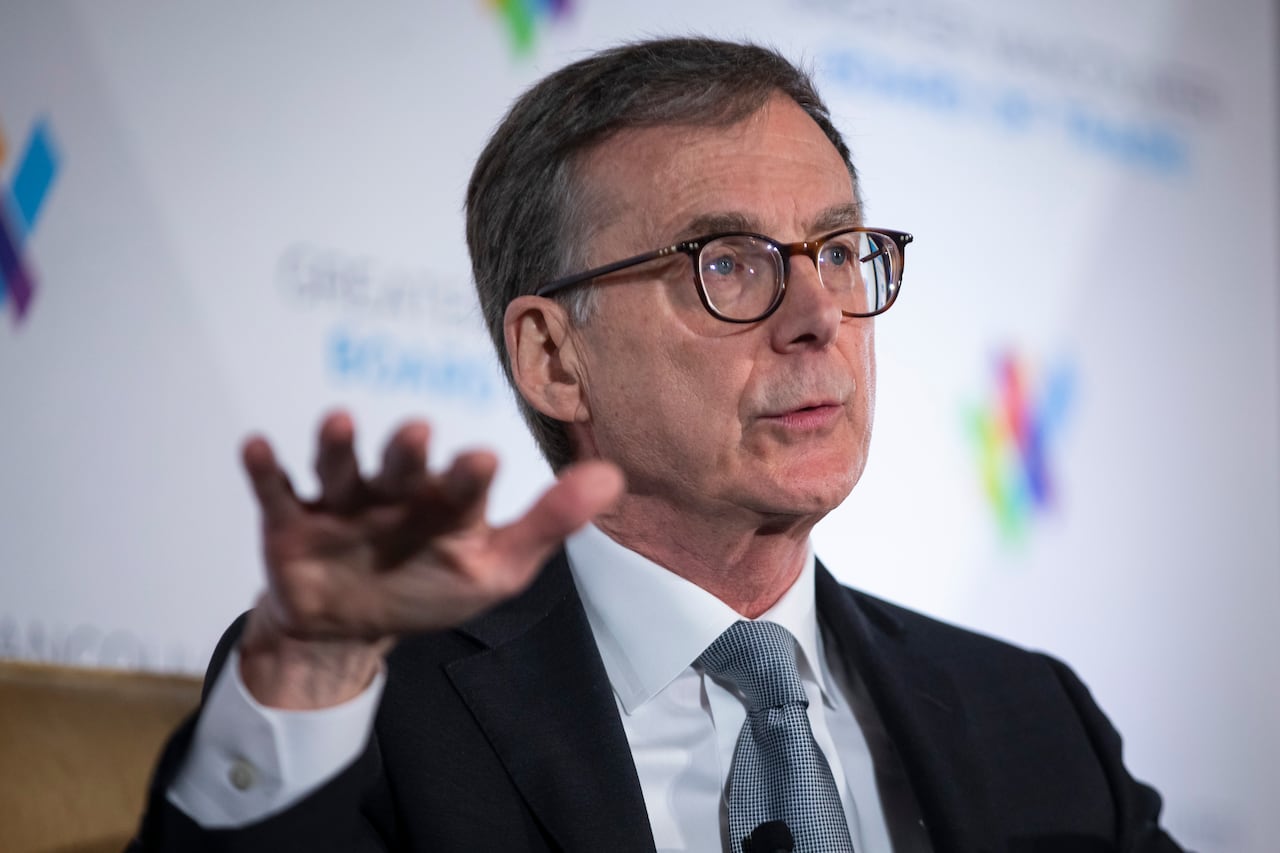
Policymakers might face raising interest rates in order to ‘nudge’ inflation closer to the Bank of Canada’s two per cent target, Gov. Tiff Macklem said over the weekend. (Ben Nelms/CBC)
Shenfeld, at CIBC, says the conflict roiling energy markets looks “more problematic,” without a clear solution in sight to ongoing threats against oil shipping in the Strait of Hormuz.
“There are concerns about a broadening of the conflict,” he said.
“Our view is that the Bank of Canada has lots of reasons to take a wait-and-see stance, given that inflation hasn’t spread beyond energy. But the governor’s remarks over the weekend did seem to raise the odds that he’s going to go ahead with the rate hike this month.”
Michael Davenport, the senior Canada economist at Oxford Economics, said Monday’s inflation reading was “a tad softer” than he expected, boosting odds for a hold from the central bank later this month.
“The decision remains a very close call,” he wrote in a note to clients. “We still expect the [bank] to lift the policy rate 50 basis points to a neutral 2.75 per cent by January to ensure the spike in energy prices doesn’t cause sustained higher inflation.”
RBC economist Abbey Xu says she continues to see little evidence that higher energy costs are significantly boosting prices elsewhere in the economy.
“The Bank of Canada is still facing an uncomfortable balance. The economy is gradually improving, but remains soft, with employment declining in both August and September, and the unemployment rate holding around 6.5 per cent,” she wrote in a note.
“At the same time, policymakers remain alert to the risk that persistently elevated oil prices lift inflation expectations, or generate broader second-round price pressures.”
RBC expects the Bank of Canada will keep its overnight rate unchanged through the remainder of 2026 before gradually raising rates in 2027.
“Softer labour-market data and higher fixed borrowing costs give policymakers room to remain patient,” Xu wrote. “However, recent communication from the Bank of Canada and Governor Macklem are denoting more urgency than the data to date might suggest and add to the risk the Bank chooses to move preemptively.
Earlier this month, Statistics Canada reported a 68,000 job decline in September. This data marked a second straight month of losses, snapping an upward trend between April and July.