
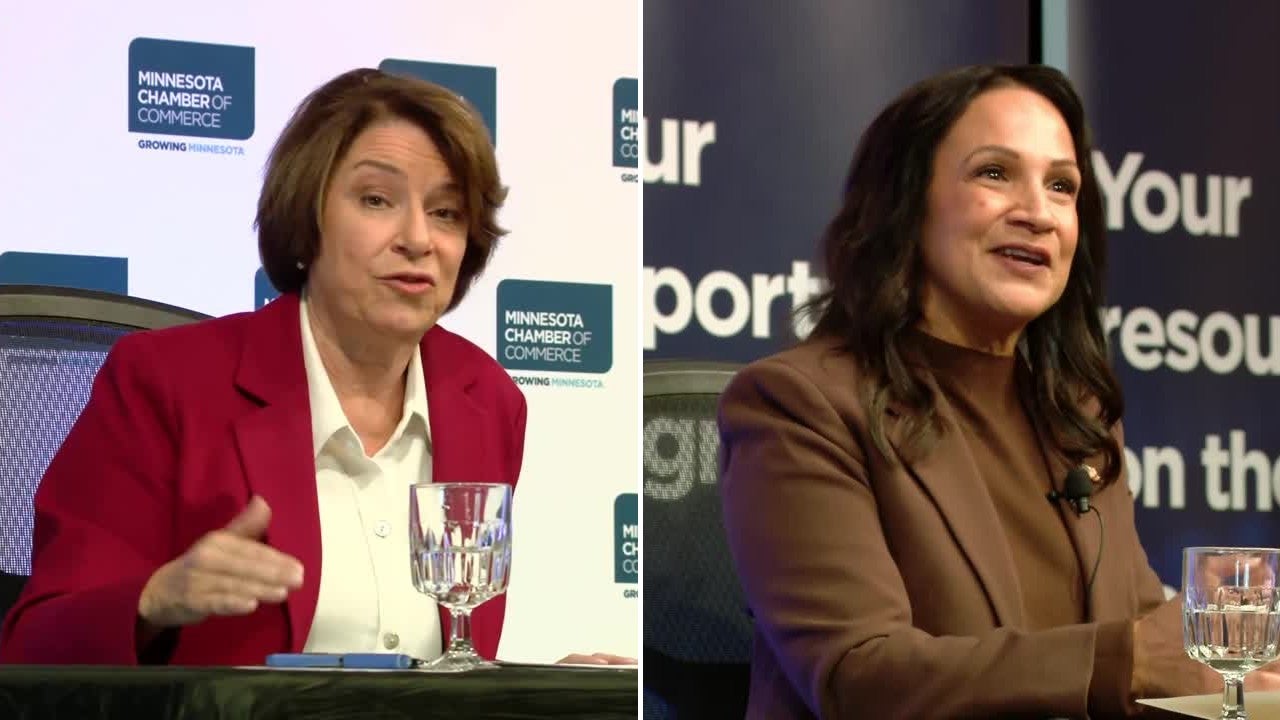
First Gubernatorial Debate
The two leading candidates to be the next Minnesota governor met for their first debate Monday morning, just over two weeks from Election Day.
5 EYEWITNESS NEWS Chief Political Reporter Tom Hauser moderated the debate between DFL candidate Amy Klobuchar and Republican Lisa Demuth at Madden’s in Brainerd.
RELATED: KSTP/SurveyUSA poll: Swing in Senate and AG races, Klobuchar up slightly on Demuth
You can watch the full debate in the YouTube video player above. Find more election coverage by CLICKING HERE.
A transcript of the debate can be read below.
Vision for the state economy
Demuth: As a fellow chamber member and a business owner, I understand the pressures that we have faced over Democrat— because of Democrat policies over the last 8 years. Those include mandates that make it harder to do business, increasing taxes, and a regulatory environment that has proven to be delays. What Minnesota needs now is a fresh start. We need a change of direction because we fully know the path that we are on for business here in the state of Minnesota is unsustainable. As your next governor, I look forward to leading in the areas of reducing delays in permitting, In regulatory reform, in reducing the burdensome taxes and the burdensome mandates. If you remember back just eight years ago, Governor Walls came in and said one Minnesota. We’ve seen anything but that. We’ve seen more division in our state, a harder business environment. It is time to pull together, put us forward. And return Minnesota to the business leader in both our state and our country that we know it can be.
Klobuchar: It’s a beautiful day up here, and I know there’s a number of resort owners and the like. Just a reminder, To anyone listening back home, it’s still open for business around here, so it’s a great place to visit. Number one, my vision is growth. My vision for Minnesota is growth. I think that is the smartest thing we can do if we’re going to reduce costs, if we’re going to have a government that matches the drive and ambition of the people of this state, your drive and ambition, we must have growth. So we know there’s headwinds. There’s headwinds with these tariffs that I detest. There are headwinds with the cost of gas, the chaos in Washington. But I view those tariffs, sadly, right now as a constant, but they cannot be an excuse. We know what’s happened in Minnesota over the last few years. We’ve seen about a 1.6% growth per year in our state in the last decade, and 2.4% for the rest of the country. Now this year, thanks to all of you, we are doing better. We’re something like 3% growth. But to me, the vision is this: top-to-bottom audit, make sure that we’re cutting that red tape and moving that government faster and smarter. Number 2, innovation, expanding domestic and international markets. And then of course, bringing down costs. That means healthcare, that means workforce, and that means housing and childcare. You can’t have the workers you need if they’re not able to afford their lives.
How to balance the state budget
Demuth: Tax hikes are absolutely off the table for me. We have seen our, our state be overtaxed year after year under the current administration, whether it’s a family budget, Or your business budget, you know the best way to control costs is to make effective changes and right-sizing that budget. So as the next governor, that’s what I would be looking at doing. The Walls administration added 6,000 new FTEs, full-time equivalent employees, to the state budget. The question is, was that the right thing for Minnesota? No. This is how we grow our budget. We make sure we have a workforce that is ready to lead. A business economy that can grow. But in addition to that, by rightsizing the government, it allows taxpayers in Minnesota to keep more of your hard-earned tax dollars. So rightsizing a budget, reducing regular regulatory environment that makes businesses choose to go other state to other states rather than staying here. But we’re going to be talking about fraud, I’m sure. And part of what we have been funding in a budget that has doubled in the last 10 years, where our population has basically stayed flat, is the fact that with out-of-control spending, it has allowed fraud to go unchecked. Under my administration, just like I have already helped with a balanced budget over the last biennium and putting in fraud protection plans, that is what you would see from me as your next governor and the leader in this state.
Klobuchar: No tax hikes. We do not need to raise taxes to balance our budget in Minnesota. I outlined the growth agenda, but then there’s also this government reform. If something is working, we keep it. If something is broken, we either fix it or end it. I’ve been willing to take on my own party on taxes in the past. The medical device tax, I actually was instrumental in getting it reduced in half and then eventually eliminating it, which was not very popular with them, but I felt it was the best thing and the right thing to do. I believe we need a new team in the agencies, not just in the governor’s office, and I’m going to replace people and do that. It’s got to start at the top, but it also has to be at the agencies, and that includes, of course, rooting out fraud. And who is better than a former prosecutor to do that? When I look at some other things that are really important for fiscal responsibility in our state, one of them is our AAA bond rating. I know how much the Chamber cares about infrastructure. We’re one of only 14 states that has a AAA bond rating, especially in this time of inflation induced by a number of the President’s policies. It is really important that we keep that bond rating. I will do that. It’s also important that we keep a strong rainy day fund for what’s to come. We’re about in the middle. We’re a state where, you know, the women are strong, the men are good looking, and the rainy day funds are about average. But I want to make sure that our rainy day fund stays strong. Finally, we need to do something about these tariff taxes. And that’s only coming from a governor that stands up and does something about the tariffs and negotiates subnational agreements with provinces in Canada and the like, and not someone that says that tariffs are effective like my opponent.
Ideas for making Minnesota’s tax system more growth-oriented and competitive
Demuth: As you look at the Walz administration and what has led over the last 8 years here in the state of Minnesota, we know that we are one of the highest tax states, both corporate and individual, here in the state. But I have to ask you this: Are you better off today than you were just 8 years ago? Are your businesses better off today than they were 8 years ago? You’ve heard the senator say that she was going to be replacing some of the commissioners. I have said very early on that I will be firing all of the commissioners in the state of Minnesota and starting fresh. We have allowed a culture of waste and fraud to go on far too long, and we can’t keep going this way. But when it comes to the tax base and what we can do here in the state of Minnesota, we have had an opportunity to conform with the federal tax bill, but yet Democrats in the House of Representatives blocked that pass-through entity. They blocked it from being continuous. They only gave us one year on it. We know that when we reduce the taxes on hard— on the hardworking people of Minnesota, we have the opportunity for growth here. There are things that we could do here in the state of Minnesota that didn’t even cost us anything, yet would explode and it would grow us as we need to be. So change is needed. And I’m going to ask you again, Are you better off than you were 8 years ago, or do you need change? If you are ready for a fresh start and needed change, I would be the one to lead that.
Klobuchar: I have made clear I’m not going to increase taxes, and I would actually like to lower taxes. We must do a comprehensive view of our tax system now in Minnesota. You know how the economy’s changed with technology and the like, and I think that will be very helpful for us to stay competitive. So tax incentives for business. Let me give you some ideas. Things I’ve supported in Washington, things I’ll support here. Better job of supporting R&D, especially for small businesses, startups, workforce training, and the work that you have to do, especially with AI coming at us, and create more incentives. For training our workers. Looking at, as the Speaker raised, the PTEs, making that more permanent. That’s crazy that we even have questions about that because it actually doesn’t cost us anything and you’re getting taxed twice. Looking at our farmers and ranchers in a really difficult economic time because of these tariffs and making sure that we do a better job of paying for their equipment, giving them incentives to be able to buy equipment, whether it is grain bins, or whether it is fencing. Making sure that we have incentives for the 100,000 new units of housing that my Lieutenant Governor, who’s over here, Ben, and I have committed to build with the private sector. And finally, bringing down costs. And the number one way we can bring down costs— and when I look at the history of what’s happened here, look at what has happened to our economy because of gas prices and diesel prices. Since this war began, I have been firmly against this war, and I believe after this election it will end. But we cannot tolerate the gas and diesel prices we’re seeing right now.
Artificial Intelligence: Threats, opportunities of AI
Demuth: AI is something that matters. It is fairly new but used by all industries. We need guardrails. And we need to make sure that we are keeping people safe. And as that develops, whether it is fraud protect— protection, or whether it is in moving our businesses forward. AI is a tool that matters, and guardrails have to be looked at.
Klobuchar: We have to develop AI responsibly, and I have been a leader on AI. When Ted Cruz goes on The View, as he did a few months ago, and said that Amy Klobuchar is working with him on AI, what comes next? Anyone would be concerned, but it is true. We are working together with Senator Thune on some guardrails for AI, and that’s what the companies are said they’re concerned about this to. To me, that means making sure these models are tested, making sure that imminent harm, that they’re alerted, that they alert the government about this. But as governor, one, broadband. I started the job as senator to get it out to every corner of the state. Those of you rural businesses know what I’m talking about. Now I’ll finish the job. Second, we have to train our workers on AI-proof jobs. We know there’s so many of them available in medical, in construction, in electricians. And then also at the same time work with our universities and colleges to train our people and our students on how to use AI responsibly.
Do you think that the state has a role in regulating data centers, or is this mostly a local issue?
Demuth: I believe that data centers are a local control issue. Now, data centers are something that are not new, but yet As you said, Tom, that controversy and the topic has really come forward. As local governments are making the decisions whether or not they want to have a data center in their area, the important piece is that residents and the people around have input. So local control with residents and the localities around matter very much. Correct information brought by those that are bringing the projects forward matter very much also. What I will say, though, is when you look at the work that we did in the legislature this— just this last 2 years in the tie, and I was happy to lead that, we were able to get through a study to look at what lifting that nuclear moratorium would mean for here in the state. The other thing that we passed in the legislature is that data centers will have to pay for their own energy costs, so they can’t drive up the cost for the residents and the businesses around the area. So data centers will continue to be a topic of conversation, but above all, I believe it’s a local control issue.
Klobuchar: The state has to have some involvement. These are major projects, but in the end, if a local community doesn’t want to have a data center, then they shouldn’t have to have a data center. So that’s very important. Secondly, people shouldn’t get hosed on their electric bills because of data centers. We know that. That’s part of the merits of the work that was done on a bipartisan basis, including with the Democratic Senate in the state legislature. We have to make sure that water is protected. We’ve gotta make sure that people are able to not have to pay for infrastructure because of the data centers. And when it comes to those tax credits, as I said, I’m gonna review the entire tax system, see what’s worked. But remember, we’re talking about that, and then we look at Iowa giving what, let me say it again, $1.4 billion to get those jobs down in Iowa. And so we’ve got to figure out what makes sense for our taxpayers for each project. I would do more when it comes to data centers with nondisclosure agreements being public. I think that’s important. I actually think it might have gotten at some of the people feeling like, what’s going on behind my back? And I think that those should be disclosed. And unfortunately, my opponent blocked that. When it comes to tech, I have been in the lead when it comes to taking on tech and being ahead of my time. And by that I mean a number of these CEOs have said, well, maybe we should have done this stuff earlier to me in Washington. They mean it. Right now, content online, the fact that you’re not able to tell if videos are real or not without some kind of disclaimer, the fact that kids are exposed to a bunch of stuff that they shouldn’t see and parents feel like they have no control over their kids’ lives. I’m going to end up being right on this. Things are going to pass federally, but I have a good understanding of technology and look forward to working with people on things that are going to be safe for Minnesota and bring jobs in.
What would you do to make Minnesota more business-friendly?
Demuth: Minnesota needs to be more business-friendly, but I want to touch on one thing. You just heard the senator talk about what she would have done when it came to fraud, and it would have been earlier. I have been in the legislature since 2019. I was already hearing about fraud in child care. And so I carried a bill my very first year that would have just required daily attendance records for childcare facilities. Democrats were in control, I couldn’t get that through. My question would be, if I could ask the senator, is why weren’t you at the hearings about fraud in your own Senate Judicial Committee hearing when we had Minnesotans that were concerned about fraud? Why weren’t other hearings— you could have reached out to the governor and said, I think we have a problem in Minnesota. There were 1,000, 1,000 press releases that were issued from when Feeding Our Future was raided in 2022 until December of ’25 by the senator. Never a word about fraud in there until after Tim Walz selected her to run as his candidate. So my question is, why didn’t you do more? As far as a business-friendly economy here in Minnesota, We need to make sure that the nation knows that Minnesota is open for business. When we have seen businesses choose other states because our permitting is going 600 days, or you see, you see steel production going down to Iowa because of uncertainty here in the state of Minnesota, it is time to change that culture. I will support business, open this up for business, and support the work that we can do right here.
Klobuchar: So the minute that the fraud went public, I did something that was real. I called our U.S. Attorney that I had put in place because I felt that he was the best one for the job, Andy Luger, because of his experience. And I said, what can I do to help? He has publicly told this story. He said, I need more prosecutors. This is bigger than I can imagine that we thought it would be. We need more prosecutors. I called the Justice Department and asked for more resources. I couldn’t ethically get involved in the cases, but I could call the Justice Department and ask for more prosecutors. He says he had gotten, as a result of that, more prosecutors than any other place in the country. They exposed the fraud. They worked with local And federal law enforcement, and they brought those cases, and they have still gotten a bulk of those cases, um, and those people convicted because of the actions of Andy Luger, who I put in place. That’s doing the real work. As for the hearings, I’ve been at a dozen hearings where I have raised or asked questions about fraud. The particular hearing that’s referenced here was a subcommittee that I was not even on. As for the workforce culture, Over 10 years in the private sector, I think we have to change things. And that means new people in our agencies, as we’ve discussed. That means public goals. That means cutting through the red tape. Josh Shapiro in Pennsylvania has a rule that if you don’t get a permit in a certain amount of time, you get your money back like Domino’s. Yes or no, you find out. That kind of certainty is incredibly important for business. So we need a culture change.
Minnesota Paid Family and Medical Leave program
Klobuchar: I would not seek to make any changes to the … I know all these business leaders in this room want our families to thrive. I want our families to thrive, and that’s why this policy was put in place. But it is brand new. It just started this year. And with any policy, whether it’s put in by Republicans or Democrats, this is a time when you review it, you look back and say, how can it be improved? And I’m gonna have an open door to listen to you for ideas for improving it. One, it has to be fiscally responsible, especially at a time where we’re dealing with, as I said, the Trump tariffs, which my opponent has not addressed, and all of these other things that are coming at us. 2, we need to make sure that we have a pipeline of workers. I know this is a chamber priority to help fill in, to help with shifts and do the, make sure that we’ve got people covering things when people are out on leave. 3, we have to make sure there’s no fraud, there’s no abuse, and make sure it is an airtight program going forward. And I’m sure you have other ideas as well. I did wanna mention one child-related, work issue, and that is childcare. I have seen these incredible examples, including right here in Brainerd, where I was just with the mayor at your Y, where local communities have come together, businesses working together, or it is counties and cities coming together. And I think we need to incentivize that, as well as taking a program for childcare, which has been supported by the business community, that has like 13 streams of money going into it, Get it consolidated, make sure there’s no fraud, and make it work for everyone. Because we have a very high workforce participation rate in Minnesota, and there are even more people that wanna work, and we wanna make sure that they can.
Demuth: Paid Family Medical Leave was something that was passed by Democrats when they had full control of state government back in 2023. With a start date of January 1st, 2026. Now, being in the minority, but also being a business owner, we were hearing from the Minnesota Chamber of Commerce. We were hearing from business groups. We were hearing from organizations saying, we’re already doing good things to take care of our employees. A mandate or a tax on all of us is going to make it more difficult. Now that paid family medical leave has rolled out, Exactly those concerns that were there about shortening the workforce, making things unpredictable, extra time waiting in emergency rooms and hospitals and schools that are struggling. We have seen those same concerns play out. Some of the things that we had offered about paid family medical leave were shortening the number of weeks, making sure it was just for family. Earned sick and safe time was another thing that was passed by the Democrats. And what we are seeing now is employers that are receiving the doctor’s notes that are required from those, from doctor, whatever the name is, at gmail.com. As your next governor, I will make sure guardrails are put in place so there can’t be any fraud or waste. We need to talk about the culture of what this is happening. You’ve got hardworking people that are working and covering for hours like they normally would, but people that are abusing it. Culture in a workplace matters very much. As a leader of a caucus where I have a number of employees, you will never see me disrespect my employees ever. I look at people, our employees, those that are partnering with us to do the work. I will not be throwing office supplies or cutting people down or, or making people feel less than. We are a team together and we can work together in each one of our individual businesses.
How would you make Minnesota more responsive to the needs of developing a workforce here in Minnesota?
Klobuchar: Well, we all know that the workforce has been one of the keys to the reasons that Minnesota has 18 Fortune 500 companies and 500,000 small businesses. It’s because we have a good workforce, but we can’t rest on our laurels. There is, as we say, work to do. And nimble and responsive is the right, right adjectives here, what we need. Number one, K through 12 achievement up and screen time in the classroom down. That will be my plan. We’re one of only like 12 states that doesn’t even ban cell phones for the whole state. Individual districts do it. I think we can do a better job and do a better job of making sure our kids are focused on learning with evidence-based curriculum. That law has been passed, but now we have to implement it across the state. Secondly, and that’s a job of a governor working with our schools. Secondly, apprenticeships. I’m going to add 10,000 new apprenticeships. That’s doubling apprenticeships to get to what we’ve talked about here with these AI-proof jobs. And making sure, my own background with my dad going to a 2-year community college not too far away up in Ely, my sister going to a 2-year community college after she didn’t graduate from high school and got her GED, I have an understanding that there’s many paths to success. Working with our 4-year degree colleges, U is doing something really interesting right now in Morrison in Rochester doing 3 years full credits for 4. In one place. The President has said she could expand it 3 or 4 times. They are in healthcare. They’re working at Mayo at the same time they’re doing that. So that’s going to be another big piece of what I want to do when it comes to workfare. There are many, to workforce, there are many, many paths to success.
Demuth: When we look at the trained workforce that we need here in the state of Minnesota, I want to point out a program that happens at St. Cloud. Technical and community college. It’s called EPIC, Exploring, uh, Potential Interests and Careers. And what that does is they bring in business leaders from around the area, whether it’s healthcare, manufacturing, other types of business, and then students from around the area. And I’ve had an opportunity to visit nearly each year since that program started. That exposes our young people to what options are out there and And I’ve heard good stories of parents that have actually changed careers after experiencing this with their students. But in order to have an educated workforce and the workforce that we need going forward, we must have kids that are receiving the education before they even graduate. Right now, only half of our kids can read at grade level by 4th grade. That means in Minnesota, we are failing our future workforce, whatever they might choose. Now, trades matters very much. I want experienced people that are doing those works. I want experienced people in the medical facility, but we have to make sure that we are investing correctly. My education plan makes sure that we were— we are putting the basics back into schools rather than more pressures and getting our eye off of educating our kids for what is next. And then of course, supporting not just the trades, our community and technical colleges, and our 4-year universities to prepare us for the next growth that Minnesota is about to, to have.
How to improve healthcare access for Minnesotans and lower costs
Demuth: Healthcare and the accessibility to it matters very much across our state. The cost of our healthcare or health insurance has exploded. Some of the things that I’ve already led on as Speaker of the House and as a legislator are the nation-leading, the reinsurance program to help bring some of those costs down. Now we need a better payer mix where it’s private and public, so putting more people on a public plan does not help bring those costs down. I look at what kind of healthcare people need, and I was happy to be a vote on the Alex Smith insulin bill. That was something that we voted on in the legislature back in April of 2020, and I was a yes vote on that. The governor signed it into law the very next day. It protected people here in the state of Minnesota when it came to rising insulin costs. But we can’t just sit there. We must focus on how we bring those costs down. Another is fraud. And we have heard the senator say that she would invest in modernizing that technology. Well, I’m happy to tell this room I’ve already done that. $90 million is what we allocated to the SSIS program that will help bring costs down across our counties. and making sure that people that are eligible to be on healthcare are, and those that are able to work can do that. This is something that we need all industry leaders in. We need medical professionals, insurance providers, the state. And when we are putting mandates on just our private pay and not on public because it’s too expensive, we are off balance. Accessibility across the state, bringing costs down overall, and making sure we have the jobs To provide what parents and families need so they can provide for their insurance through the private market also is how we’ll bring the overall cost down.
Klobuchar: I strongly support reinsurance. Appreciate your work on that. But that is not the only answer. Number one, our healthcare insurance costs too much. It just costs too much. Our whole healthcare system costs too much, and Trump has made it worse. So just today, my opponent actually made a comment about the, the help that people need when it comes to affording plans on the individual marketplace. That’s a lot of our small businesses in Minnesota, and said they don’t bring costs down for people. That just isn’t true. 8 million people have been tossed off their healthcare nationally since Donald Trump refused to extend those tax premiums when it comes to helping people with their premiums. He hasn’t done it. I’m gonna do it in Minnesota if he won’t do it in Washington. And a number of states have done it. New Mexico actually saw an increase in people insured. I hope I won’t have to. I hope they do it in Washington. I also think we need to look at some special help with premiums for small businesses. 3 states have done it, red states. And I think it’s worth looking at that as well. I have led the way on prescription drug price negotiations when it comes to Medicare, led that bill. Both Trump and Biden have used it. It saves seniors now $6 billion taxpayer money, $1.5 billion for seniors themselves. I wanna use the bulk purchasing power of the state government to, already the biggest one around in the country, to be able to get more, less expensive drugs and bring in more, biosimilars and bring those costs down. Supporting rural hospitals. My opponent refused to back the 340B discount for drugs. I back it. I think it’s important. And when it comes to insulin, she voted against capping it. And I do suggest that you look at what Alex Smith’s mother just said the last 2 days. She supports me. She said that my opponent— Your time is up. And this is the mom of a kid that died. that my opponent did not help when it comes to camping insulin. So let’s not throw that name around without being honest to the real bill that they wanted to pass…
Addressing rising property tax increases
Demuth: As far as our property taxes, I know we just all paid our property taxes just a few days ago. They have exploded in this state for a number of reasons: paid family medical leave, earned sick and safe time, mandates on businesses also hit our cities, our counties, our school districts, as well as all of you in this room. So the problem is that our cities, counties, and townships are passing those prices on to. the property tax owners. Less mandates, making things more affordable, rooting out fraud, reducing the state budget is a way that will have that outward effect to make sure our property taxes come down. We will be having a Blue Ribbon Commission on looking at the cost of property taxes.
Klobuchar: The counties and local governments are getting squeezed, and my first directive will be no unfunded mandates. I knew what this was like as county attorney, and it has to end. The second thing is to transform the way our government works. Right now there are some models going on in our state, but we need to expand on these. We’ve got a number of state— of counties that are coming together to work on healthcare, Medicaid. They’re actually administering some of the programs together. Like 13 of them. We need more of that regionally. We’ve got Ramsey and Washington working together right now on waste management. These sound like small ball things. They’re not if we can reduce costs by reducing the administration of these and having a state governor that actually wants this to happen and realize when it comes to technology, yes, it was a $90 million down payment, but some of these counties are dealing with like 40-year-old computers with flashing cursors and think like Oregon Trail days. That has to change, and it will change when I’m governor. Finally, when it comes to property taxes, the entire suggestions of my opponent, the Speaker, when it comes to property taxes are literally eaten up by the cost shift in the big beautiful bill that she supported to the counties when it comes to food programs. $150 million on the back, property tax cut in disguise. I am negotiating with Senator Bozeman right now to not just get Not one year of those delayed, but 2 years. That’s $300 million for property taxpayers in Minnesota. And then we’ll get our error rate down. We are about in the middle as usual, but this whole scheme they cooked up was crazy. It rewarded high error rate states like Illinois and Georgia and screwed us in the middle, and that has to change.
What would you have done to get the $15B Mesabi Metallics steel plant in Minnesota instead of Iowa?
Klobuchar: I’m excited about the work that we can do together as a state government to be able to bring in new businesses and expand others. We have to be nimble, we have to be smart, we have to be fast, but we have to also be aware of our fiscal situation. First of all, the Nashwauk mine is something I’ve been working with, pushing for, for a while. The one that’s there, that is actually 1,500 construction jobs. As some of our union friends know, I’ve been endorsed by the building trades. I’ve been strongly endorsed by the steelworkers who are working in a number of our mines across the Iron Range because they know I’ve stood with them. I was once the keynote speaker at the Iron Ore Institute with none other than J.D. Vance when he was a senator. So I get this marketplace. I do want to look at this Iowa— they have put $1.4 billion of taxpayer money, highly controversial in their legislature, including with some conservatives. That is like 80— it’s a lot of money per job, $800,000 per job. So I’d want to look at what makes sense for Minnesota fiscally when we look at what these incentives are and how we’re going to do this. But what does make sense is the billion dollars that I got federally for the Blatnik Bridge. That’s over 1,000 jobs. What does make sense is our future, helium, hydrogen, The work that we’re doing on geothermal, the work that we can do with adding more energy to the grid, lifting the nuclear moratorium, looking at what all of our great assets are when it comes to bringing in new business in Minnesota. I think this is exciting time for our state, and we need to have a governor that’s gonna bring in that business and see what those opportunities are.
Demuth: Mesabi Metallics, as we watch the, the start and the work that goes on there, To know that our natural resources are here in Minnesota, but yet it was more advantageous to move to Iowa to do the production, is an example of the Walz failed status quo. That there is uncertainty here in Minnesota when it comes to businesses. So as governor, what I would do is I would make sure that our regulatory process and our permitting process is done in a fair amount of time so that there is certainty within that. There will not be mandates that continue to be put on businesses where business owners don’t know if they should trust the changes and the whims of the leadership under Democrat control here in the state of Minnesota. We need to grow business here. You did hear the senator say that $90 million for the SSIS, or systems modernization, was a drop in the bucket. But I want you to know that those old systems that are being used in our counties that drive up the cost and drive up taxes across the board, those systems have been in place for almost 40 years. There’s employees that are younger than those systems that they’re required to use. But instead of taking an $18 billion surplus that we had in 2023, Democrats in the state of Minnesota chose to spend it on everything else while raising our taxes and the state budget another 38%. Instead of investing in infrastructure that would have helped keep fraud under control and would have made our counties more efficient. So a change in culture across the state is what is needed, whether it’s at the county level, large business, small business, and supporting our businesses of all types is what you will see and what you have seen from me with my time in the legislature.
Approach to helping pro sports franchises with new stadiums
Demuth: I will absolutely have an open-door policy as the next governor. I have had a very open-door policy when it comes to being speaker and a legislator. When I was first elected back in 2000, I started serving in 2019, I had gone back to my district and I said, not everyone voted for me, but I will be 100% your representative, and I look forward to having those conversations. Now, in those conversations, you don’t always see eye to eye, but I think they can take place and they can happen respectfully. So my open-door policy, if elected as your next governor, would continue to be the same. The conversations, the collaboration, which is the way that I’ve always led, hearing on both sides of issues, matters very much in decisions that are made. We have not always seen that here in the state, but I think it, it gets to the point of the fact that as the next governor, I will be looking at how the government can serve the people of Minnesota rather than the reverse, is what we have been experiencing here, where the people of Minnesota have had to serve the government here in Minnesota.
Klobuchar: Sports has been very important in my life. As you know, my dad was the lead reporter on the Vikings. He actually wrote a book which is sadly still relevant today called Will the Vikings Ever Win the Super Bowl? But with their 5-0 season with only scoring 3 touchdowns, We’re doing well. So I look at this as what’s best for the people of Minnesota. What’s best for sports fans? Yes, keeping these teams are high— it’s highly important for our state, but we want to be really smart how we negotiate things. Right now the Wild has an arena there that I think we need to update to get with the times, but at least we should be allowing the city to do their tax whatever they want to do to help pay for that. The legislature gave some money to the arena next door, to the community center next door, but I think we need to be smart about how we do that. There’s other things with some of our other sports teams. In the end, they’ve produced jobs when we built them. They’ve been a point of pride for Minnesota. They’ve been an economic driver, including us getting in the NFL draft. But in a time when things are tough, We’ve got to be really smart about how we do this and how we negotiate packages and that we don’t get hosed for the taxpayers. That’ll be my number one look at this. But I am open to looking at working with these teams and making sure we keep these stadiums strong and we keep our economy strong. I would also end there by saying there are other smaller arenas too, like the Mighty Ducks Act that passed that helps with some of our high school teams and makes sure that we’re able to keep arenas not just in small towns, which are important, but also in suburbs, in the city, going strong. So let’s not forget, it’s not just about pro sports, as cool as that is. It is also about these high school leagues and some of our college teams as well.
Your perspective on the opportunities and aspirations for Minnesota that will shape the future of their businesses and communities
Damuth: As I have traveled around the state, Both as a candidate for governor, but even before, meeting with people and hearing what is important or what is on your mind matters very much to me. As I mentioned earlier, I will always have an open-door policy. But serving as a legislator and hearing where there were concerns that were specifically brought up by businesses as far as where we land on GDP, where our taxes are so high, Where mandates are put on our businesses that make it harder to do the work that we’ve done, we have watched businesses choose to not expand, sometimes close the doors, or move out of state. And I’ve heard that, and I’m always looking for solutions. If elected as the next governor, I would commit that schools will be stronger. Fraud won’t be something that is just allowed to happen, but it will be taken seriously and people will be held accountable, including people in my own administration. I want to make sure that we have the tax base that we need, and that is growing business and looking for innovation so we can be known for the good things about Minnesota and draw people in rather than seeing some of our young people or even our older adults move out. When you think about the wealth tax or the death tax, you think about taxing Social Security. Those are things that are driving people out of the state. And so as I’ve traveled around the state and talked with people, it’s not just a matter of just showing up in a community and grabbing a picture, but what matters to the very smallest area? What matters to our agriculture? What matters to our resort community? Clean water and clean air and bike trails. It’s pulling all of that together and giving hope as we move forward. So if you’re okay with the status quo and what we’ve experienced over the last 8 years, then you have a choice to make in 15 days. But if you want a fresh start, a new direction, and leadership that’ll move us forward, I would be honored for you to consider voting for me.
Klobuchar: Every year I visit all of Minnesota’s 87 counties, and I do that because I don’t just want to go where it’s comfortable. I want to go where it’s uncomfortable, where maybe people don’t agree with me on some things, but they’re willing to work with me on a bunch of stuff that helps our state. I think leaders should show up and be there. I think you know my background. I grew up in Plymouth. My family’s from northern Minnesota. My husband’s family is from Mankato. I’ve had over 10 years of experience in the private sector, which I think matters. From there, I became the chief prosecutor of the biggest prosecutor’s office in Minnesota, which I think is going to be a major asset when it comes to sending fraudsters to jail. I then went to the U.S. Senate, where I have been number one for bipartisan bills. I was in one Congress number 3 for passing bills into law. Grassley beat me, but he’s 93. And I continue to believe in getting things done, that that is what matters. My vision for Minnesota is a place where people want to move to and people want to stay. It’s a place where our government matches your drive and ambition, where we don’t just rest on our laurels of inventing the pacemaker and the Post-it note, as great as those things are, but we invent the next big thing, that we’re a state that makes stuff. Invents things and exports to the world. That we get through the red tape. That we make our government more fiscally responsible and more efficient, and it meets your needs. That we lower costs for the people of our state, because right now, with these headwinds coming from Donald Trump, and everyone knows, no matter where you are politically, what I’m talking about, we need a Governor that is going to be able to work with people across the aisle, But also stand up to that. Stand up to these tariff taxes that are costing Minnesotans $2,000 a year, and has brought our exports down 13% in our state. Stand up to this war in Iran, which has meant our gas prices have gone way up. Do something when it comes to healthcare and bring down their costs. So that is a stark difference between my opponent and me. And I ask that you look at my website, AmyKlobuchar.com, And you will see our plans laid out there. I don’t want to move this state to the left or to the right, I want to move our state forward.
For Related Stories: Amy Klobuchar Debate Elections Governor Governor’s Race Gubernatorial Race Lisa Demuth Minnesota Minnesota Politics