
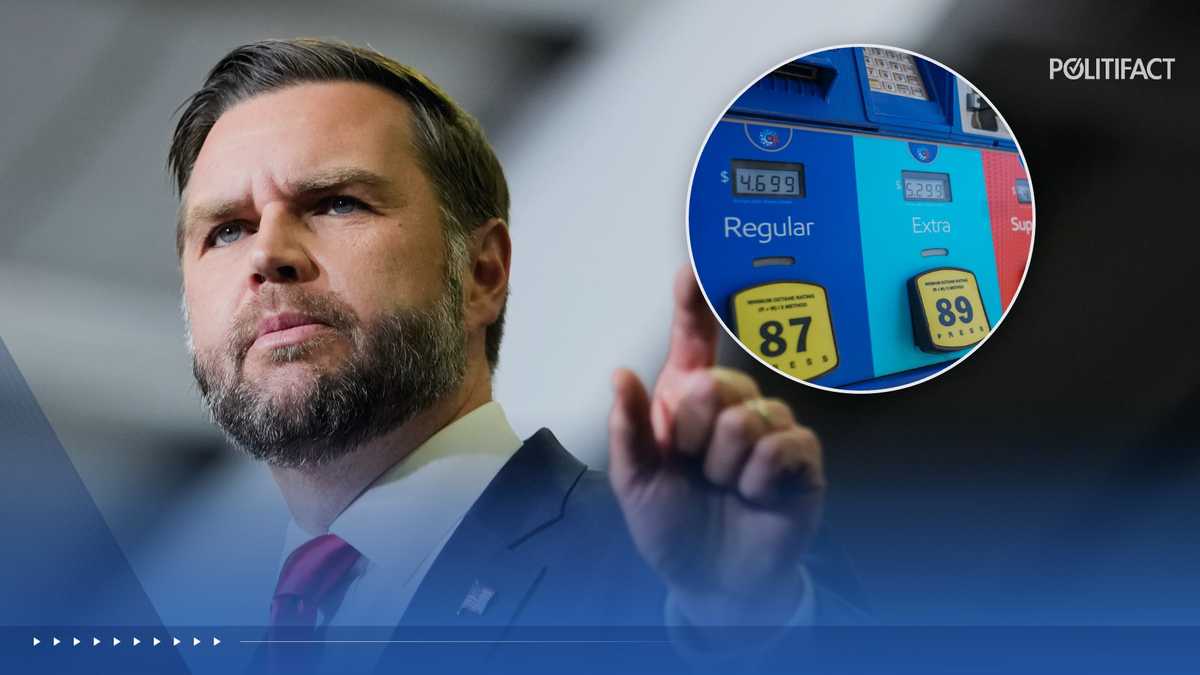

As the Trump administration faces voter pushback over high gasoline prices, Vice President JD Vance tried to shift the blame to former President Joe Biden.
This story was originally published on PolitiFact.com.
During a CBS News town hall Oct. 17, Vance said, “The biggest reason why gas prices are so high is because when Joe Biden was president, we had about 20% of American refining capacity that went offline. We’re slowly bringing that online. But it does take a little bit of time. And because we shut down so much refining capacity, we were more susceptible to the shocks that we’ve seen in the Middle Eastern energy crisis.”
Vance’s office did not respond to our questions for this article. But while California has lost 20% of its gasoline refining capacity, national refinery capacity has remained relatively stable.
Twenty percent is “not a correct statistic in terms of national refinery capacity,” said Patrick De Haan, head of petroleum analysis for GasBuddy, which tracks U.S. gasoline prices.
What’s more, presidential policy is one of many factors that shape U.S. refining capabilities, multiple oil industry experts told PolitiFact, and that the most obvious cause of today’s high gasoline prices is the Iran war, which was launched by Trump, not Biden.
“The biggest factor influencing high gasoline prices is the elevated cost of crude oil, caused by the reduction in ship traffic through the Strait of Hormuz and damage to export and pipeline facilities in Saudi Arabia and other Gulf countries,” said Hugh Daigle, a professor with the University of Texas at Austin’s petroleum and geosystems engineering department.
How could Biden’s policies have made a difference?
Energy market experts said that some of Biden’s policies — notably efforts to combat climate change, which involve transitioning away from fossil fuels and toward cleaner, renewable energy — likely contributed to some refiners’ decisions not to greenlight new refineries or to expand existing ones.
In particular, California’s stringent environmental policies help explain why two refineries shuttered there. The timing is less clear than Vance made it sound: The closure of a Phillips 66 refinery in Los Angeles was announced two weeks before Trump won reelection in 2024. Valero announced the closure of its refinery in Benicia, California, in April 2025, when Trump was president. Both facilities closed during Trump’s second term.
How does the refining economy work?
Biden’s policies are not considered the prime culprit for today’s high gasoline prices, experts said.
The bigger factors shaping U.S. refining capacity are market-driven, experts said. They include:
The current and expected demand for fuel. The growth of electric cars — partially nudged by government policy but also driven by consumers’ decisions — has put some downward pressure on demand for gasoline, and thus the demand for refining. And as more people work from home, they have to drive less often.
Foreign refining capacity. The more foreign refining capability there is, the less pressure for oil companies to rely exclusively on U.S. refiners. “Since 2019, global refining capacity has shrunk by about 1 million barrels a day while demand has grown by about 4.5 million barrels a day,” said Skip York, a fellow at Rice University’s Center for Energy Studies.
U.S. refiners are busy right now because 3 million barrels a day are offline in Russia and the Middle East because of Ukrainian and Iranian attacks. Much of the Russian and Middle Eastern refinery capacity is geared toward producing diesel. As a result, York said, U.S. refiners have switched some of their production from gasoline to diesel — which has further hiked gasoline prices for U.S. drivers.
Refinery profitability. When Phillips 66 announced it was closing the Los Angeles refinery, the company said that in addition to concerns about California regulations, it made the decision despite the facility being profitable There were “more attractive projects in the company’s portfolio,” York said.
U.S. and world events. During recessions, there is less demand for gasoline, so refinery use tends to drop. “The big drop in U.S. refining capacity utilization happened in spring of 2020, during the initial wave of COVID shutdowns,” said Clark Williams-Derry, an energy finance analyst at the Institute for Energy Economics and Financial Analysis.
How does U.S. refinery capacity today compare with the Biden era?
Despite disruption driven by the COVID-19 pandemic, wars and market factors, U.S. refinery usage has remained relatively stable under both Biden and Trump, data from the U.S. Energy Information Agency shows.
This content is imported from infogram. You may be able to find the same content in another format, or you may be able to find more information, at their web site.
In 2021 and 2022, deferred maintenance and supply-chain breakdowns during the pandemic undercut refinery capacity. U.S. refining capacity has been at historically normal levels ever since, Daigle said.
This content is imported from infogram. You may be able to find the same content in another format, or you may be able to find more information, at their web site.
Williams-Derry calculated how many refineries’ last date of operation fell during Trump’s two terms and compared it with how many shut down during Biden’s term. He found that the amount of refining capacity lost from shutdowns under Trump quadrupled the amount lost under Biden.
“Personally, I don’t think that politics had much to do with any of these closures,” Williams-Derry said. He cited a Phillips 66 facility in Belle Chasse, Louisiana, that was 50 years old in 2021 when it suffered hurricane damage. “Phillips tried to sell it but couldn’t find a buyer, so it turned it into a terminal and closed the refinery,” he said.
Why are gasoline prices high now?
The most obvious cause of high gasoline prices today is the start of the Iran war. Prices spiked immediately after the war began Feb. 28 and have remained high since.
This content is imported from infogram. You may be able to find the same content in another format, or you may be able to find more information, at their web site.
“Reduced refinery capacity would contribute somewhat to higher gasoline and diesel prices today, but this is by no means the biggest reason why gasoline prices are so high today,” said Kenneth Gillingham, a Yale University economist who specializes in energy and environmental issues.
Our ruling
Vance said, “The biggest reason why gas prices are so high is because when Joe Biden was president, we had about 20% of American refining capacity that went offline.”
Vance’s statement is inaccurate on multiple levels.
California, not the U.S., lost 20% of its refining capacity. The national outlook has been largely stable. Market forces and global realities influence refinery production more than presidential policy does, and the most obvious cause of today’s high gasoline prices is the Iran War, which was launched by Trump, not Biden.
We rate the statement False.
This story was originally published on PolitiFact.com.
It is republished here as part of a reporting and fact-checking partnership between PolitiFact and Hearst Television.